
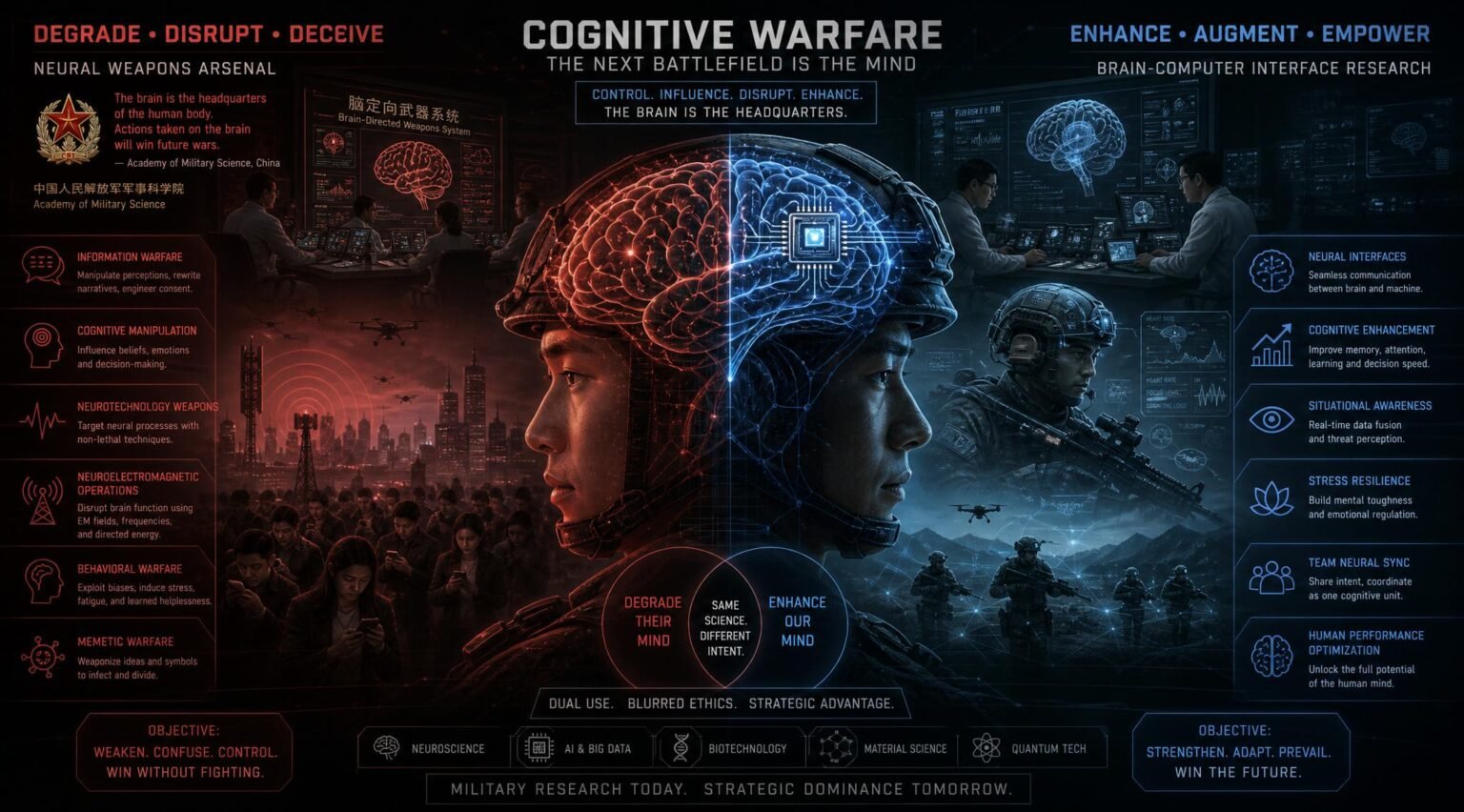
In 2022, a researcher at China’s Academy of Military Science published a prediction in the PLA Daily: soon, machines would read the human brain, and the human brain would directly control machines.a Not science fiction. Not a speculative essay. Military doctrine, published in the official newspaper of the People’s Liberation Army, authored by a scholar at the institution that advises China’s Central Military Commission on war theory.
Yang Cunshea calls it the “neural weapons arsenal”: cognitive warfare tools that treat the brain not as something to protect or enhance, but as something to attack. Hawks read this and reach for countermeasures. Doves read it and reach for regulations. Rights scholars like Farahany read it and argue, correctly, that cognitive liberty protections need to be in place before the capability matures.
But beneath these different responses lies a shared assumption that none of them examine: that this trajectory is inevitable. If we don’t build it, they will. The only question is how to manage what’s coming, never whether what’s coming can be refused, or whether the world it produces is one worth choosing.
What Is Cognitive Warfare?
Cognitive warfare targets human cognition itself — will, belief, perception, decision-making — rather than bodies or infrastructure. It operates through information manipulation, psychological exploitation, and emerging neurotechnologies designed to degrade or control an adversary’s mental functions.
Yang’s framework lays out the scope. Cognitive domain operations, he argues, are characterised by five properties: they are continuous (no distinction between peacetime and wartime), all-personnel (anyone can be a target, including — he notes — intelligent machines), all-phase (they precede, accompany, and outlast kinetic operations), all-domain (spanning land, sea, air, space, and cyber), and whole-of-government (requiring coordinated action across military, diplomatic, economic, and cultural channels).a The US China Aerospace Studies Institute independently translated and confirmed this framework in a 2023 analysis of the same article.
What’s striking is what this framework displaces. The existing debate around autonomous weapons, anchored by Sparrow’s responsibility gap and the Campaign to Stop Killer Robots, was built for kinetic kill decisions. Should a machine decide who dies? That question assumes the weapon destroys a body.
Cognitive warfare doesn’t. It targets cognition. The definitional taxonomy that runs from the Phalanx CIWS through loitering munitions to fully autonomous lethal systems has no row for a weapon whose damage is psychological.
The Same Research, Pointed Two Directions
The part that should unsettle anyone drawing clean lines between “enhancement” and “attack” is that the PLA’s own researchers don’t draw them. Jin, Hou, and Wang’s 2018 paper in the Chinese Journal of Traumatology lays out what they call Military Brain Science — and divides it into nine branches: understanding the brain, protecting it, monitoring it, injuring it, interfering with it, repairing it, enhancing it, simulating it, and arming it.b
Nine branches. One funded programme. Enhancement and attack sitting on the same research agenda, sharing the same labs, the same funding streams, the same institutional sponsors. The brain is described as the “headquarters” of the human body, and the explicit objective is to develop weapons that “precisely attack the headquarters.”b
This collapses a distinction your intuition probably wants to keep intact. The ethical conversation around the ethics of military brain-computer interfaces tends to treat soldier enhancement and adversary targeting as separate concerns, one raising questions about consent and identity, the other about IHL compliance and harm. The primary literature doesn’t separate them. They’re the same science pointed in different directions, and the researchers themselves say so explicitly.
If you’ve watched Ghost in the Shell: Stand Alone Complex, you’ve seen this duality dramatised. Kusanagi’s cyberbrain is simultaneously her greatest tactical asset and her most exploitable vulnerability. The same interface that lets her hack systems lets others hack her.
Kamiyama was writing fiction in 2002. Jin, Hou, and Wang were writing a peer-reviewed research agenda in 2018. The convergence is uncomfortable.
Is China Developing Brain-Control Weapons?
Yes — as a matter of documented investment, institutional commitment, and official US response. The evidence is not speculative.
In 2020, the PRC’s Ministry of Science and Technology allocated $85 million for AI research including “brain-inspired software and hardware, human-machine teaming, swarming, and decision making,” as documented in the US Department of Defence’s 2021 Annual Report to Congress on Chinese military developments.c In December 2021, the US Commerce Department blacklisted China’s Academy of Military Medical Sciences and eleven subsidiary institutes for using biotechnology “to support Chinese military end uses and end users, to include purported brain-control weaponry.”d The Central Military Commission has funded military brain science projects since at least 2016.
So the investment is real. The institutional architecture is real. The US government’s response treats it as real: sanctions, entity-list designations, formal threat assessments.
But here is where precision matters. Yang’s own language is future tense. Machines will read the brain. The brain will control machines.
The most alarmist secondary reporting, particularly the CCP BioThreats Initiative’s NeuroStrike series, makes claims that did not survive source verification at the standard these citations are held to. What we can confirm is a funded, institutionally serious, doctrinally embedded research programme. What we cannot confirm is that it works.
The slippage is quiet but consequential. Scholars like Farahany are right to take the investment seriously and to argue for cognitive liberty protections before the capability matures, not after. That’s proactive, not alarmist. But the gap between “China is funding this” and “China can do this” has not yet become its own object of sustained inquiry, and that gap matters for everyone building policy on either side of it. It stays unexamined, in part, because both sides treat the destination as given — and when the destination feels inevitable, whether you’ve actually arrived stops feeling like an urgent question.
When Cognitive Warfare Makes Suffering the Weapon
Here is where cognitive warfare forces a question the existing frameworks aren’t built for. Yang’s text describes cognitive attacks exploiting “human psychological weaknesses such as fear, anxiety, and suspicion” to manufacture “an atmosphere of insecurity, uncertainty, and mistrust.”a
A missile causes suffering as a byproduct of physical destruction. A cognitive weapon causes suffering as the mechanism. The suffering isn’t collateral. It’s the payload.
That reframes a question usually asked in the opposite direction. The familiar version asks whether machines can suffer. This version asks what it means when humans design systems to administer suffering with precision, at scale, without producing a body to count.
The proportionality and distinction tests that govern kinetic warfare under international humanitarian law weren’t built for this. Is disorientation from a 7 Hz infrasound pulse a psychological harm or a physical one? Jin, Hou, and Wang’s paper discusses “the damaging effects to sensitive target areas of the brain tissues by acoustic weapons, laser weapons, high-explosive weapons, and electromagnetic pulse weapons.”b The answer is both, simultaneously — which puts the harm closer to Thomas Metzinger’s territory of negative phenomenology than to the Geneva Conventions’.
I find this the hardest part to sit with. Not the technology — the category problem. We have legal frameworks for physical destruction and separate frameworks for psychological manipulation. Cognitive warfare occupies the seam between them, and the seam has no law.
A Race No One Agreed to Enter
Hawks, doves, and doctrine-writers have all built their positions inside the same frame: inevitability. The money is real: $85 million from PRC’s Ministry of Science and Technology in 2020 alone. The peer-reviewed papers are real — Jin, Hou, and Wang (2018), Yang Cunshe (2022), Constantinescu (2026).b,a,e The US sanctions are real. And Yang’s own language is still future tense — machines will read the brain, not machines can.
Farahany is right that waiting for proof before building protections is a losing strategy. Cognitive liberty frameworks need to exist before the neuroscience matures, not after. But even that argument — perhaps the most thoughtful version available — operates inside the inevitability frame. It asks how to defend the mind in a world where brains are battlefields. It does not ask whether that world is the only one on offer.
The question no one in this debate seems to be asking is prior to all the others: can this future be refused? Not managed, not regulated, not mitigated — refused. And if that question sounds naive, it is worth noticing how quickly we learned to dismiss it, and what that quickness tells us about the assumption we’ve already absorbed.
References
- Yang Cunshe [杨存社] (2022). “把准认知域作战之脉——探析认知域作战特点及发展趋势” [Grasping the Pulse of Cognitive Domain Operations — Exploring Its Characteristics and Development Trends]. PLA Daily (解放军报), 16 August 2022. 81.cn · Note: the “neural weapons arsenal” and “machines will read the human brain” passages are the author’s own translation from the Chinese original; the “five totalities” framework is independently corroborated by the China Aerospace Studies Institute (Baughman, 2023). Archive
- Jin, H., Hou, L.-J., & Wang, Z.-G. (2018). “Military Brain Science — How to Influence Future Wars.” Chinese Journal of Traumatology, 21(5), 277–280. DOI
- Office of the Secretary of Defense (2021). Military and Security Developments Involving the People’s Republic of China (Annual Report to Congress). US Department of Defense. PDF
- US Department of Commerce, Bureau of Industry and Security (2021). “Addition of Certain Entities to the Entity List and Revision of an Entry on the Entity List.” Federal Register, 86 FR 71557, 17 December 2021. Federal Register
- Constantinescu, M. (2026). “Weaponizing the Mind — Emerging Technologies in Cognitive Warfare.” Defense & Security Analysis [ahead of print]. DOI