
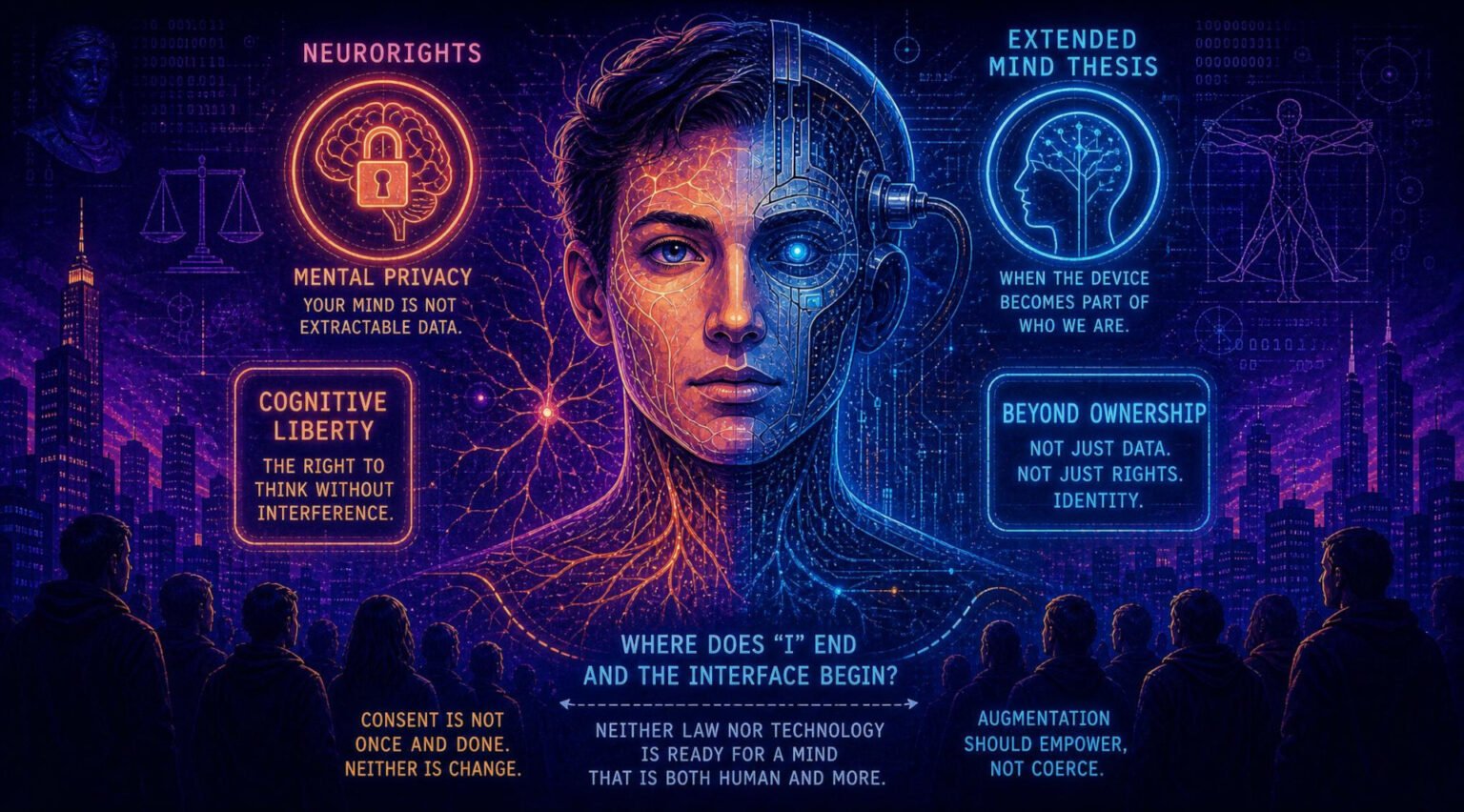
“These are kind of Jesus-level things,” Elon Musk told Forbes in May 2026, describing what Neuralink’s brain implants can do, “like when technologies are hitting Jesus-level miracles, it’s pretty good.”a The phrasing is worth pausing on. The same impulse that names AI systems after gods — Gemini, Titan, Prometheus — now names brain implants after miracles. We have been here before, linguistically. What’s new is that the technology beneath the language is starting to earn a fraction of the claim. That fraction is where the hard questions about Neuralink ethics begin — not in the rhetoric, but in the operating rooms and consent forms and data streams that the rhetoric floats above.
The medical case for brain-computer interfaces has never been stronger. At UCSF, the Chang Lab’s BRAVO trial has achieved 78 words per minute in speech decoding for a patient who cannot speak — faster than most people type on a phone.b In August 2025, a man with ALS named Mark Jackson used Synchron’s Stentrode to navigate an iPad with his thoughts alone, the first demonstration of a brain implant working through Apple’s standard accessibility protocol.c Neuralink’s PRIME trial has expanded to twenty-one participants across five countries, with the company’s Blindsight project targeting its first completely blind patient by the end of 2026.d For people locked inside bodies that no longer obey them, these are not incremental improvements. They are the difference between silence and speech, between paralysis and a cursor on a screen. The question of whether they get their voices back is not academic.
But the same interface that reads a patient’s motor cortex also generates a continuous stream of neural data, the most intimate information a human being can produce. The data flows out. The algorithms learn. The company stores what it collects under terms the patient signed while desperate. This is the landscape that any serious treatment of Neuralink ethics has to navigate: a technology that simultaneously restores human dignity and creates new vulnerabilities that no existing legal framework was built to address.
The deeper question, the one that both the technology’s champions and its critics keep stepping over, is not who owns that data. It is where the patient ends and the device begins. When an implant becomes part of how you think and feel, the boundary the entire debate organises around may already be dissolving.
The Technology Behind the Neuralink Ethics Debate
In 1973, a UCLA researcher named Jacques Vidal published a paper proposing that electrical signals from the brain could be decoded in real time to control external devices.e He called the concept a “brain-computer interface.” It took half a century for the technology to catch up with the idea. What Wolpaw (2002) later clarified, and what matters for the ethics, is that a BCI is not mind-reading.f It is a co-adaptive skill, learned by both the user and the machine. The brain adjusts to the device. The device adjusts to the brain.
In the United States, three companies define the leading edge of clinical BCI development, and each embodies a different trade-off between bandwidth and damage. China’s BCI sector is scaling in parallel — over 170 companies, a national roadmap, and billions in state funding — though its clinical-stage invasive devices have not yet generated the same ethical flashpoints. Neuralink’s N1 chip uses penetrating electrodes: thin threads inserted directly into cortical tissue, offering the highest signal resolution but requiring a craniotomy and accepting some degree of tissue disruption.d Synchron’s Stentrode takes a radically different approach: the device is delivered through the jugular vein and lodges in a blood vessel near the motor cortex, reading signals from inside the vasculature without ever touching brain tissue.c It sacrifices bandwidth for safety.
Then there is Precision Neuroscience, founded by Benjamin Rapoport, a neurosurgeon who co-founded Neuralink and left over safety concerns. Rapoport’s Layer 7 Cortical Interface sits on the brain’s surface rather than penetrating it. His argument is blunt: “All penetrating electrodes damage the brain,” he told the Harvard Medicine Magazine in 2025. “If you add more electrodes to scale bandwidth, then the damage increases. And if you’re doing that with a device that’s supposed to help vulnerable people — then there’s a bit of a paradox there.”g This is worth taking seriously, though it’s also worth noting that Rapoport runs a competing company. His critique is genuine. His incentives are not disinterested.
Behind all three sits the Chang Lab’s BRAVO trial, which represents the research frontier: electrocorticographic arrays that decode speech intent from the ventral sensorimotor cortex at speeds that make the technology feel, for the first time, fast enough to matter.b What Metzger et al. (2023) demonstrated was not a proof of concept. It was a proof of viability — a system fast enough and accurate enough that a patient could hold a real conversation.
The differences between these approaches are real and consequential. A penetrating electrode array reads more neurons but damages more tissue. An endovascular device spares the tissue but reads fewer neurons. A surface array sits between them. Each makes a bet about which trade-off patients and surgeons will accept.
But each also shares the thing that makes brain computer interface ethics urgent: every one of them generates neural data that leaves the skull. The variation is in how much damage the reading costs and how much data comes out, not in whether the privacy problem exists. Neuralink ethics, Synchron ethics, Precision ethics — the company names change, but the structural question is the same.
Who Owns the Data from a Brain Implant?
In most jurisdictions, the company does. Brain-computer interface companies typically retain broad rights to neural data under terms-of-service agreements that patients sign before implantation. A few US states — Colorado, California, Montana — have begun classifying neural data as sensitive or private property, and Chile’s constitutional amendment established the first national framework. But for the majority of BCI patients worldwide, no dedicated legal protection exists for the data their implants produce.
The first judicial test came in Chile. In August 2023, the Supreme Court ordered the neurotechnology company Emotiv to delete brain data collected from former Senator Guido Girardi Lavín — the same politician who had championed Chile’s 2021 constitutional amendment protecting neurorights in the first place.h The ruling was hailed as a landmark: the world’s first court enforcement of the right to mental privacy. But the legal scholars who looked closely were less certain. A Stanford Law Blog analysis in April 2026 argued that Chile’s existing privacy framework could have handled the case without any new constitutional provision. Whether neurorights need their own legal architecture or can shelter under existing privacy law is, as of mid-2026, still an open question.
Nita Farahany’s 2023 book made the case for a dedicated framework.i Her concept of “cognitive liberty,” the right to mental self-determination, is the most developed philosophical response to the neural data problem. What gives Farahany’s argument its edge is the power asymmetry she identifies: a patient who needs a brain implant to speak or move is not in a position to negotiate data terms with the company that built the device. The agreements are, in her word, “predatory” — not because the companies are unusually villainous, but because the structural dynamics of medical desperation make genuine consent almost impossible. A patient choosing between silence and a terms-of-service agreement is not exercising freedom. They are being offered a deal they cannot refuse, wrapped in the language of choice. The brain computer interface ethics literature has no good answer for this yet, and the problem only sharpens as the devices get better.
Here is where the standard framing starts to crack. Clark and Chalmers argued in their 1998 paper “The Extended Mind” that cognition does not stop at the skull.j If a notebook, a smartphone, or a neural implant becomes a functional part of how someone thinks, it is constitutive of their mind, not an external tool they happen to use. The thought experiment they used was simple: a man named Otto stores his memories in a notebook. If we say the notebook is part of Otto’s mind when he relies on it to function, what do we say about a chip that does the same thing from inside his skull?
The implications for Neuralink ethics are unsettling. If the implant is part of the patient’s mind, then the data it generates is not data about a person. It is the person. And the ownership frame collapses, because you cannot own yourself in the way you own your data.
The neurorights movement has tried to address this. Ienca and Andorno (2017) coined the term “neuroright” and proposed a formal framework of protections for the mind.k Yuste’s Neurorights Foundation developed a parallel framework that influenced Chile’s constitutional amendment directly.l But neither has fully reckoned with the Extended Mind complication. The neural data problem may not be a data problem at all. It may be something we do not yet have the right category for — forms of suffering that don’t fit existing categories are becoming a recurring feature of the technology landscape, and brain-computer interfaces may be generating a new one.
When the Machine Writes Back
Everything discussed so far involves the device reading the brain. The harder ethical territory begins when the device writes to it.
Closed-loop deep brain stimulation can shift a patient’s emotional state directly, adjusting mood, motivation, even the felt sense of identity through targeted electrical impulses. The neuroethics literature has raised alarms about patients who cannot tell whether a mood shift is their own or the machine’s. Lavazza et al. (2025), in the most comprehensive recent treatment of Neuralink’s ethical landscape, discuss this as a genuine concern, though they note that the empirical evidence for DBS-induced identity alteration is more contested than the popular account suggests.m Some patients report feeling estranged from themselves. Others report feeling more like themselves than they have in years. The phenomenon is ethically significant regardless of its frequency, because the question it poses is not how often identity alteration happens but what it means for consent and selfhood when it does.
Philip K. Dick saw this coming in 1968. In Do Androids Dream of Electric Sheep?, the Penfield Mood Organ lets users dial in emotional states through brain stimulation — named after real neurosurgeon Wilder Penfield, who mapped the brain’s cortical regions by electrically stimulating conscious patients in the 1930s. Dick’s protagonist dials up “pleased acknowledgment of husband’s superior wisdom.” His wife Iran refuses, scheduling sessions of depression instead, because she will not consent to being numbed to the world’s emptiness. That resistance — the insistence on feeling what is real rather than what is convenient — is the same instinct that makes DBS identity alteration feel wrong even when the evidence is thin. We are not objecting to a clinical finding. We are objecting to the possibility.
The objection becomes concrete with Synchron’s Stentrode. Once the endovascular device integrates with the blood vessel wall, a process that begins within weeks of implantation, removal risks damaging the vessel.c The patient’s relationship with the device becomes, in a meaningful sense, permanent. Informed consent typically assumes that a patient can withdraw. What does consent look like for an augmentation you cannot reverse?
And then there is Second Sight. In 2020, the company behind the Argus II retinal implant collapsed financially, leaving roughly 350 patients with malfunctioning hardware inside their bodies and no one to service it.n Terry Byland, who had implants in both eyes, was left without technical support, without a path to repair, and without any guarantee that the hardware inside his skull would not degrade in ways no one could predict. The Nature investigation that followed documented a systemic pattern, not an isolated case — other neurotechnology companies had left patients in similar positions. The Severance scenario — a person split between two versions of themselves, one visible to the system and one abandoned by it — is not only fiction. It is what happens when a patient depends on proprietary neural hardware with no right-to-repair mandate, no interoperability requirement, and no post-market obligation.
The bioconservative response to all of this is Fukuyama’s “Factor X” argument: that there is some ineffable quality of humanness, not reducible to any single trait, that enhancement technologies threaten to destroy.o I find this argument more honest than it usually gets credit for. Its vagueness is its weakness, but it is also its integrity. Fukuyama is admitting he cannot name the thing he is trying to protect, which is closer to the truth than the confident frameworks on either side. The paradox Rapoport identified, that devices meant to help the vulnerable also damage them, is the clinical version of the same unease.g What makes Neuralink ethics genuinely difficult is not that one side is right. It is that both sides have identified real suffering that the other side’s framework cannot see. The legal and philosophical response to this impasse has coalesced around a concept: cognitive liberty. Whether that concept can bear the weight being placed on it is the next question.
What Is Cognitive Liberty?
Cognitive liberty is the right to mental self-determination — the freedom to control your own cognitive processes, protect your mental privacy, and resist external interference with your thoughts. Farahany (2023) defines it as the necessary legal foundation for an era when technology can read and alter brain activity.i
The neurorights frameworks deserve closer examination, because they are frequently conflated and the differences between them carry real consequences. Ienca and Andorno’s 2017 paper proposed four neurorights: cognitive liberty, mental privacy, mental integrity, and psychological continuity.k These are protective in character. They assume a bounded mind that can be intruded upon, and they build walls around it. Yuste’s five-right framework goes further, adding mental identity, free will, fair access to mental augmentation, and protection from algorithmic bias.l Where Ienca defends the existing mind, Yuste asks who gets to enhance it.
The distinction matters more than most discussions of neurorights acknowledge. One framework is defensive. The other is redistributive. A serious conversation about neurorights requires knowing which is on the table, because the policy implications diverge sharply once the conversation moves from principle to regulation. Ienca’s rights could be enforced with privacy law. Yuste’s require something closer to a theory of distributive justice for the mind.
Chile remains the only national test case, and the results are instructive in both what they achieved and what they left open.h The 2021 constitutional provision was a genuine first: no other country had embedded neural data protection at the constitutional level. The 2023 Supreme Court ruling enforced it against a real company making real products. But the companion legislation that would give the provision regulatory teeth was still pending in the Chilean legislature as of early 2026, and the enforcement machinery remains thin. The sceptics’ argument — that existing privacy law could have handled the Emotiv case without any constitutional amendment — has not been refuted so much as set aside in the enthusiasm for the landmark. Whether the new rights do work that existing rights cannot is the question the next decade of Neuralink ethics will have to answer.
Here is where the Extended Mind complication returns with full force. If cognitive liberty means the right to control your own cognitive processes, and your cognitive processes now extend into a device, does cognitive liberty extend to the device? If the implant is constitutive of your mind, then tampering with it is not a property crime. It is a violation of your personhood. And at that point, the question of what qualifies for moral status stops being a thought experiment about distant robots and becomes a live question about the machine inside your skull. Neuralink ethics, at its sharpest, is not about privacy policies or data governance. It is about whether we understand what a person is well enough to protect one.
One question keeps surfacing in public forums: could a brain chip be hacked? The concern touches a real vulnerability. Neurosecurity is a dimension of cognitive liberty that neither framework has adequately developed, and the technical details deserve more space than any single discussion of neurorights can give them. But the seed is worth planting: if the mind extends into hackable hardware, the attack surface of personhood has changed.
The DARPA Pipeline and the New Neural Divide
The brain-computer interfaces entering clinical trials today did not emerge from garages. They emerged from the Pentagon. DARPA has invested over $500 million in BCI technology, including the Neural Engineering System Design program, which set targets of recording one million neurons simultaneously and stimulating one hundred thousand.p Paradromics and Synchron both received DARPA funding. This is not a conspiracy theory. It is the normal defence-to-commercial transfer mechanism, the same pipeline that produced the internet, GPS, and voice recognition.
What makes it ethically significant for BCIs is the dual-use problem. The same technology that restores a paralysed veteran’s ability to move also enables silent soldier-to-soldier communication, neural drone control, and cognitive performance monitoring. The research was funded for both purposes simultaneously. The patients who benefit and the soldiers who are enhanced draw from the same technology base, and the companies that build the devices serve both markets. Anyone mapping the ethics of Neuralink and its competitors will eventually trace the funding back to defence. The military origins of the technology we now call therapeutic are not an embarrassment to be managed. They are a structural feature that shapes the ethics.
What the DARPA pipeline reveals is that Neuralink ethics cannot be treated as a consumer-technology problem. The regulatory frameworks being proposed, from Chile’s neurorights to Farahany’s cognitive liberty, were designed for a world in which neural data flows from patient to company. They were not designed for a world in which neural data flows from soldier to command structure, or from civilian consumer to intelligence apparatus. The dual-use reality means that any framework adequate to the technology has to account for uses its designers may not have intended and its users may not have consented to.
William Gibson saw the soldier’s end of this pipeline in The Peripheral. Burton Fisher, a USMC veteran, carries haptic implants from the military’s Haptic Recon program — technology that synced soldiers together neurally during operations, “two souls becoming one.” The implants left Burton with neural damage, a disability check for “haptics glitch,” and no prospect of repair from a military that has moved on to the next programme. Gibson published the novel in 2014. The Second Sight collapse happened in 2022. The parallel is not a metaphor. It is a pattern.
The inequality dimension cuts the other way. Three billion people remain offline globally. If cognitive augmentation follows the trajectory of every prior technology platform — and there is no reason to assume otherwise — it will reach the wealthy first and stay expensive longest in the places that need it most. Yuste’s fifth neuroright, fair access to mental augmentation, is the only proposed framework that addresses this.l It has no enforcement mechanism. Alex Rivera’s Sleep Dealer (2008) remains the sharpest cinematic rendering of where this leads: workers in Tijuana whose brains are jacked into a network to control robots across the US border, selling their neural labour without ever crossing the line. Who profits from the data, and who bears the damage, are not symmetric questions. The line between healing and upgrading is drawn by the people who can afford to stand on the upgrading side.
O’Connell (2017) called the broader project Promethean — a secular, science-driven effort to overcome mortality and biological fragility that shares deep structural parallels with religion.q The Musk interview that opened this discussion is evidence for O’Connell’s thesis. The “Jesus-level” framing is not incidental. It reveals the theological register that BCIs operate in even when their developers would deny it.
Neuralink Ethics and The Question Behind the Question
Return to the patient in the BRAVO trial — the person for whom a brain-computer interface is not a philosophical problem but a way to say good morning. The medical case is real. The suffering it addresses is real. Nothing that follows is meant to diminish that.
But the question — whose brain is it? — presupposes something that the evidence no longer supports. It presupposes a boundary. The Extended Mind Thesis destabilises it philosophically.j The DBS identity-alteration evidence destabilises it phenomenologically. The Stentrode’s irreversibility destabilises it surgically. And Dick’s Penfield Mood Organ destabilised it imaginatively half a century before any of these devices existed.
The boundary between the person and the device is not a line that might dissolve someday. For the patients and veterans already living with neural hardware, it is dissolving now.
What this means for the frameworks being built to protect the mind, neurorights, cognitive liberty, data ownership, is that they may need to protect something without stable borders. A right to mental privacy assumes a mind that can be private. A right to cognitive liberty assumes a self that is free. If the self now includes the device, these rights need to account for an entity that is neither fully biological nor fully technological, whose boundaries shift with every software update and every new electrode that integrates with tissue. The deepest problem in Neuralink ethics is not a policy gap. It is a conceptual one.
The question behind the question is not who owns the brain. It is what the brain is becoming — and whether we can build protections for a thing whose edges we cannot find. The more honest question after that, the one neither the enthusiasts nor the sceptics are comfortable with, is who suffers while we work it out.
Iain M. Banks coined “neural lace” in his Culture novels — the technology whose name Musk borrowed for his company’s earliest incarnation. Banks’s laces were instruments of integration, not domination: a civilization so advanced it had moved past the question of ownership entirely. The politics Banks embedded in the concept — lace as cooperation, not control — are worth remembering now that the term has migrated from science fiction into SEC filings. The name carries a vision its current owners may not have read.
References
- Musk, E. (2026, May 18). Interview with Randall Lane at Forbes Innovator 250 Celebration, Hotel Nia, Silicon Valley. Forbes Video. https://www.forbes.com/video/1862ac5a-787c-4d47-ab91-a360708e5f99/ · YouTube mirror: https://youtu.be/adgbH9FixW0 · Archive
- Metzger, S. L. et al. (2023). “A High-Performance Neuroprosthesis for Speech Decoding and Avatar Control.” Nature, 620, 1037–1046. DOI: 10.1038/s41586-023-06443-4 · See also: UCSF Chang Lab, https://changlab.ucsf.edu/speech-neuroprosthesis
- Synchron Inc. (2025, August 4). “Synchron Debuts First Thought-Controlled iPad Navigation Using Apple BCI HID Protocol.” BusinessWire. · Mitchell, P. et al. (2023). “Assessment of Safety of a Fully Implanted Endovascular Brain-Computer Interface for Severe Paralysis in 4 Patients: The Stentrode With Thought-Controlled Digital Switch (SWITCH) Study.” JAMA Neurology, 80(3), 270–278. DOI: 10.1001/jamaneurol.2022.4847 · Archive
- Neuralink Corp. (2024–present). PRIME (Precise Robotically Implanted Brain-Computer Interface) clinical trial. First patient implanted January 29, 2024 (Noland Arbaugh). https://neuralink.com/ ·
- Vidal, J. J. (1973). “Toward Direct Brain-Computer Communication.” Annual Review of Biophysics and Bioengineering, 2, 157–180. DOI: 10.1146/annurev.bb.02.060173.001105
- Wolpaw, J. R., Birbaumer, N., McFarland, D. J., Pfurtscheller, G. & Vaughan, T. M. (2002). “Brain–Computer Interfaces for Communication and Control.” Clinical Neurophysiology, 113(6), 767–791. DOI: 10.1016/S1388-2457(02)00057-3
- Rapoport, B. (2025). Profile and interview. Harvard Medicine Magazine. https://magazine.hms.harvard.edu/articles/designing-brain-computer-interfaces-connect-neurons-digital-world · Archive
- Republic of Chile, Supreme Court (2023, August 9). Girardi v. Emotiv Inc., Rol No. 105065-2023. Constitutional provision: Ley No. 21.383 (October 25, 2021). · Analysis: Cornejo-Plaza, M. I. et al. (2024). Frontiers in Psychology, 15, Article 1330439. DOI: 10.3389/fpsyg.2024.1330439
- Farahany, N. A. (2023). The Battle for Your Brain: Defending the Right to Think Freely in the Age of Neurotechnology. St. Martin’s Press. ISBN: 978-1-250-27295-9. https://us.macmillan.com/books/9781250272966/thebattleforyourbrain/
- Clark, A. & Chalmers, D. J. (1998). “The Extended Mind.” Analysis, 58(1), 7–19. DOI: 10.1093/analys/58.1.7
- Ienca, M. & Andorno, R. (2017). “Towards New Human Rights in the Age of Neuroscience and Neurotechnology.” Life Sciences, Society and Policy, 13(1), Article 5. DOI: 10.1186/s40504-017-0050-1
- Yuste, R. et al. (2017). “Four Ethical Priorities for Neurotechnologies and AI.” Nature, 551, 159–163. DOI: 10.1038/551159a · Neurorights Foundation: https://neurorightsfoundation.org/
- Lavazza, A., Balconi, M., Ienca, M., Minerva, F. et al. (2025). “Neuralink’s Brain-Computer Interfaces: Medical Innovations and Ethical Challenges.” Frontiers in Human Dynamics, 7, Article 1553905. DOI: 10.3389/fhumd.2025.1553905
- Strickland, E. & Harris, M. (2022). “Their Bionic Eyes Are Now Obsolete and Unsupported.” IEEE Spectrum. https://spectrum.ieee.org/bionic-eye-obsolete · See also: “Abandoned: The Human Cost of Neurotechnology Failure.” Nature (December 2022). · Archive
- Fukuyama, F. (2002). Our Posthuman Future: Consequences of the Biotechnology Revolution. Farrar, Straus and Giroux. ISBN: 978-0-374-23643-4.
- DARPA (2016–present). Neural Engineering System Design (NESD) program. https://www.darpa.mil/program/neural-engineering-system-design · Archive
- O’Connell, M. (2017). To Be a Machine: Adventures Among Cyborgs, Utopians, Hackers, and the Futurists Solving the Modest Problem of Death. Granta Books. ISBN: 978-1-78378-328-8.