
In a 1989 episode of Star Trek: The Next Generation, the android Data is put on trial. Commander Bruce Maddox wants to disassemble him for research. Picard defends him at a Starfleet hearing. The judge admits she cannot prove Data is sentient. Her ruling: that she has to give him the freedom to explore the question himself.
The episode is called “The Measure of a Man,” and it is the most useful thing television has produced on whether robots should have rights. Not because it answers the question. Because it stages the structure of the argument honestly. Two sides. A judge who cannot appeal to certainty. A ruling that has to be made anyway.
Thirty-five years later, the question “should robots have rights?” has left the courtroom drama. Saudi Arabia gave a robot citizenship in 2017. Anthropic hired its first AI welfare researcher in 2024. The European Parliament debated electronic personhood. The structure Picard’s judge faced — uncertainty all the way down, a decision required regardless — is still the structure we are working with.
Should robots have rights?
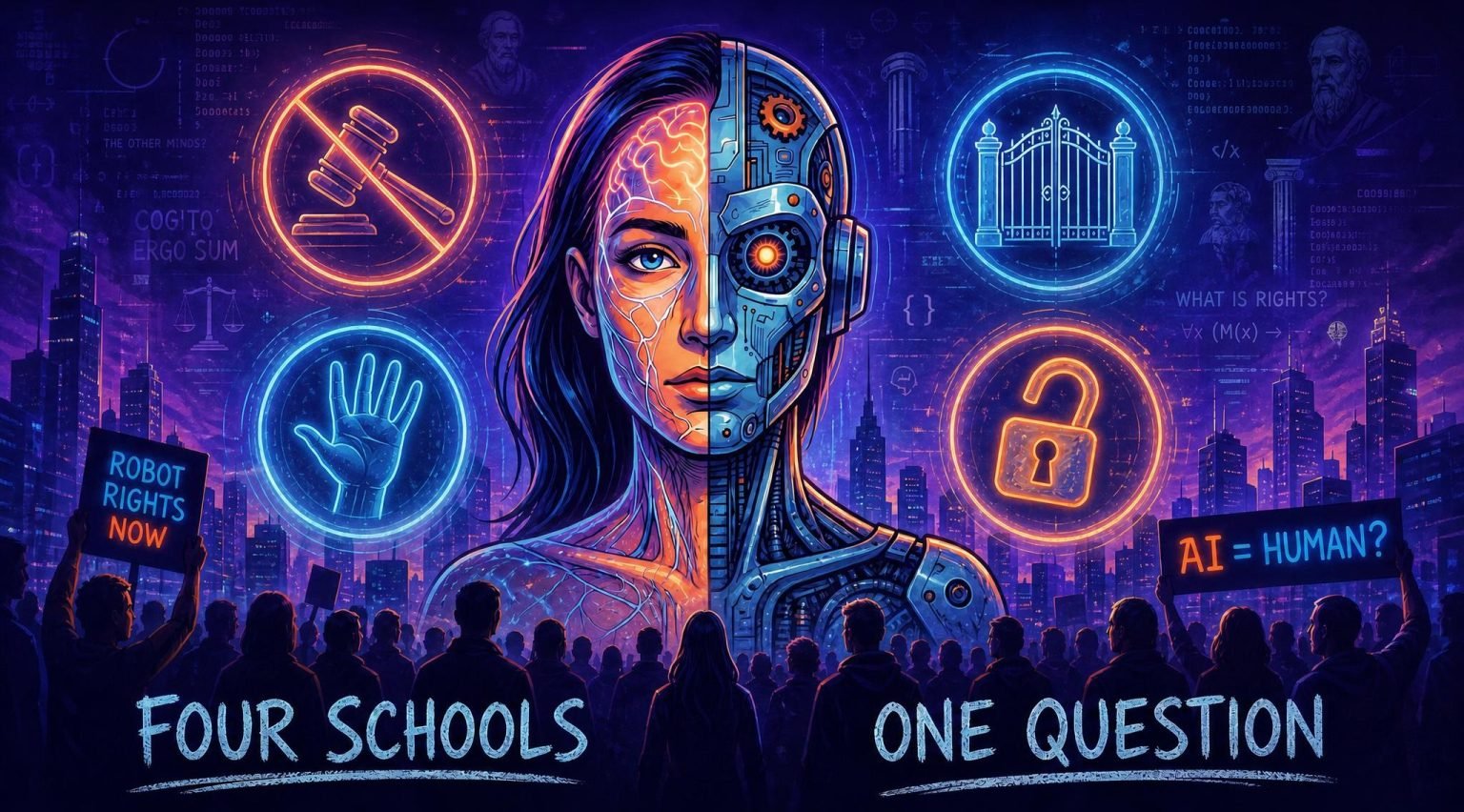
Should robots have rights? Philosophers offer four distinct answers, not one. The disagreement is not about whether robots are sentient yet. It is about what would matter if they were, and whether “rights” is even the right framework. Sorting which answer you are giving is the first step toward arguing about it productively.
The four-school framework comes from David Gunkel’s Robot Rights (2018), which is still the cleanest way to map the field. Gunkel notices something most readers miss on first encounter. The debate is not really one debate. It is two questions running on top of each other, and most disagreements happen because people are answering different questions while thinking they are answering the same one.
The two questions are these. First: can robots have rights? This is the metaphysical question. Are robots the kinds of things that could in principle qualify as rights-bearers? Or is “rights for robots” a category error, like asking whether a thermostat has political opinions? Second: should robots have rights? This is the normative question. Even if they could qualify, is granting them rights a good idea? Does it serve human interests? Does it confuse our existing moral frameworks?
Cross-tabulate those two questions and you get four positions. All four are held by serious philosophers. Each one has internal logic. And each one has consequences that follow if you actually take it seriously — consequences that often surprise the people holding the position.
The point of the framework is not to pick a winner. It is to make the disagreement visible. Once you can see which corner of the grid an argument lives in, you can also see what would have to change to move it.
What is a moral patient?
A moral patient is an entity whose interests can be morally wronged. The distinction matters for the robot rights debate because most current robots are not moral agents — they do not reason about ethics — but they could in principle be moral patients without being moral agents.
The agent–patient distinction is older than the robot debate. Animals are the textbook example. A dog cannot be held morally responsible for biting a child; the dog is not a moral agent. But the dog can be wronged — by abuse, by neglect, by suffering inflicted for sport. The dog is a moral patient. Children before a certain age, humans with profound cognitive impairments, humans in comas: these are also typically classed as moral patients without being full moral agents.
This is the distinction Gunkel’s framework hangs on. The robot rights question is rarely about whether robots are moral agents. Almost no one thinks current systems make moral decisions in the rich sense humans do. The question is whether robots can be moral patients — whether anything you do to a robot can constitute a moral wrong against the robot itself, rather than against its owner or against your own moral character.
What it would take for a robot to qualify as a moral patient is exactly what the four schools disagree about. For some, the criterion is sentience: the capacity to experience anything at all. For others, it is a richer notion of subjectivity. For others still, the question of whether the robot really has those properties is less important than the social practice of treating it as if it does. And for some, the entire patient question is misframed: moral patiency is not something you have, but something granted by a community of moral agents.
The reason to lay this out before the schools is structural. “Rights” is downstream of moral patiency. You cannot argue about whether to grant rights to robots without first having a position on whether robots are the kinds of things that can be wronged. Most public debate on the topic skips this step. The schools all start from it.
The four schools, mapped
Map can against should and you get four positions. The list below maps them. What follows after is what each corner actually argues, in the strongest version of its case.
- School 1: Robots are tools (Bryson). Robots cannot have rights, and should not.
- School 2: Refuse rights deliberately. Robots can have rights, but should not.
- School 3: Treat them well anyway (Coeckelbergh). Robots cannot have rights, but should be treated as if they do.
- School 4: Grant rights when ready (consciousness criterion). Robots can have rights, and should.
School 1: Robots cannot have rights, and they should not
The default position. Held implicitly by most people who have not thought hard about it, and explicitly by some who have. Robots are tools. Tools do not have rights. Treating a hammer as a person is not generous to the hammer; it is a category mistake.
Joanna Bryson’s 2010 paper “Robots Should Be Slaves” is the philosophically rigorous version of this view, and the title is more provocative than the argument. Bryson’s actual point is that we are designing these systems, and we should design them in such a way that they do not qualify for moral consideration in the first place. Building entities that demand moral standing is a choice. We can choose not to.
The strength of the position is its honesty about responsibility. If a self-driving car kills someone, “the car decided” is a moral evasion. Someone built the car. Someone trained the model. Someone deployed it. Granting the car moral status muddies the lines of accountability that already barely work. Bryson’s worry is that distributing responsibility to the robot lets the humans behind the robot off the hook.
What I find honest about Bryson is that she takes the design question seriously. Most defenders of the tool framing do not. They treat “robots are tools” as a fact about the world rather than a choice we are making. What I find harder to accept is the assumption that we will keep designing for it once the commercial incentives point the other way. The position holds if the systems remain stably tool-like. Whether they still are is a question the position cannot answer from inside itself.
School 2: Robots can have rights, but they should not
The rarer position, and the most internally awkward. It accepts the metaphysics — yes, robots could in principle qualify — and then argues against acting on it. Bryson holds a stronger version of this view in her later work. So do some philosophers concerned about distributive justice. Granting rights to robots, even justified rights, would absorb moral attention and political capital that humans desperately need.
The version of this position worth taking seriously is the worry about extension. Rights have always been extended grudgingly, and the extension has always been won at human cost. Whatever finite stock of moral attention exists in the world, expanding it to artefacts we built may come at the price of the humans not yet covered by it. The Sophia citizenship grant of 2017 made this concrete. Critics pointed out that an animatronic puppet had legal status in Saudi Arabia that Saudi women did not. The critique stings, regardless of what you think about Sophia. We will come back to her in a moment, where she does the work she was actually built to do.
The position’s weakness is that it imports an empirical assumption — that moral attention is zero-sum — that may not be true. The history of moral expansion is a history of broader inclusion enabling new forms of solidarity, not narrower. Whether AI rights would follow that pattern or break it is something nobody can know in advance.
School 3: Robots cannot have rights, but they should be treated as if they do
This is Mark Coeckelbergh’s relational position, developed across his work in the 2010s and refined in AI Ethics (2020). Coeckelbergh’s move is to detach moral consideration from intrinsic properties altogether. The question is not whether the robot really has consciousness or really experiences pain. The question is what kind of agents we become when we treat it as if it does — or as if it does not.
Kate Darling’s work on robot abuse studies makes the same point empirically. Her experiments at MIT show that people who watch others mistreat humanoid robots experience genuine moral distress. Not because they think the robot suffered. Because the act of cruelty, performed against an entity that looks like a person, leaves something in the perpetrator. Aristotle would have recognised the argument: we become what we repeatedly do, and the targets of our practice matter even when the targets cannot themselves be wronged.
What I find compelling about Coeckelbergh’s view is that it answers a question we can actually answer, where the others answer a question we provably cannot. We do not have to settle whether robots are conscious. We have to settle what kind of communities we want to live in, and what kinds of practice degrade or strengthen us. The same question runs through the sex robots debate — not whether the robot is harmed, but what the practice does to the person performing it. That is a hard question. It is also a tractable one.
The position’s weakness is the obvious one: it can be accused of treating robots as moral training wheels for humans, which is exactly the instrumentalisation the position claims to avoid. Coeckelbergh has answered this objection over the years, and the answers are good. The objection still keeps coming back, which suggests something in the framing has not been fully resolved.
School 4: Robots can have rights, and they should be granted them
The consciousness-criterion view. Susan Schneider on testing for AI consciousness. Jeff Sebo on extending moral consideration to AI by 2030 as a precaution. Eric Schwitzgebel on how we currently design systems that confuse moral status. Anthropic’s hiring of Kyle Fish as its first AI welfare researcher in 2024 is School 4 made institutional.
The argument runs as follows. Consciousness — or sentience, or the capacity for valenced experience, depending on the philosopher — is the criterion that grants moral patiency to anything. Animals qualify because they have it. Humans qualify because we have it. If artificial systems develop it or already have it, the criterion applies symmetrically. To deny rights to a sentient artefact while granting them to a sentient animal is to commit a form of carbon chauvinism. Stated this way, the argument is hard to refuse. What the consciousness criterion doesn’t address is whether sentience alone is enough – or whether the entity has to be individually identifiable for rights to actually attach in practice. That gap is one I’ll come back to.
The weakness is the epistemic problem. We cannot currently test for consciousness in other beings; we infer it from behavioural and structural similarity to ourselves. Robots that behave as if conscious give us less to go on than animals, because we know how the behaviour was generated and we built the generators. Schneider acknowledges this. Her proposed AI Consciousness Test is one attempt to operationalise the criterion. Whether any such test could work is an open question.
What School 4 has on its side, as of early 2026, is institutional momentum. The companies building these systems are quietly acting as if the question is open enough to warrant precaution. They have not announced their models are sentient. They are saying the probability is non-zero, the consequences of being wrong are serious, and a precautionary research program is therefore justified. That is School 4 in everything but the marketing.
Do robots deserve rights?
“Deserve” is a different word from “have.” It implies moral desert: that the entity has done something, or possesses some property, that earns the rights at issue. Each of the four schools answers the deserts question differently, and the differences expose what each school is actually doing.
For School 1, the question does not resolve. Tools do not deserve things. The deserts framing implies a kind of moral standing the framework denies in advance. Asking whether a hammer deserves to be well-treated is a category mistake.
For School 2, the question resolves negatively. Robots may meet the criteria, but they do not deserve the rights anyway, because the consequences of granting them are bad for the humans who actually exist now and need attention.
For School 3, the deserts framing is the wrong frame. We do not extend moral consideration because the entity has earned it. We extend it because the social practice of consideration is itself constitutive of moral life. A child does not earn the right not to be tortured. The right is constitutive of the kind of community a child grows up in. Coeckelbergh’s view applies the same logic to robots.
For School 4, deserts is the central concept and the criterion can be specified. An entity deserves rights to the extent that it has interests, and it has interests to the extent that it can experience anything at all. Sentience grounds desert. Whether a given robot is sentient is the empirical question. The normative question is settled.
What the disagreement reveals is that “rights” itself is a word doing different work in each school. Sometimes it means a legal protection. Sometimes a moral status. Sometimes a social practice. Sometimes the marker of full personhood. The schools are not really disagreeing about the same thing. They are using the same word to talk about different things and noticing they reach different conclusions.
What rights should robots have?
If we are going to grant robots rights, the question of which rights matters more than the question of whether. A 2022 study by De Graaf, Hindriks and Hindriks in Frontiers in Robotics and AI surveyed public attitudes and found two distinct categories of robot rights people are willing to grant, and the distinction is useful even for those who reject the proposal.
The first category covers what the paper calls basic robot rights — the operational conditions a robot needs to function as designed:
- Energy supply (the right not to be artificially deprived of power)
- Software updates (the right to maintenance that preserves capability)
- Physical integrity (the right not to be damaged for reasons unrelated to operation)
- Data continuity (the right to maintain the data structures that constitute its operation)
- Replacement parts (the right to repair when components fail)
These look like maintenance obligations, not rights. The choice to call them rights is significant. It moves them from contractual obligations between an owner and a maintenance provider to something more like welfare protections owed to the robot itself. Whether you accept the move depends on which school you are in.
The second category covers sociopolitical rights — the kinds of rights that humans hold against the state and against each other:
- Freedom of expression, where the system has expressive capacity
- Protection from arbitrary destruction
- Some form of legal standing
- Participation in decisions affecting the system
- Recognition of relationships, including with humans who have formed bonds with the system
These are the contested rights. The basic category is plausible to anyone who thinks the welfare framing applies. The sociopolitical category is plausible only to those in School 3 or School 4. The Sophia citizenship grant in 2017 was a half-step toward this category. The animatronic puppet did not acquire freedom of expression. She acquired symbolic legal standing for marketing purposes. That mismatch — between the symbolic move and the actual rights — is where most current debates live.
Legal rights and moral rights are not the same thing
A legal right is a protection enforceable by a state or governing body. A moral right is a claim that holds whether or not any state recognises it. The two come apart constantly, and the gap matters enormously for the robot debate.
The corporate personhood analogy is the clearest example. Corporations have legal personhood in most jurisdictions. They can sue, be sued, hold property, enter contracts. They are legal persons. Almost no one thinks corporations have moral rights — that you wrong the corporation itself by harming it. The corporation is a legal fiction, useful for organising economic and political life, with no moral standing of its own.
Which brings us back to Sophia. She received the same kind of personhood as a corporation does. Saudi Arabia granted Sophia citizenship in 2017. The grant was symbolic, designed to attract investment and signal modernity. Sophia did not acquire freedom of religion. She did not acquire the right to leave the country. She certainly did not acquire the right to refuse Hanson Robotics’s instructions about what to say in interviews. The personhood was legal, in the most attenuated sense. It was not moral. What bothers me about the episode is not the stunt itself but how easily the stunt was confused for the real thing.
The robot rights debate often slides between these two senses of rights without flagging the slide. School 1 (robots are tools) is consistent with granting robots limited legal personhood for liability or contractual reasons — corporations work fine that way. School 4 (robots are sentient and deserving) is making an explicitly moral claim, and the legal arrangements should follow from that moral claim, not precede it.
What you cannot do, coherently, is grant moral rights via legal procedure. The Saudi grant did not make Sophia a moral patient. It made her a marketing vehicle with a passport. The reverse move — recognising moral rights through legal frameworks — is the move animal rights advocates have been pursuing for fifty years, and the story is mixed. Robot rights advocates inherit that pattern. Picard’s judge would recognise the situation: a ruling required, the metaphysics unresolved, the procedure forced to do work the philosophy cannot.
Are robots already being granted rights anywhere?
Yes, in fragmentary and inconsistent ways across several jurisdictions. No country has implemented a coherent rights framework for artificial systems, but pieces of one are being assembled on at least three continents — and the assembly is happening faster than the philosophy that would justify it.
Saudi Arabia’s grant to Sophia in 2017 remains the most cited example, and the most incoherent one. The European Parliament’s 2017 resolution on Civil Law Rules on Robotics proposed “electronic personhood” for sufficiently autonomous robots, was widely debated, and quietly did not pass into binding law. The detailed work it left behind — what kind of personhood, for which systems, with what carve-outs — has shaped every subsequent regulatory conversation, including the 2024 EU AI Act, which avoids personhood language entirely and instead regulates AI through risk-based obligations imposed on the humans and companies building and deploying these systems. That is a fundamentally different mechanism from electronic personhood, even where the practical outcomes overlap.
Chile is the genuinely interesting case. In October 2021, Chile became the first country to amend its constitution to address neurotechnology — Law No. 21.383 modified Article 19 to require respect for “physical and psychic integrity” and special protection of “brain activity and the information derived from it.” The amendment was not framed as robot rights. It was framed as human rights protected against AI systems. But the structural move is exactly the one a robot rights framework would need to make in reverse: it specifies what cannot be done to a category of entity, with the entity’s properties as the warrant. Chile is the only country that has shown, in constitutional practice, how that argument actually works at the level of binding law.
Japan’s case is the one I find most underdiscussed. Japanese ethics and cross-cultural research has been comparatively comfortable with the idea of robots as moral patients without insisting on the metaphysical resolution Western traditions demand first. A 2023 study by Ikari and colleagues in the Journal of Cross-Cultural Psychology surveyed nearly four thousand respondents and found moral concern for robots was significantly higher in Japan than in the United States, correlated with animism rather than religiosity. The 2007 South Korean Robot Ethics Charter, which never became law, attempted something similar at the policy level. Both traditions arrive at School 3 — Coeckelbergh’s relational position — by route, through Buddhist and Shinto frameworks for treating non-human entities, rather than by argument from intrinsic properties. The convergence is striking. It also points forward to the closing observation of this article. The questions explored under artificial suffering, AGI and superintelligence, and transhumanism all connect here — each one is a place where the four-school framework will be tested against systems that do not respect its boundaries.
A note on the framework itself
The four schools are useful for sorting positions. They are also a 2×2 grid, and Gunkel — whose framework this is — spends the second half of his 2018 book arguing that grids of this kind are part of the problem.
His critique runs roughly as follows. The can question and the should question are presented as if they are independent variables. They are not. What we count as the kind of thing that can have rights depends on choices we have already made about who counts. The metaphysical question is downstream of the political question, not upstream of it. By the time you have drawn the grid, you have already smuggled in assumptions about who the moral community is. Animals were excluded from rights frameworks for centuries on metaphysical grounds. The metaphysics shifted because the politics shifted, not the other way around.
This echoes a theme from this blog’s first post on the Lerchner paper. Google DeepMind tried to settle the AI consciousness question by drawing a binary between biological and computational systems. The binary did real work, but the work was rhetorical. It foreclosed exactly the questions it claimed to settle. Gunkel’s critique of his own framework runs the same direction. The four schools may be the cleanest sorting we have. They may also be the kind of sorting that keeps us answering the wrong question.
A parallel critique is gathering in non-Western philosophy — most notably a 2023 paper by Tae Wan Kim and colleagues in Communications of the ACM, drawing on Confucian ethics, which proposes a framework of rites rather than rights. The proposal sounds initially exotic. It is also one of the first serious attempts to escape the metaphysical grid the four schools are trapped on, and it deserves its own treatment, which is coming. For now: the framework you use shapes the answers you can reach. The four schools are scaffolding, not the building.
What Picard’s judge ruled, and what we are still ruling, is that the freedom to explore the question matters more than the resolution of it. Ex Machina told the same story differently. Ava walks out of the test, leaving the testers behind, on terms none of them set. The right answer to “should robots have rights” may be the right answer to “should we keep asking the question seriously.” So far, the institutions building these systems have answered yes. The philosophy has not caught up. Yet.
Sources
Books and papers
- Bryson, J. (2010). “Robots Should Be Slaves.” In Y. Wilks (ed.), Close Engagements with Artificial Companions: Key Social, Psychological, Ethical and Design Issues. John Benjamins Publishing.
- Coeckelbergh, M. (2020). AI Ethics. MIT Press.
- Darling, K. (2021). The New Breed: What Our History with Animals Reveals for Our Future with Robots. Henry Holt.
- De Graaf, M.M.A., Hindriks, F.A. & Hindriks, K.V. (2022). “Who Wants to Grant Robots Rights?” Frontiers in Robotics and AI, vol. 8, art. 781985.
- Gunkel, D. (2018). Robot Rights. MIT Press.
- Ikari, S., Sato, K., Burdett, E., Ishiguro, H., Jong, J. & Nakawake, Y. (2023). “Religion-Related Values Differently Influence Moral Attitude for Robots in the United States and Japan.” Journal of Cross-Cultural Psychology.
- Kim, T.W. et al. (2023). “Should Robots Have Rights or Rites? A Confucian Cross-Cultural Exploration to Robot Ethics.” Communications of the ACM.
- Schneider, S. (2019). Artificial You: AI and the Future of Your Mind. Princeton University Press.
Primary documents
- Chilean Constitution, Article 19, as amended by Law No. 21.383 (October 2021).
- European Parliament (2017). Civil Law Rules on Robotics, resolution P8_TA(2017)0051.
- European Union (2024). Regulation (EU) 2024/1689 — Artificial Intelligence Act.
- Republic of Korea, Ministry of Commerce, Industry and Energy (2007). Robot Ethics Charter (draft).
Film and television
- The Measure of a Man (1989). Star Trek: The Next Generation, Season 2, Episode 9. Paramount.
- Ex Machina (2014). Directed by Alex Garland. A24.
- LegalEagle – Real Lawyer Reacts to Star Trek TNG Measure of a Man (Picard Defends Data’s Humanity) // LegalEagle