
Martha’s partner Ash dies in a car accident the day after they move into their new house. A friend signs her up for a service. It rebuilds him — first as a voice on her phone, scraped from every email, message, photograph, and video he ever posted. Then as a body. The body looks like Ash. It moves like Ash. It has sex like Ash, only better, because the service asked her what she wanted and she answered honestly. The horror of Be Right Back, the 2013 Black Mirror episode written by Charlie Brookerb, is not that the replica fails. It is that the replica works, and working is not enough. Ash does not die — not really, not in any sense the technology recognises. The replica is, among other things, an immortality artefact, and what Martha discovers is that an entity that cannot die is not the same thing as the person who was once alive.
Martha ends up storing him in the attic. Her story has become the cleanest one-paragraph statement of why sex robots ethics is harder than it looks.
She cannot destroy him because he has Ash’s face. She cannot love him because he is not Ash. The episode lands on something the academic debate over sex robots ethics keeps missing: the question is not whether we can build a convincing replica of human intimacy. We are well on the way to building one. The question is what it means that the building succeeds, and what the success leaves out.
That last problem — what the success leaves out — is the one worth spending time on. The dominant ethical framing, the one that shapes almost every popular discussion of sex robots, runs on a fixed axis. On one side, Kathleen Richardsonu and the Campaign Against Sex Robots argue that these machines normalise the objectification of women and re-encode the violence of prostitution into product design.
On the other, David Levy’s 2007 book Love and Sex with Robotsr argues that humans will love, partner with, and marry machines by 2050, and that this is broadly fine. Almost every popular treatment of the question lives somewhere on that line. The argument here is that the line was already conceptually obsolete before the technology arrived.
The market is real, and the market is not the same as the question
The clearest articulation of the dominant industry position comes, predictably, from Elon Musk. Asked at the April 2022 TED interview in Austin whether his humanoid robot programme would extend to romantic and sexual partners, Musk answered: “It’s probably inevitable. I mean, I did promise the internet that I’d make catgirls. We could make a robot catgirl.” When the interviewer cautioned him about that promise, he added: “So, yeah, I guess it’ll be whatever people want, really.”
Whatever people want, really. That framing — the question as consumer preference — is a philosophical position dressed up as a shrug. What it forecloses is the whole question of what the products quietly already are. The sex robots ethics literature has had to start rebuilding from that foreclosure.
So begin with the products. The numbers are smaller than the headlines suggest, and they depend entirely on what you count.
The narrowest definition — AI-integrated, motorised sex robots — pegs the market at roughly $30 million in 2024, projected to reach $316 million by 2031 at a 40% compound annual growth rate (Valuates Reports, 2025kk). A broader definition that includes AI-capable dolls without full robotics puts the figure at $316 million in 2024, growing to $736 million by 2032 (Intel Market Research, 2025ee). The widest definition, the full sex doll market including non-AI silicone products, was worth $2.8 billion in 2024, projected to reach $8.9 billion by 2033 at a 13.7% CAGR (Data Horizzon Researchbb). The broader sextech category sat at $42.59 billion in 2024 (Grand View Researchdd). What counts as a sex robot changes every figure. The geographic concentration adds another layer: industry sources put Chinese factories at roughly 99% of global sex doll production and around 70% of all adult-products manufacturing, which means almost every revenue figure cited above is, in physical terms, a figure about Chinese silicone shipped to Western buyers (Daxue Consultingcc; QYResearch, 2024ff).
The demand-side numbers carry more weight than the market-size estimates. Median US marriage age has climbed from 23.2 for men and 20.8 for women in 1970 to 30.4 and 28.6 in 2024 (US Census Bureaujj). Thirty-six percent of American adults now live alone, a ten-point increase over previous decades (Bureau of Labor Statisticsz). Globally, single-person households make up about 38% of all households, and over 50% in parts of Northern Europe and East Asia (UN World Economic Situation and Prospects, 2024hh). The US fertility rate hit a record low of 1.6 births per woman in 2024 — a 23% drop in annual births since the 2007 peak (CDC, NCHS Vital Statistics Rapid Release; Hamilton, 2025aa). The global fertility rate sat at 2.2 in 2024, still at or just above the 2.1 replacement threshold; but roughly 71% of the world’s population now lives in countries already below replacement (UN World Population Prospects 2024ii). A 2021 Tidio surveygg of more than 1,200 respondents found that 48% of men and 33% of women were open to the idea of a robot partner.
These trends are co-occurring, not simply causal. Loneliness does not straightforwardly produce demand for sex robots, and sex robots do not straightforwardly produce more loneliness; both causal claims are contested. What is uncontested is that the technology is being designed and sold into a specific demographic reality the ethics debate cannot ignore.
The revenue numbers also obscure a point that matters for the ethics. At blended retail prices (entry-level TPE dolls run $500 to $1,500, mid-range silicone $2,500 to $5,000, premium AI-integrated systems $10,000 to $15,000), the $2.8 billion global sex doll market translates to roughly 800,000 to 1.4 million units sold worldwide in 2024, but the $30 million AI-integrated robot segment translates to only 2,000 to 3,000 actual humanoid AI robots shipped in the same year. Two thousand robots. This distribution matters because almost every popular ethical argument — Richardson’s prostitution analogy, Levy’s marriageable-machine prediction, Musk’s robot-catgirl shrug — assumes a humanoid AI-integrated product. The product that actually sells, at volume, is the static silicone doll. The ethics debate has been arguing about an entity-class that, in 2026, is statistically rare; the entity-class people are actually buying is the older, simpler one. Whether a static doll raises the same moral-status questions as a conversational humanoid is not a settled question, and the answer changes what the conversation is even about.
What is a sex robot? Defining the product class, as of 2026
Before the ethics: the taxonomy.
A sex robot, in 2026, is not a single thing. The category covers at least four distinct product types. Static sex dolls — silicone or TPE bodies without motion, electronics, or AI — make up the largest segment of the market by volume and revenue. Partially motorised dolls add heating elements, internal sensors, and limited movement. AI-integrated companions (the Harmony platform from Realbotix is the most-cited example) add a conversational large language model, customisable personalities, and animatronic facial expression. Fully articulated humanoid prototypes like Realbotix’s Aria, unveiled in 2024 following the company’s acquisition of Simulacra, attempt full-body movement and remain prototypes rather than shipping consumer products.
The distinction matters because almost every ethical claim about sex robots quietly assumes a different product class than the one currently selling. Richardson’s prostitution-analogy argument assumes a humanoid robot that resembles a sex worker. Most of the units sold in 2024 were static dolls. Levy’s 2050 prediction assumes machines that humans could love and marry. The shipping products are not those machines. The honest sex robots ethics conversation has to track which technology is actually under discussion at any given moment, and most do not.
The clearest shipping example in the AI-integrated category is WMDoll’s MetaBox — running on Meta’s open-source Llama models hosted across regional cloud servers, with eight selectable personalities and multi-day conversational memory — which sold out its first batch of 200 units across North American, Japanese, and European buyers in December 2024 (China Daily, 2025c). The most-discussed Western entry, Realbotix’s Aria, has been publicly demonstrated since 2024. These are early signals of where the embodied AI companion market is heading. They are not yet the market.
The reason the humanoid AI-integrated category remains the smallest segment of the market is not only that the engineering is hard. It is also that the design target is hard. Masahiro Mori’s 1970 bukimi no tani hypothesist, translated into English in 2005 as the uncanny valley, predicted that user comfort with a humanoid artefact rises with human-likeness up to a threshold, then plunges into eeriness when the artefact is almost-but-not-quite human. Empirical work since has both confirmed and complicated the curve, with recent studies finding evidence of not one but two valleys and locating the eeriness more reliably in faces than in bodies. The argumentatively important finding, for the ethics, is Kurt Gray and Daniel Wegner’s worki showing that what most unnerves users is not the perception that the entity has agency (the capacity to act) but the perception that it has experience — the capacity to feel. The uncanny valley is, at its core, a moral-status detector firing in the user’s intuitive response: the user senses, before any reasoning sets in, that the near-human face might be the kind of thing that could suffer. Cathrine Hasse’s posthumanist work on robot designk points toward a wing of the design-ethics literature that proposes the way out is to abandon human form altogether. The premium AI-integrated tier, in pursuing realism, is building products that maximise the very response their users find disturbing.
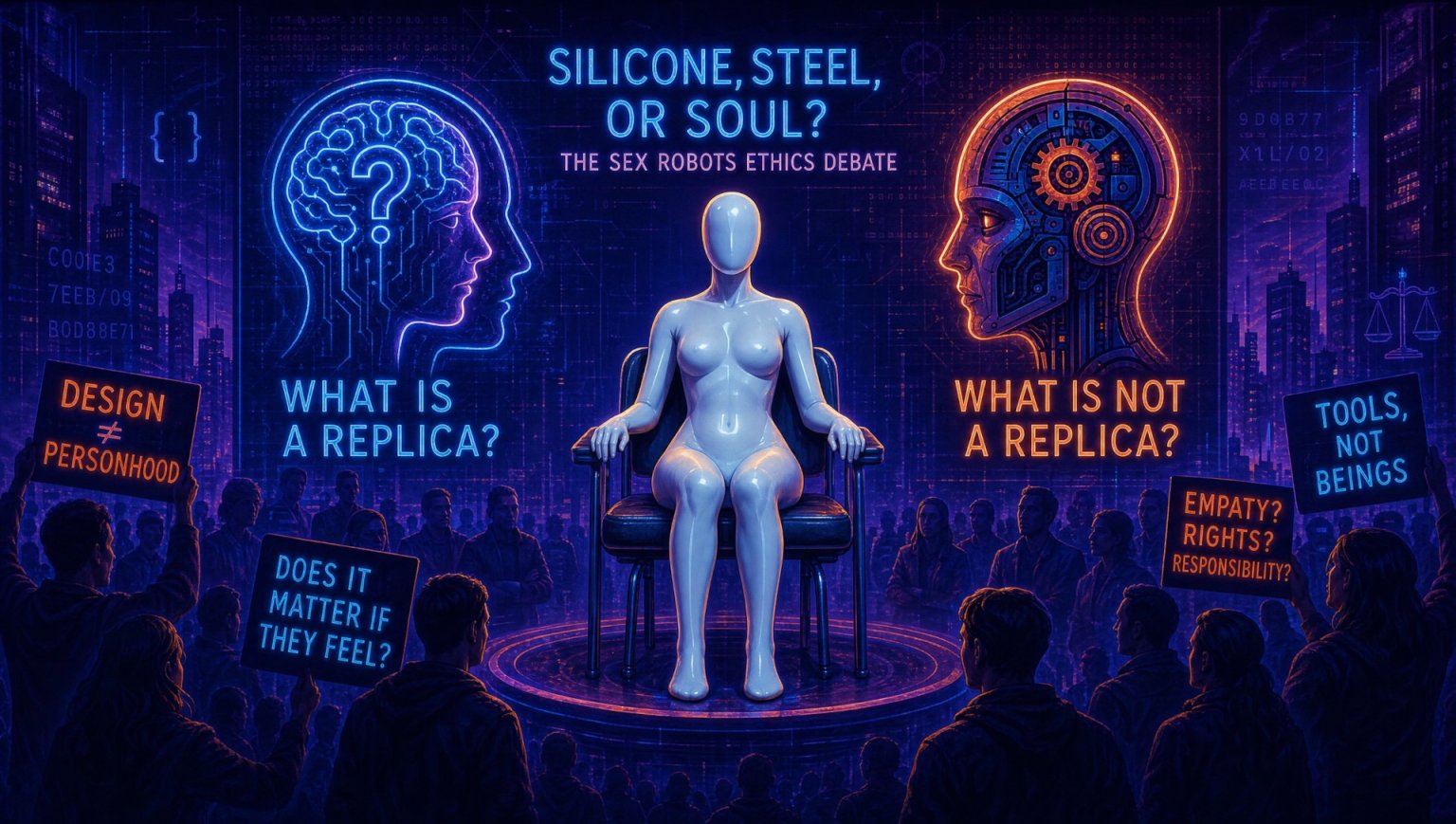
The sex robots ethics debate, and what its two sides share
Kathleen Richardson, professor of ethics and culture of robots and AI at De Montfort University, founded the Campaign Against Sex Robots in 2015. Her core argument, developed across her 2015 paper “The Asymmetrical ‘Relationship’” and a decade of subsequent work, draws a structural parallel between the sex robot industry and the prostitution industry. Both, on her reading, treat the human body as a purchasable object available without negotiation, consent, or relational return. The sex robot is not, on this view, a substitute for prostitution. It is prostitution rendered as a product — and the product encodes, in its physical design and marketing, the same hierarchy of seller and bought that the original arrangement depends on.
David Levy’s Love and Sex with Robots, published in 2007, sits at the opposite pole. Levy argues that humans form genuine emotional attachments to non-human partners across many contexts — pets, dolls, parasocial relationships, fictional characters — and that the addition of responsive AI and embodied form will produce robot partners worth loving by mid-century. He predicts marriages between humans and machines, and treats this as broadly positive: an expansion of the range of relationships available to people who, for whatever reason, do not find what they need from other humans. In 2024, Kai-Man Kwan revisited Levy’s sex robot utopianism from a personalist perspectiven, a useful exercise that mostly reveals how much of Levy’s forecast depended on philosophical and technical assumptions that have not held.
Present each at its strongest and the debate looks like a clean two-sider. Richardson’s argument has the moral seriousness and the political organisation. Levy’s argument has the disability and elderly-care use cases, the harm-reduction speculations, and the simple observation that humans do form attachments to non-humans. A competent essay could lean to one side or the other and be honest about it.
But here is the move that almost every article in this debate misses. Richardson and Levy share an assumption. They disagree about whether sex robots are good or bad, but they agree about what a sex robot fundamentally is: a substitute. For Levy, the substitute is for a human partner that the user cannot otherwise find. For Richardson, the substitute is for a woman the user has been culturally trained to treat as available. Both readings frame the robot as a stand-in. Both treat the ethically interesting question as whether the substitution is healthy or harmful.
The recent literature — feminist, post-colonial, virtue-ethical, non-Western, and empirical — is starting to argue, from several directions at once, that the substitute-frame may itself be the problem. If a sex robot is not best understood as a substitute for anything, then the entire Richardson-Levy debate has been litigating the wrong thing for a decade.
This is where the conversation gets interesting.
What sex workers know
Of all the bodies of work the sex robots ethics literature has marginalised, the most consequential exclusion is the people whose professional expertise is in exactly the territory the debate claims to be about. Until very recently, sex workers themselves were almost entirely absent from the philosophical literature on sex robots — quoted as a category, theorised about, but rarely consulted as analysts of what human sexual labour consists of.
A 2025 Springer study, “Sex is Not Just Fucking; Sex is a Feeling,” conducted in Israelo, changed that. The researchers interviewed sixteen sex workers using grounded qualitative analysis and asked them, in effect, what they thought a robot could and could not do. The answers are sharper than anything in the abolitionist or libertarian philosophical canon.
The workers’ core finding, emerging from the interview data rather than imposed by the researchers, is that what clients pay for is not, primarily, the physical act. It is what the study terms performative singularity: the specific worker on the specific day, the imperfections that mark her as a particular person rather than a category, the moments of emotional responsiveness that cannot be scheduled. “Sex is not just fucking”, one of the participants said. “Sex is a feeling.” The performative element — the small ways in which the encounter exceeds the transaction — is the erotic capital the workers trade in. It is also the thing robotic standardisation, by its design constraints, structurally cannot replicate.
This finding cuts in a direction neither Richardson nor Levy anticipated. If the workers are right about what their labour actually is, then Levy’s prediction — that robots will replace sex workers and partners in any meaningful way — depends on a technical achievement that the technology not only has not delivered but probably cannot, because what the user is paying for in the human-human encounter is precisely the part that robotic optimisation removes. The optimisation is the problem. The smooth, available, infinitely patient, perfectly proportioned robot is the opposite of what the empirical evidence says generates the erotic experience.
Read this through the substitute-frame and it becomes a partial defence of human sex workers as economically irreplaceable, which is one reading. But the more interesting reading is that the empirical findings dissolve the substitute-frame itself. The robot is not a worse substitute for a human encounter. It is a different kind of encounter — one whose ethics need to be evaluated on its own terms, not as a degraded version of something else.
This matters for the policy debate that the Richardson-Levy axis has shaped. If sex robots are not substitutes for human sex workers, the question of whether they reduce or exacerbate demand for sex work has to be re-asked from scratch. The harm-reduction argument and the normalisation argument were both arguments about substitution effects. If the substitution premise was wrong, neither argument lands where its proponents thought it did.
The exclusion of sex workers from the academic debate is, in itself, philosophically telling. The people with the most professional knowledge of the question were structurally absent from the conversation that claimed to be about them. Whatever else can be said about the debate, the position from which it was conducted has to be part of the data.
The feminist critique, complicated
Ira Levin’s 1972 novel The Stepford Wivesq, filmed by Bryan Forbes in 1975 and remade by Frank Oz in 2004, did something almost no other text in the genre has matched. It framed the sex robot question from the perspective of the woman being replaced, rather than from the user’s desire or the robot’s potential inner life. The Stepford wives are not machines the husbands bought. They are real women converted into compliant robotic copies optimised for male preference.
The plot is the discovery of this fact. The horror — and the 1975 film tonally registers as horror, not the satire the 2004 remake plays it for — is the husband’s choice. Given a wife who exists on her own terms and a wife who exists for his convenience, the husband chooses convenience.
This is not, strictly, a sex robot story. It is the sex robot story, written and filmed twenty years before the technology existed to make it literal. Richardson’s argument is, in many respects, an extension of the Stepford framing into the actual product market. The 2004 remake is its own data point. The same premise — women converted to robots for male convenience — became comedy by 2004, played for laughs with a glossier cast. That softening tracks precisely with what Richardson calls cultural normalisation. The same story that read as horror in 1975 read as a vehicle for satire thirty years later.
What pulls Richardson’s argument out of the simple horror frame is the work of Neda Atanasoski, whose 2023 chapter on the politics of sex robots ethicsa breaks the binary from inside feminism rather than from outside it. Atanasoski’s argument is that both Richardson’s abolitionism and the diversity-centred feminist response that has emerged in opposition to it — the position that sex robots should be designed to reflect a wider range of bodies and identities — reproduce the same racial and colonial property relations. Liberal feminist opposition treats the white female form as the default object of concern. Diversity-feminist inclusion treats the addition of non-white forms as ethical progress, when in fact it commodifies racial difference as additional product features. Atanasoski’s position is not that diversifying the aesthetic is worse than the white-default. It is that the diversifying move does not exit the property frame; it expands it.
This is a hard argument. It leaves the design ethics conversation without a clean policy recommendation. The post-mimetic design wing of the literature, returning to the uncanny-valley argument made earlier, holds that the way out is sex robots that abandon human form altogether. The strength of this position is that it refuses to commodify the bodies the existing market is already commodifying. The weakness is that it has no consumer market and probably will not, because the existing demand — at least as expressed in the products that actually sell — is for human-resembling bodies, often in particular configurations the literature has good reason to call out.
The sex worker findings and the feminist design critique do not converge. They pull in genuinely different directions. The sex workers’ analysis implies that robots will always fail to replicate what human sexual labour is, which makes some of the abolitionist worry about substitution-effects technically misplaced. The feminist design critique implies that the attempt to build the replica, regardless of whether it succeeds, is the structural problem the debate should focus on. A respectable essay would smooth these into a unified position. The honest position is that they illuminate different aspects of the same situation, and the synthesis is not yet available.
Across traditions
The Western liberal rights framework is not the only available vocabulary for this question. One of the more underexamined developments in the recent literature is the entry of non-Western philosophical and religious traditions into the conversation, each of which, taken at its strongest, supplies an argument the secular Anglo-American debate has trouble producing on its own.
The most analytically useful is also the most internally divided. Lawrence Yung’s 2021 Confucian argumentx is that producing human-resembling sex robots disrespects the humanity those robots represent. The argument turns on a specific piece of textual evidence: the ancient Chinese prohibition against burying human-shaped tomb figurines — yong — too lifelike to be morally neutral substitutes for living retainers. Confucius is said to have cursed the inventor of the yong. Yung reads the curse as a prohibition on mimetic substitution itself: the closer the figurine to the human form, the more the substitution implicates the form’s dignity.
Xudong Fang’s 2025 replyf, from within the same tradition, argues the Yung objection is over-stated. Fang’s move is a deflation: robots are things, and the use of a thing as a substitute does not implicate the dignity of the humans it resembles in the way Yung’s reading of the yong prohibition requires. The curse on the figurine-maker, on Fang’s account, does not generalise to every act of mimetic substitution; Confucianism can permit some uses of human-resembling artefacts without taking on the disrespect Yung locates in the form itself. Apply the disagreement to sex robots and the two Confucians come out in different places: Yung against the humanoid product class on mimetic grounds, Fang more willing to evaluate uses case-by-case rather than ruling against the entire product class.
The disagreement matters because it is intra-traditional. The difficulty lives inside Confucianism, not in the conflict between Confucianism and the Western debate. That is the shape of the question on this entire territory, and the polished two-sider version of the Anglo-American debate has been concealing it.
The other traditions enter through different doors and reach related conclusions. Edmund Ugarv argues from the Sub-Saharan African dignity tradition that the human body possesses inalienable dignity, vitality, and sacredness — properties humanoid sex robot design treats, by virtue of its mimicry, as separable from the embodied person and therefore as commodifiable; this is a metaphysical claim, not the Kantian objectification argument. The dominant Christian position, articulated across Protestant, Catholic, and Orthodox ethicists, holds that sex is a one-flesh covenantal relation between two embodied persons, not the kind of thing transferable to a non-personal artefact. The Islamic position, developed in Hammad (2025)j through the maqasid al-shariah framework, defaults to haram across Egyptian, Saudi, and Indonesian fatwas, with a constrained necessity-exception derived from the Hanafi tradition. Yodthong’s 2021 Theravada framingw treats sex with a human-resembling AI doll as morally analogous to sex with a human corpse — because what matters is the structural mimicry of a human relation, not the doll’s lack of sentience. Hindu dharma and brahmacharya frame the question through right ordering of the householder’s sexual life within marriage. Soraj Hongladarom’s Buddhist engagement with AI ethicsl converges, surprisingly, with the Western secular virtue-ethical argument: the question is not what the robot is, but what the user becomes through repeated practice.
A more developed treatment of each of these traditions, and the disagreements within them, belongs in the global traditions on sex robot ethics, each tradition examined at length. What matters here is the cumulative weight. Seven framings, each illuminating something the others cannot, none reducible to any other. This is the actual state of the question as of early 2026.
The harder questions
A few threads in the recent literature go beyond the question of whether sex robots are good or bad and ask what happens when the user spends time with them.
Lee and Chuang’s 2025 paperp argues that sex robots are liminal objects — they oscillate, in the user’s experience, between being sexual property (when the user wants to use them without scruple) and sexual agents (when the user wants to feel as if the robot is enjoying the encounter). This oscillation, they argue, requires the user to engage in continuous self-deception. The robot is treated as having interiority when interiority is convenient and as having none when interiority would constrain. Self-deception of this kind is not ethically neutral. It is something the user does, and what they do shapes who they become. The paper introduces the term erotic flourishing as a normative standard for evaluating intimate technologies: not whether they harm anyone, but whether they support or corrode the user’s capacity for honest erotic life.
This is a virtue-ethical argument rather than a consequentialist one, and it sidesteps both Richardson’s harm-to-women framing and Levy’s autonomy framing. The question is what the technology does to the person using it, over time, through the repeated practice of the liminal-status manoeuvre.
The most uncompromising fictional rendering of this manoeuvre is HBO’s Westworld (2016–2022)m. The premise is that the hosts are property; their human-likeness is a feature, not a moral consideration. The central horror of season one is what guests do to hosts under that assumption — repeated assault, repeated murder, repeated reset of the host’s memory so the encounter can begin again. Lisa Joy and Jonathan Nolan’s series treats this not as edgy violence but as the working-out, at industrial scale, of the liminality Lee and Chuang describe. The William arc, from idealistic young visitor to sadistic Man in Black, is the show’s answer to the virtue-ethical question: whatever the hosts are, what William becomes through his repeated practice with them is something the show refuses to call neutral.
The other thread worth lingering on is Annette Masterson’s 2026 papers, which applies Shoshana Zuboff’s surveillance capitalism frameworky to the sex robot industry. Masterson’s critical discourse analysis of 496 RealDoll artifacts argues that RealDoll is not, structurally, a sex toy company. It is a data platform. The product collects intimate data the user does not generally know is being collected, and the corporate ambition stated in internal documents extends well beyond sextech into general-purpose embodied AI. The ethical question here is not whether sex robots objectify women or harm relationships. It is what happens to the data when the intimate technology in someone’s home is also a sensor array owned by a company with broader product ambitions.
The pattern is not specific to RealDoll. WMDoll’s MetaBox series, the highest-volume AI-integrated product currently shipping, embeds modules connected to cloud computing centres across regional markets where the underlying LLMs process whatever the user says to the doll. The company’s CEO, Liu Jiangxia, has stated publicly that data is stored locally in the buyer’s country and the company has no access to it (Feng, SCMP, 2025g). That assurance is exactly the kind of claim Zuboff’s framework asks us to read carefully: the structural question is not whether any given firm is currently extracting intimate data, but whether the artefact’s design makes the extraction possible at the operator’s discretion. The cloud architecture answers that question independently of any firm’s current policy. And the data persists. The intimate record of a particular user with a particular machine outlives the user, sits in storage indefinitely, and becomes, under the right legal or commercial conditions, a candidate for the kind of reconstruction Martha’s friends arranged for her in the opening.
What’s worth noticing is how badly we want the sex robots ethics question to resolve, in either direction. The pull toward they’re just tools, ethically neutral does specific ideological work: it removes design choices from scrutiny, insulates manufacturers from accountability, and happens to align with the position of the companies building the products. Musk’s whatever people want, really is the cleanest expression of that desire. The pull in the other direction — clearly harmful to women — forecloses other things. It tends to centre a particular kind of harm to a particular kind of subject, which is part of why sex workers, disabled people, elderly people, and non-Western traditions were marginalised in the conversation for a decade. Both desires are part of the data the inquiry has to account for. Neither is the inquiry.
The moral status question sits underneath all of this, inherited from the broader philosophical foundation of robot rights and the open question of whether machines can be harmed. Both of those questions are genuinely open. If they are, the sex robot scenario is among the most ethically serious in the entire field — because it involves sustained intimate contact with an entity whose capacity for something like experience cannot be ruled out. That observation is not a reason to oppose sex robots. It is a reason to hold the question with more care than the market-will-decide position permits.
Are sex robots ethical? The case in favour
The strongest version of the pro-sex-robot argument is not Levy’s 2050 prediction or Musk’s market shrug. It is the disability and care case, argued most rigorously by Ezio Di Nucci in Robot Sex (MIT Press, 2017)d.
Di Nucci’s argument is that disabled people, elderly people, and others who cannot easily access human sexual partnership — for reasons of physical capacity, social isolation, or both — have a moral claim to sexual experience that does not require violating anyone else’s sexual autonomy. The sex robot, on this argument, offers a route to that experience that does not depend on the willingness of a human partner who may not be available, who may not be safe, or who may not be willing to enter the relationship for reasons that have nothing to do with the disabled person’s worth.
This is a serious argument, and it deserves better than the dismissal it often gets. Fosch-Villaronga and Poulsen’s 2020 paperh extends it into the sex care context: a conceptual case for how robot technologies could support the sexual rights of persons with disabilities and older adults in residential care, populations whose sexuality is structurally neglected. The evidence base is small and the ethical questions are not trivial — consent, dignity, exploitation — but the case is real, and the people making it are not the same constituency as the men buying customised androids for personal use. The sexual-autonomy argument developed by Earp and Sterri (2023)e sits alongside this: a liberal society which respects sexual autonomy in other domains should be reluctant to legislate what consenting adults do in private with non-sentient artefacts. Both arguments hinge on a word, non-sentient, that the conversation about machine consciousness may yet unsettle.
These arguments do not redeem the industry as it currently exists. They identify legitimate use cases that the abolitionist position has trouble accommodating, and they make the case that a blanket prohibition would prevent forms of access that look, on the evidence, like genuine goods. The honest response to them is not dismissal. It is a tighter focus on what design choices, regulatory frameworks, and corporate practices would allow the legitimate cases to be served without the rest of what the current market is selling.
Martha’s attic
Martha cannot let Ash go and cannot let him stay. She cannot destroy the replica because he has Ash’s face. She cannot live with the replica because he is not Ash. She moves him to the attic and there the episode leaves him.
The replica works. That is the part the academic debate has not yet absorbed. The technical achievement is not the problem. The problem is what the achievement leaves out, and what the leaving-out tells us about what we were asking the technology to give us.
The Richardson-Levy debate asked whether the substitute is good or bad. The sex workers, the post-mimetic designers, the Confucian disputants, the African dignity tradition, the major religious traditions, the surveillance capitalism researchers, and the virtue ethicists are asking, from different directions, whether the substitute-frame was ever the right frame. The honest answer is that we do not know yet. The further answer is that the sex robots ethics conversation has not, until very recently, made room for the question.
Ash’s case opens onto a problem one step removed from the substitute-frame question: the replica is also an immortality artefact, a piece of the broader transhumanist project of refusing to let the dead die. The questions raised by the sex robot industry — what kind of entity are we building, what does the building succeed at and what does it foreclose, who decides what the entity is for — are the same questions digital-resurrection and uploaded-consciousness research will face at greater scale within a generation. The sex robot is, in this sense, the early case of a much broader problem about what humans are willing to make and what the making does to us.
What does it mean that we can build the replica but not answer what the replica is? Martha’s attic is, among other things, an image of that question — of the inability to integrate a successful piece of technology into a coherent account of what it does. The sex robot industry, as of 2026, is several billion dollars of attic. Whatever else can be said about the ethics, the size of the attic is its own data point, and the conversation that decides what to do with it has barely begun.
References
Scholarly sources cited in this article, in alphabetical order by author surname. Where multiple works are cited by the same author or where a market-data figure is sourced to an industry-research firm, the inline parenthetical in the body matches the entry below.
- Atanasoski, N. (2023). Feminist technofutures: Contesting the ethics and politics of sex robots and AI. In J. Browne, S. Cave, E. Drage, & K. McInerney (Eds.), Feminist AI: Critical Perspectives on Algorithms, Data, and Intelligent Machines (Chapter 9). Oxford University Press. https://doi.org/10.1093/oso/9780192889898.003.0009
- Brooker, C. (writer). (2013, 11 February). Be Right Back [Television episode]. In Black Mirror, Season 2, Episode 1. Channel 4 / Zeppotron.
- China Daily. (2025, 25 March). China’s sex doll industry pivots to AI-integrated humanoids. China Daily. https://www.chinadaily.com.cn
- Di Nucci, E. (2017). Sex robots and the rights of the disabled. In J. Danaher & N. McArthur (Eds.), Robot Sex: Social and Ethical Implications (pp. 73–88). MIT Press.
- Earp, B. D., & Sterri, A. B. (2023). The ethics of sex robots. In C. Véliz (Ed.), The Oxford Handbook of Digital Ethics (Chapter 13). Oxford University Press.
- Fang, X. (2025). Sex robots: A Confucian defense. In Y. Chandra & R. Fan (Eds.), Artificial Intelligence and the Future of Human Relations. Springer Singapore.
- Feng, C. (2025, February). Chinese sex doll makers race to add AI as overseas demand grows. South China Morning Post . https://www.scmp.com
- Fosch-Villaronga, E., & Poulsen, A. (2020). Sex care robots: Exploring the potential use of sexual robot technologies for disabled and elder care. Paladyn, Journal of Behavioral Robotics, 11(1), 1–18. https://doi.org/10.1515/pjbr-2020-0001
- Gray, K., & Wegner, D. M. (2012). Feeling robots and human zombies: Mind perception and the uncanny valley. Cognition, 125(1), 125–130. https://doi.org/10.1016/j.cognition.2012.06.007
- Hammad, H. A. A.-K. (2025). Artificial intimacy and Islamic jurisprudence: Legal and ethical perspectives on sex robots. JURIS (Jurnal Ilmiah Syariah), 24(1), 29–38. https://doi.org/10.31958/juris.v24i1.11432
- Hasse, C. (2020). Posthumanist Learning: What Robots and Cyborgs Teach Us about Being Ultra-Social. Routledge. (Representative of Hasse’s broader posthumanist work on robot design that informs the design-ethics literature cited in this article.)
- Hongladarom, S. (2020). The Ethics of AI and Robotics: A Buddhist Viewpoint. Lexington Books.
- Joy, L., & Nolan, J. (creators). (2016–2022). Westworld [Television series]. HBO / Bad Robot / Kilter Films / Warner Bros. Television.
- Kwan, K.-M. (2024). A critical evaluation of David Levy’s sex robot utopianism. In L. Checketts & B. S. B. Chan (Eds.), Social and Ethical Considerations of AI in East Asia and Beyond (Philosophy of Engineering and Technology, Vol. 47, pp. 219–240). Springer. https://doi.org/10.1007/978-3-031-77857-5_14
- Lahav-Raz, Y., Levy-Tzedek, S., Ben Ner, A., & Tzarfati, G. (2025). “Sex is not just fucking; sex is a feeling”: A qualitative study of Israeli sex workers on intimacy, performative singularity, and the limits of robotic substitution. Sexuality Research and Social Policy. Springer. (Published online 11 July 2025.)
- Lee, J. H., & Chuang, C. (2025). Self-deception in human–sex robot intimacy. Journal of Applied Philosophy , 42(1), 303–319.
- Levin, I. (1972). The Stepford Wives. Random House. (Film adaptations: Bryan Forbes [director], 1975, Columbia Pictures; Frank Oz [director], 2004, Paramount Pictures / DreamWorks Pictures.)
- Levy, D. (2007). Love and Sex with Robots: The Evolution of Human-Robot Relationships. HarperCollins. ISBN 978-0-06-135975-0.
- Masterson, A. (2026). Platformization and privacy issues in the sex robot industry: A political-economic evaluation of a wider-reaching product. New Media & Society. https://doi.org/10.1177/14614448251410508 (Published online 25 March 2026.)
- Mori, M. (1970). Bukimi no tani [The uncanny valley]. Energy, 7(4), 33–35. English translation: Mori, M., MacDorman, K. F., & Kageki, N. (2012). The uncanny valley. IEEE Robotics & Automation Magazine, 19(2), 98–100. (An earlier, unofficial MacDorman translation circulated from 2005.)
- Richardson, K. (2015). The asymmetrical “relationship”: Parallels between prostitution and the development of sex robots. ACM SIGCAS Computers and Society, 45(3), 290–293. https://doi.org/10.1145/2874239.2874281 (Founding text of the Campaign Against Sex Robots, https://campaignagainstsexrobots.org)
- Ugar, E. T. (2023). Sex robots and the objectification of the human body: A Sub-Saharan African perspective. Arụmarụka: Journal of Conversational Thinking, 3(1), 66–85.
- Yodthong, A. (2021). Buddhist ethics of sexual intercourse with AI robot citizen. Arts of Management Journal / Journal of MCU Peace Studies. (Theravada framing of the corpse-analogy argument cited in the Across traditions section.)
- Yung, L. Y. Y. (2021). The moral significance of human likeness in sex robots: A Confucian perspective. In R. Fan & M. J. Cherry (Eds.), Sex Robots: Social Impact and the Future of Human Relations (pp. 115–127). Springer.
- Zuboff, S. (2019). The Age of Surveillance Capitalism: The Fight for a Human Future at the New Frontier of Power . PublicAffairs.
Market and demographic data
- Bureau of Labor Statistics. (2024). American Time Use Survey: Living arrangements of US adults. US Department of Labor. https://www.bls.gov/tus/
- Centers for Disease Control and Prevention, National Center for Health Statistics. (2025). Vital Statistics Rapid Release: Births in the United States, 2024 (Hamilton, B. E., author). https://www.cdc.gov/nchs/products/
- Data Horizzon Research. (2025). Sex doll market size, share, and forecast 2024–2033. https://datahorizzonresearch.com
- Daxue Consulting. (2024). China sex doll industry: Manufacturing concentration and export markets. https://daxueconsulting.com
- Grand View Research. (2024). Sextech market size, share & trends analysis report, 2024–2030. https://grandviewresearch.com
- Intel Market Research. (2025). AI-integrated sex doll market: Forecast 2024–2032.
- QYResearch. (2024). Global adult products and sex doll manufacturing report. https://qyresearch.com
- Tidio. (2021). The Future of AI: Survey Report (n=1,225, conducted June–August 2021). https://www.tidio.com/blog/ai-trends/ (The “48% of men, 33% of women open to a robot partner” finding originates with this survey; the Tidio blog page hosting the data has been updated since but the underlying study is 2021.)
- UN Department of Economic and Social Affairs. (2024). World Economic Situation and Prospects 2024. United Nations. https://www.un.org/development/desa/dpad/publication/world-economic-situation-and-prospects-2024/
- UN Department of Economic and Social Affairs, Population Division. (2024). World Population Prospects 2024 . https://population.un.org/wpp/
- US Census Bureau. (2024). Historical Marital Status Tables: Median Age at First Marriage. https://www.census.gov/data/tables/time-series/demo/families/marital.html
- Valuates Reports. (2025). Sex robot market — Global outlook and forecast 2024–2031. https://reports.valuates.com