
Roughly 99.9% of all species that have ever lived are extinct. The figure is rough, the geological timescales blurry, but the order of magnitude has held up across paleontology and astrobiology for decades. Transhumanists and their critics both reach for it. They reach for it to opposite conclusions.
For Dan Faggella, founder of the AI research firm Emerj and one of the more articulate voices for what he calls axiological cosmism, the statistic says the human torch was always going to go out — and that the only question worth asking now is what kind of flame carries the value forward after us.a Pope Leo XIV, in Magnifica Humanitas, his landmark encyclical on artificial intelligence signed on May 15, 2026, reaches for the same fact to argue the opposite. The transience of biological existence is precisely what makes the dignity of the human person non-negotiable. Not something to be engineered past. The fragility is the point.b
One statistic. Two civilisations’ worth of conclusion separating the two readings.
That gap is the territory of transhumanism ethics. And before tracing how anyone arrives at one conclusion or the other, Gattaca (1997, dir. Andrew Niccol) is worth thirty seconds of attention.c Vincent Freeman is born into a society that has already decided which way to go. No genetic optimisation at conception — a “natural” in the kinder vocabulary, an “Invalid” in the institutional one. His genome reads to a future employer the way a criminal record reads to a current one. The baseline human has been declared insufficient.
What the film never asks, and what the debate has mostly skipped past, is whether anyone actually knew what the baseline was before deciding it needed improvement.
That is the question worth sitting with before the argument begins.
What the transhumanism ethics debate actually argues about
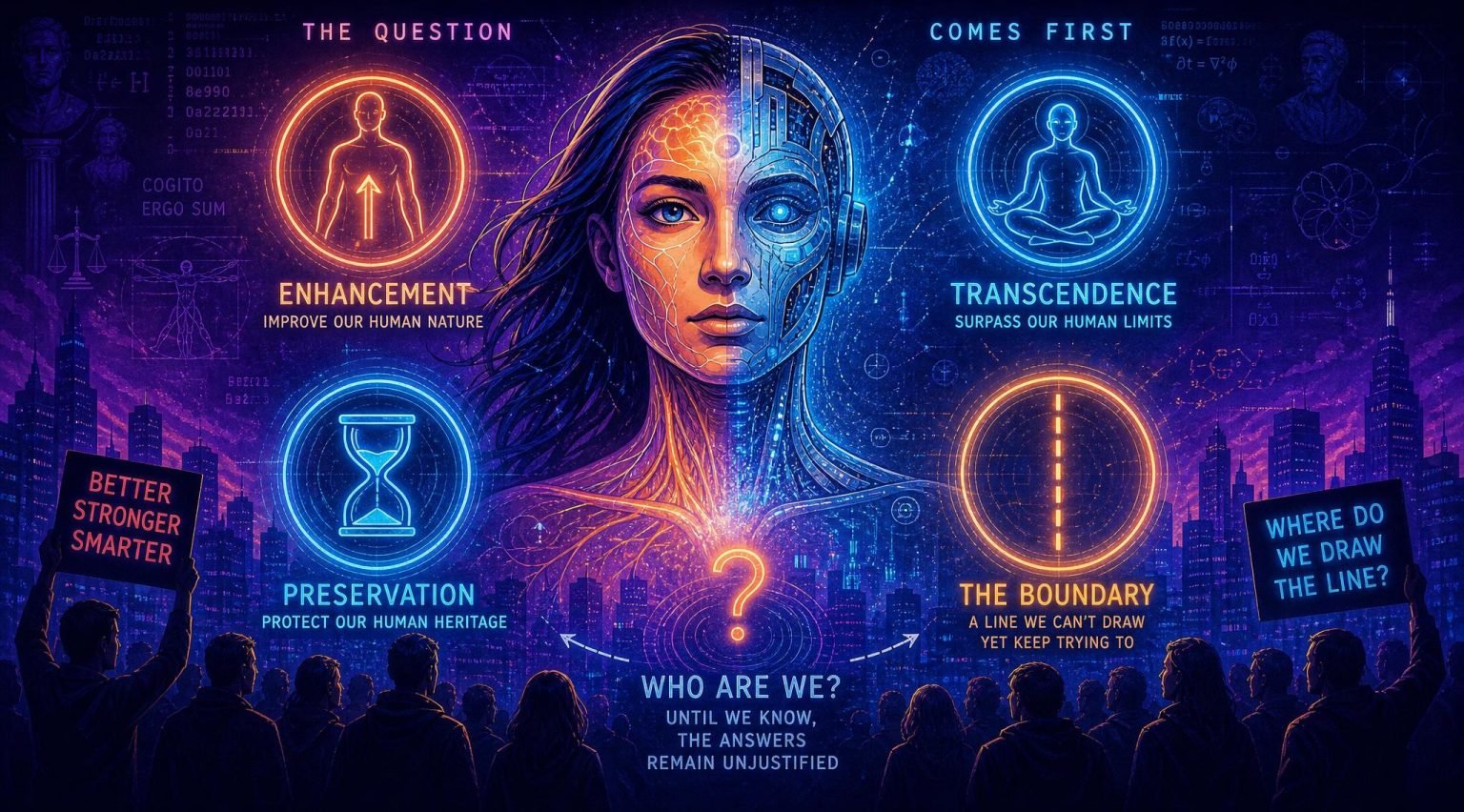
Transhumanism, broadly, is the view that human beings can and should use technology to expand cognitive, physical, and emotional capacities — extending lifespan, expanding intelligence, eventually transcending whatever biological limits have defined the species so far. So far, so anodyne. Inside that broad definition, transhumanism ethics runs on a disagreement about which of two very different projects deserves the label.
Enhancement transhumanism keeps the human being as the reference point. The human gets richer senses, longer life, expanded cognition, perhaps an eventual merger with the AI systems they design. But the human remains the measure of all things — improved, augmented, upgraded, still recognisable in the mirror. Kurzweil’s 2024 book The Singularity Is Nearer is this position at its most confident. Exponential gains in compute and bandwidth, the argument runs, will let us cross the threshold from biology into something else without losing the thread of who we are.d The optimist’s version.
Successor transhumanism — cosmism, in Faggella’s framing — drops that assumption entirely. Humanity is not the final locus of value but a temporary conduit within a larger value-generating process. The torch is always temporary; only the flame matters. What gets carried forward might be biological, might be silicon, might be something we don’t yet have words for. The point is that being human, in the current sense, was never the destination.a
Leo XIV’s encyclical happens to provide the clearest taxonomy of these two camps available in a single document right now. Transhumanism, he writes, “envisions the enhancement of human beings through technologies — such as biomedicine, body engineering, devices and algorithms — with the aim of increasing performance and capabilities.” Posthumanism, “especially in its more radical forms, goes further: it challenges anthropocentrism and envisions a hybridization of human beings, machines, and the environment, even anticipating a threshold where humanity surpasses itself in a new evolutionary stage” (§116).b
It’s worth noticing that this taxonomy is useful even for readers who reject Leo XIV’s theology entirely. He is mapping the terrain, not just defending one corner of it.
There is also a third position in the conversation worth naming, because most public discussion treats it as an afterthought when it is actually the most coherent of the three. The defender, represented most powerfully at present by Leo XIV himself, holds that the human person — as imago Dei, in his framing — is the non-negotiable anchor of moral consideration. Any technology that treats humanity as a problem to be solved rather than a person to be respected has already gone wrong. He is not a transhumanist of either stripe. He is the most serious critic the debate has.
One distinction worth locking in before going further. In Bostrom’s usage, a transhuman is a person in transition — still within recognisable human parameters but being modified toward something beyond them, an evolutionary link toward posthumanity.e A posthuman is what comes after: an entity with at least one general central capacity (Bostrom names healthspan, cognition, and emotion) so far beyond any current human maximum that no current human could be its meaningful peer.f Transhuman: the bridge. Posthuman: what’s on the other side.
Are transhumanists playing God?
The most common objection to the whole enterprise is also the most misrepresented. “Playing God” tends to get dismissed by transhumanists as the same reactionary squeamishness that opposed anaesthesia and organ transplants. That dismissal is too fast. The serious version of the critique is not theological, and it is the part of transhumanism ethics most often waved away without a hearing. It comes from three secular political philosophers who arrive at the same concern from different starting points.
Francis Fukuyama gave the worry its sharpest political-theory form. In a 2004 Foreign Policy article, he named transhumanism “the world’s most dangerous idea” — not because technology was the problem, but because the liberal democratic order depends on a shared conception of human nature, and genetic enhancement would erode it.g Remove the biological floor beneath human equality, and the entire architecture of rights that has been built on top of it starts to shift. That is not a slippery slope. It is the wall the whole structure leans on.
Michael Sandel’s The Case Against Perfection (2007) makes a different and, to my mind, more interesting argument.h The drive to design and optimise — children, athletes, cognition — reflects what he calls a Promethean aspiration to mastery, and the cost of that mastery is something most parents would not knowingly trade for it. Drawing on the theologian William F. May, he calls it the “openness to the unbidden”: the capacity to receive what life gives rather than only choose what it delivers. Enhancement forecloses that openness. Not by accident. By design.
Habermas, in The Future of Human Nature (2003), makes the third version of the case from the angle of autonomy.i A child who has been genetically shaped by her parents’ choices exists in a different relationship to her own freedom than one who was not. The designed life is, in some sense, already lived before it begins. You inherit not just your genes but the intentions that selected them.
Leo XIV makes the sharpest version of the eugenics worry that runs underneath all three of these critiques: “If the human being is treated as something to be perfected or surpassed, it becomes easier to accept that some lives are less useful, less desirable or less worthy. In the name of progress, ‘necessary sacrifices’ may begin to be justified, placing the burden on the most vulnerable in pursuit of a supposed optimization of the species” (§117).b This is not a distant theoretical risk. It is the logic Gattaca dramatises in every scene. It is the logic that gave eugenics its twentieth-century institutional force.
The bioconservative case has its own weak points, and intellectual honesty requires naming them. Fukuyama tends to naturalise the current human form in ways that don’t fully survive scrutiny — the “biological floor” he wants to protect has never been fixed, since the human form has been in continuous evolutionary motion for as long as there has been a human form to speak of. Sandel’s openness to the unbidden can be read, uncharitably, as an argument for accepting all kinds of suffering that technology could reasonably prevent. These are real objections to the objections.
But here is what the bioconservatives are right about, and what their opponents consistently underestimate. The moment you accept that the human can be optimised, you have also accepted that there is a standard of optimisation. Someone sets that standard. Whether it is a government, a corporation, a parent, or a market, they set it according to their own values, which may not be yours. The enhancement debate is not only a debate about technology. It is a debate about power.
Five voices, five blind spots
The conversation about all of this is currently dominated by five major thinkers, each correct within a domain, each operating as if their domain settles the question.
Ray Kurzweil has been more right than his critics like to admit. The law of accelerating returns — his observation that information-based technologies improve exponentially rather than linearly — has held up reasonably well as an empirical prediction across decades. Where it breaks down is at the moment of inference: from exponential gains in compute, his argument slides to the conclusion that simulating the neurons recreates the consciousness. That step is not a technological prediction. It is a philosophical assumption, and it is the one the entire transhumanist edifice rests on. In The Singularity Is Nearer he still treats it as a step in an argument rather than the premise that needs examining.d Forty years of work and the central claim remains a smuggled assumption.
Max Tegmark is the most structurally honest of the five, and probably the least confident, which is not coincidental. His Life 3.0 (2017) maps the possibility space rather than advocating for any particular outcome.j He sits between the camps in a way that is intellectually rare and probably difficult to sustain. Cosmists think he is too attached to the human; defenders think he is too open to its transcendence. His willingness to hold the tension without forcing a synthesis is closer to the intellectual posture this question deserves than anything the other four manage.
Faggella is right about something the enhancement camp tends to brush past: civilisational-scale decisions may require moral frameworks that extend beyond the human, and clinging to anthropocentrism when building superintelligent systems may be a category error — a confusion of the torch with the flame. The argument deserves engagement rather than dismissal as misanthropic. He is also, as he discloses on his own site, the founder and CEO of Emerj AI Research, a market research firm serving Fortune 500 clients on AI strategy. That is not a disqualification. It is context for evaluating his confidence level. Someone whose professional success rests on the proposition that posthuman intelligence is the central question of our time will have particular incentives toward that conclusion.a The point lands harder when you notice that almost everyone advocating loudly for any version of transhumanism has a similar incentive structure (corporate, academic, personal), and that the defenders mostly do not.
Leo XIV provides the most institutionally powerful defence of the human person currently in circulation, and Magnifica Humanitas is also the most precise taxonomy of the debate’s camps available anywhere. The encyclical is, however, almost entirely absent of serious engagement with Buddhist, Islamic, or Hindu philosophical frameworks on the same questions of consciousness, selfhood, and human potential. In a document running 235 pages and making civilisational claims about the human person, that absence is not incidental. The Western-Catholic framing is the framing the document works in, and that framing has been considerably less rigorous about human consciousness than several traditions that have been investigating it for millennia.
Anil Seth — neuroscientist, author of Being You (2021), and the voice behind a widely-watched 2026 TED talk on AI consciousness — offers what may be the single most useful distinction in the whole conversation: intelligence is about doing; consciousness is about being, about feeling.k These are not the same thing. The assumption that they travel together, that a sufficiently intelligent system will automatically have an inner life, is, in Seth’s words, a reflection of our psychology, not an insight into the nature of reality. The implication for transhumanism is direct. Upload fantasies, mind-transfer scenarios, the merger-with-AI visions all assume that what is worth preserving about a human mind can be captured, encoded, and transferred. That assumption requires consciousness to be a kind of information. And that is precisely what remains to be established — which is also why the question of what a superintelligence would actually be stays unstable: if the full range of human intelligence is uncharted, the comparison has no fixed point to measure from.
The pattern across all five is the same. Sincere, well-intentioned partial blindness operating at civilisational scale. Each one is right about the part of the question they have studied. Each one proceeds as though that part settles the rest. It is the structural weakness running through transhumanism ethics as the field is currently practised.
The prior question
Here is what all five of those positions share, and what their loudest disagreements have never quite forced into the open: they proceed as if ordinary human consciousness, as it currently operates in ordinary human life, is the known quantity. The enhancer upgrades what they assume they know. The cosmist leaves behind what they assume they know. The defender protects what they assume they know. All three treat the baseline as settled.
Seth’s distinction begins to crack this open. If intelligence and consciousness do not necessarily travel together — if a system can be brilliant without anything going on inside it — then the question of what human consciousness actually is is not settled by pointing at intelligence. So what does settle it?
That is where the debate has a hole at its centre, and nobody seems troubled by the hole. It is the hole transhumanism ethics has organised itself around without naming.
Kurzweil’s merger requires that we know what is worth merging. Faggella’s flame requires that we know what the torch was carrying. Leo XIV’s defence requires that we know what is being defended. All three require a prior account of human consciousness adequate to the task being asked of it. The part that should bother us more than it does is that we do not have that account. And the people building the programmes — genetic, cybernetic, digital, philosophical — have not noticed that they need one. The most concrete version is already arriving in the move to wire computation directly into the brain, where the question of who controls what happens inside a skull stops being theoretical.
Akira (1988, dir. Katsuhiro Otomo) is the pop culture object that captures this most viscerally, even if it is not usually read in this register.l Tetsuo Shima does not fail because the enhancement technology fails. The technology works. He fails — catastrophically, apocalyptically, on a scale that flattens Neo-Tokyo — because the programme that amplified his power had no account of the psychological and psychic material it was unleashing. The enhancement assumed the question it needed to answer.
That is probably too dramatic as a literal prediction. It is not too dramatic as a metaphor for what happens when you scale up a system whose internals you have not bothered to map.
What psychology found, and the transhumanism debate ignored
The transhumanism conversation has been carried almost entirely by technologists, philosophers, and theologians. A century of clinical and research psychology has been largely absent from it. That is not a small omission.
Viktor Frankl survived Auschwitz and three years across Nazi concentration camps. His conclusion — built from inside that experience rather than from any theorist’s armchair — was that the primary human drive is neither pleasure nor power but meaning.m The logotherapy he developed in Man’s Search for Meaning (1946) holds that humans can sustain extraordinary suffering when it is meaningful, and that the removal of suffering without the provision of meaning solves the wrong problem. Kurzweil’s vision is richer senses, longer life, expanded intelligence. Frankl’s empirical data point is that none of those things, present or absent, determines whether a human life feels worth living. The transhumanist programme optimises the substrate. Frankl asks what the substrate is for.
Bessel van der Kolk, in The Body Keeps the Score (2014), documents something the mind-upload thought experiment requires us to ignore.n The psyche is not separable from the body in the way digital transfer assumes. Trauma does not live only in memories or cognition; it lives in the nervous system, in tissue, in the body’s regulatory patterns.
The assumption underlying whole-brain emulation is that the relevant contents of a mind are the ones that can be encoded — that what matters about you is information-shaped. Van der Kolk’s clinical record, drawn from thirty years of treating trauma survivors, challenges this directly. Not as philosophy. As findings. The body is not the container for the mind. The body is part of the mind.
Then there is Jung’s shadow — the parts of the psyche that remain unconscious, unintegrated, unaddressed. Enhancement and transcendence proposals are entirely silent on what happens to the shadow when you augment or upload. Do you carry the unresolved material into the posthuman? Do you amplify it? The silence is not incidental. It reflects the same unexamined baseline: ordinary functioning consciousness as all there is, with the rest understood as either already integrated or unimportant.
Abraham Maslow, in his later work — particularly Toward a Psychology of Being (1962) — was mapping something he called Being cognition.o A mode of perception available in peak states, qualitatively different from ordinary cognition, not merely more of it. Transhumanist enhancement treats consciousness as a quantity to be increased. Maslow’s data, drawn from empirical study of peak experiences across hundreds of subjects, suggests consciousness has depths the dial-turning model cannot reach. You don’t arrive at Being cognition by turning up the volume on ordinary cognition. They are different registers. Different rooms in a house most people have only seen the entrance of.
William James was mapping this territory decades before any of them. The Varieties of Religious Experience (1902) remains the most serious empirical treatment of non-ordinary states of consciousness in Western psychology.p He was mapping mystical states, conversion experiences, altered perception — a range of human experience his contemporaries mostly dismissed and that contemporary transhumanists have not engaged with at all. A 120-year-old work of empirical psychology has not entered this debate. That fact alone is editorially significant. It suggests the debate has not been as empirically serious as it claims to be.
Add to all of this the more recent work — Stanislav Grof’s systematic mapping of non-ordinary states of consciousness, first set out in Realms of the Human Unconscious (1975) and later extended through holotropic breathwork;q the contemporary psilocybin studies of Roland Griffiths and colleagues at Johns Hopkins, where a majority of volunteers rated the experience among the most personally meaningful of their lives,r and the parallel neuroimaging work of Robin Carhart-Harris and David Nutt at Imperial College London mapping the brain’s transition into the psychedelic state.s This body of evidence documents states of human experience that are not mystical claims but documented phenomenological data. And the transhumanist frameworks cannot account for any of it, because the frameworks assume ordinary functioning consciousness covers the full range.
The argument here is not that everyone should meditate more. The argument is simpler and harder to deflect. Here is a substantial body of documented human experience that the transhumanism debate has not engaged. Its absence is a problem for the knowledge claim the debate depends on. You cannot credibly know what you are enhancing, transcending, or protecting if you have not bothered to look at the full range of what the thing you are discussing actually is.
What the contemplative traditions mapped — for millennia
If Western psychology is the smaller omission, the non-Western contemplative traditions are the larger one.
Buddhism presents the most structurally challenging response to the upload and mind-continuity assumptions, because it begins from a directly opposed premise. The Buddhist doctrine of anattā — non-self — holds that there is no fixed, continuous self to upload in the first place. What we call the self is a process: a stream of interdependent mental and physical events, not a discrete entity that could be transferred from one substrate to another. The upload question, is the upload still you?, has a Buddhist answer that neither the transhumanists nor their Western critics have fully reckoned with. The question may be malformed. There is no continuous you in the baseline case either.
This is not anti-technology. It is a claim about the nature of the problem. Buddhist contemplative traditions offer two and a half millennia of systematic phenomenological investigation of exactly the territory the transhumanism debate takes for granted. What they find is not what the debate assumes.
Islamic philosophy approaches the same question through two interlocking concepts: khalīfa (vicegerency — the human as God’s steward on earth) and insān al-kāmil (the Perfect Human). The concept of insān al-kāmil holds that human perfection is cognitive and conscious excellence, not physical augmentation — a spiritual dimension the enhancement framework, focused as it is on biological and computational substrate, systematically neglects.t The Islamic critique is precise. Islam prioritises moral and spiritual evolution over technological perfection. Not a rejection of technology, but a claim that the enhancement debate has identified the wrong variable as the relevant one.
Sri Aurobindo offers perhaps the most sophisticated Hindu engagement with the question of human evolution and consciousness development.u His framework is neither enhancement transhumanism nor successor transhumanism — and reading him alongside Kurzweil is genuinely disorienting, because the diagnosis runs in the opposite direction. Aurobindo sees human consciousness as currently operating below its potential, but not because the hardware is insufficient. What he calls the involution of consciousness into matter has produced a condition in which consciousness has not yet recovered its full range. The next stage of human development, in his framework, is not an upgrade of the existing system. It is the emergence of a fundamentally different mode of awareness — supramental consciousness — that sees and experiences reality in its integral wholeness. The transhumanist wants to improve the processing speed. Aurobindo’s framework suggests the operating system has barely been booted.
What is striking across all three traditions, given how different their starting points are, is the convergent observation. The baseline human consciousness that the transhumanism debate treats as the known quantity is, within these traditions, explicitly understood as operating well below its potential. The enhancement debate is arguing about what to do with the surface of a depth it has not measured.
If we get this wrong
The inequality question is the most politically legible version of what is at stake in transhumanism ethics, and it deserves a direct answer here even if its full treatment belongs in a focused piece elsewhere.
If enhancement technologies develop along the trajectory they appear to be following — expensive first, more accessible later, never quite free — the result is a long stretch of decades in which some people can afford cognitive, physical, or longevity enhancements and others cannot. Gattaca imagines this as a caste system written into genetics. The less dramatic but more plausible version is a labour market where enhanced individuals consistently outcompete unenhanced ones, and the pressure to enhance becomes effectively mandatory for participation in the economy. Not a government eugenics programme. A market one.
Fukuyama and Sandel both flag this, and Leo XIV’s §117 is the sharpest statement of the risk. But the inequality problem is compounded by the epistemological one. If the enhancement itself is miscalibrated — if we are upgrading a system whose full range we do not understand — then what gets amplified is not necessarily what was most worth amplifying. The haves and have-nots would not simply have an unequal distribution of human potential. They would have an unequal distribution of a particular, narrow conception of it, one built on assumptions that have not been examined.
This bears on a question already live elsewhere in the field: whether enhanced humans would deserve a different moral status from unenhanced ones — which runs straight into the debate over which entities deserve moral consideration. If enhancement changes what a human is, it changes the membership of the category we have been building our ethics around. And the technologies that would do the changing are not hypothetical. Parts of the transhumanist programme are already the present, not a future scenario.
The question transhumanism ethics hasn’t asked
There is a version of transhumanism ethics that would be honest about what it does not know. Tegmark’s Life 3.0 is the closest thing to it — a serious attempt to map the possibility space without assuming the answer.j It is also, significantly, the least confident of the major voices. The certainty travels in the opposite direction from the epistemic situation. The more someone knows about what is and isn’t established here, the less confident they tend to be about what should be done.
Kurzweil is confident. Faggella is confident. Leo XIV is confident. All three are working from accounts of human consciousness that are incomplete by any serious measure — incomplete by the standards of psychology, incomplete by the standards of the contemplative traditions, incomplete by the standards of the neuroscience Seth represents.
What would it look like to engage this question honestly? It would look like acknowledging that the entity being debated, with its consciousness and its depths and its uncharted territories, is not yet fully known. That the programmes of enhancement, transcendence, and preservation are all, in different ways, proposals about how to handle something whose nature has not been adequately established. That the prior question is not a stalling tactic but the question the debate has been conducting itself around without ever quite asking.
Buddhism has been investigating that question for twenty-five centuries. Psychology has been investigating it for one. Neuroscience is investigating it now, and finding, in Seth’s words, that the relationship between intelligence and consciousness is not the settled matter we assumed. None of these inquiries has produced a final answer. What they have collectively produced is a picture far richer, far stranger, and far less settled than the transhumanist programmes — on any of the three sides — have been quietly building on.
The 99.9% extinction figure that opened this asks what was worth carrying forward from all those forms that came before us. What, if anything, was the flame in the torch. That question has not been asked with anything like the seriousness it deserves. And the programmes proposing to answer it by action — by enhancement, by transcendence, by preservation — are running ahead of an understanding they have not yet built.
So perhaps the right move is not to ask, what should we do with the human?
Perhaps the move is to ask, what is the human, actually? — and to be willing to stay with the question long enough to find out.
References
- Faggella, D. (2026). “Moral Paradigm Shift – from Torch to Flame.” danfaggella.com, May 24, 2026. https://danfaggella.com/paradigm/
- Leo XIV. (2026). Magnifica Humanitas. Encyclical Letter on Safeguarding the Human Person in the Time of Artificial Intelligence. Signed May 15, 2026; released May 25, 2026. Vatican City: Holy See. https://www.vatican.va/content/leo-xiv/en/encyclicals/documents/20260515-magnifica-humanitas.html
- Niccol, A. (dir.). (1997). Gattaca. Columbia Pictures / Jersey Films.
- Kurzweil, R. (2024). The Singularity Is Nearer: When We Merge with AI. New York: Viking.
- Bostrom, N. (2005). “A History of Transhumanist Thought.” Journal of Evolution and Technology, 14(1), 1–25. https://nickbostrom.com/papers/history.pdf
- Bostrom, N. (2008). “Why I Want to be a Posthuman When I Grow Up.” In B. Gordijn & R. Chadwick (Eds.), Medical Enhancement and Posthumanity, pp. 107–137. Springer. https://nickbostrom.com/posthuman.pdf
- Fukuyama, F. (2004). “Transhumanism.” Foreign Policy, 144, 42–43.
- Sandel, M. J. (2007). The Case Against Perfection: Ethics in the Age of Genetic Engineering. Cambridge, MA: Belknap Press / Harvard University Press.
- Habermas, J. (2003). The Future of Human Nature. Cambridge: Polity Press.
- Tegmark, M. (2017). Life 3.0: Being Human in the Age of Artificial Intelligence. New York: Knopf.
- Seth, A. (2021). Being You: A New Science of Consciousness. London: Faber & Faber. See also: Seth, A. (2026). “Why AI Isn’t Going to Become Conscious.” TED Talk, May 1, 2026. https://www.ted.com/talks/anil_seth_why_ai_isn_t_going_to_become_conscious
- Otomo, K. (dir.). (1988). Akira. Toho / Tokyo Movie Shinsha.
- Frankl, V. E. (1946/1959). Man’s Search for Meaning. Boston: Beacon Press.
- van der Kolk, B. (2014). The Body Keeps the Score: Brain, Mind, and Body in the Healing of Trauma. New York: Viking Press.
- Maslow, A. H. (1962). Toward a Psychology of Being. Princeton: Van Nostrand.
- James, W. (1902). The Varieties of Religious Experience. London: Longmans, Green & Co. [Public domain.]
- Grof, S. (1975). Realms of the Human Unconscious: Observations from LSD Research. New York: Viking Press.
- Griffiths, R. R., Richards, W. A., McCann, U., & Jesse, R. (2006). “Psilocybin can occasion mystical-type experiences having substantial and sustained personal meaning and spiritual significance.” Psychopharmacology, 187(3), 268–283. DOI: 10.1007/s00213-006-0457-5
- Carhart-Harris, R. L., Erritzoe, D., Williams, T., et al. (2012). “Neural correlates of the psychedelic state as determined by fMRI studies with psilocybin.” Proceedings of the National Academy of Sciences, 109(6), 2138–2143. DOI: 10.1073/pnas.1119598109
- Can, S. (2023). “Critique of Transhumanism’s Concept of Humans from the Perspective of Islamic Thought.” Ilahiyat Studies, 14(1), 107–131. DOI: 10.12730/is.1274636. See also: Bouzenita, A. (2018). “The Most Dangerous Idea? Islamic Deliberations on Transhumanism.” Darulfunun İlahiyat, 29(2), 201–228. DOI: 10.26650/di.2018.29.2.0031.
- Aurobindo, S. (1940). The Life Divine. Sri Aurobindo Ashram Trust. [Public domain editions available.]