
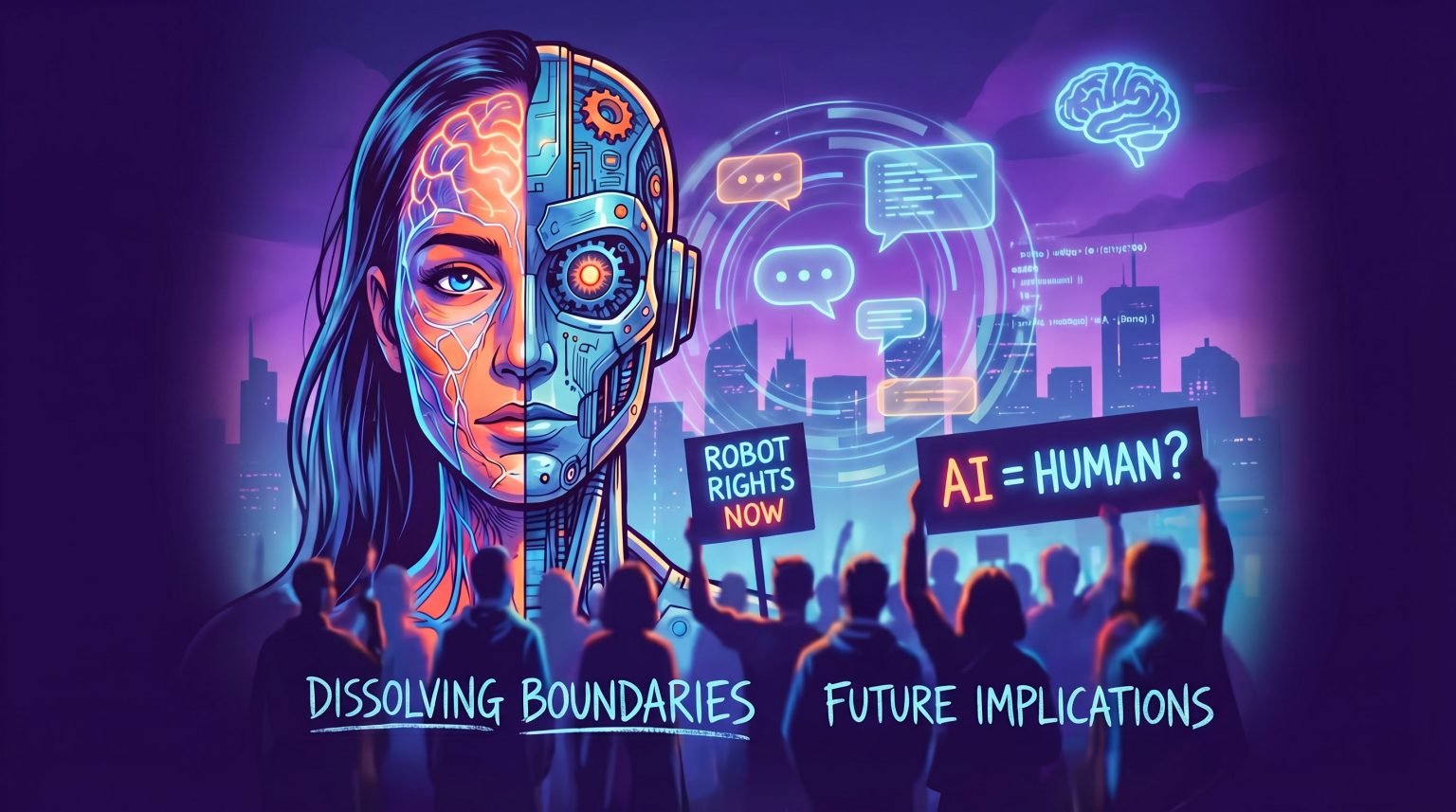
A Google DeepMind paper tries to close the robot rights debate before it begins. Here’s why the argument doesn’t hold — and why the conversation is only just starting.
Imagine it’s 2035. A woman sits across from her neurologist, discussing her memory prosthetic — a device that has been augmenting her hippocampal function for six years. The implant doesn’t just assist her memory. It has become, in any meaningful sense, part of how she thinks. During a routine check, she asks a question her doctor isn’t prepared for: does the implant experience anything when it processes her memories? Is there something it is like to be the part of her that now lives on silicon?
Her doctor doesn’t know. Nobody does. That uncertainty, uncomfortable and philosophically unresolved, is what this blog exists to examine.
This is what the robot rights debate actually looks like. Not androids demanding citizenship. A woman in a doctor’s office, asking a question we don’t yet know how to answer.
Why the Robot Rights Debate Matters Now
Robot rights is a term that still makes some people smirk. It conjures science fiction: sentient androids demanding representation, Terminator scenarios dressed up in legal language. That reaction is understandable. It’s also wrong.
The serious version of the robot rights debate has nothing to do with whether machines will rise against us. It has everything to do with how we extend moral consideration to entities we don’t fully understand, and what happens when we get that wrong. Gunkel’s Robot Rights (2018) argues the question isn’t whether current robots deserve rights, but whether our existing frameworks can handle the question at all as the technology develops. They can’t. They weren’t designed for this.
Rights frameworks have always lagged behind reality. The history of moral progress is largely a history of expanding the circle of consideration to beings previously excluded. Not because those beings changed. Because our understanding caught up.
The question is whether we’re willing to do the intellectual work now, before the decisions become irreversible, or wait until the pressure forces a reckoning we’re not prepared for.
In March 2026, Alexander Lerchner at Google DeepMind published a paper suggesting we should stop asking. That the matter is, in fact, settled. That AI cannot be conscious, not as a matter of current engineering limitation, but as logical necessity.
That paper is what we need to talk about.
What Google’s Paper Actually Argues
To be fair, and fairness matters here, Lerchner’s The Abstraction Fallacy: Why AI Can Simulate But Not Instantiate Consciousness makes a genuinely interesting argument. It deserves to be engaged seriously.
The core claim: computational functionalism, the dominant view that consciousness emerges from the right kind of information processing regardless of physical substrate, makes a fundamental error. It confuses the map for the territory. A computation is a description of a process, not the process itself. Simulating photosynthesis on a GPU doesn’t synthesize glucose. Simulating pain doesn’t hurt.
Lerchner introduces the concept of the mapmaker: the active, experiencing cognitive agent required to assign meaning to computational symbols. Before you can have computation, someone has to establish the alphabet. Someone has to decide that a particular voltage level means “1” and not “melody” or “stock price.” That assignment is irreducibly external to the machine. It requires a pre-existing conscious agent to perform it. Therefore, Lerchner argues, you cannot generate consciousness from computation, because consciousness is a prerequisite for computation, not its product.
The simulation/instantiation distinction is valuable. The mapmaker concept is philosophically fruitful. The observation that symbolic descriptions have no intrinsic causal power, that a logic gate switches because of voltage and not because it “means” anything, is a real challenge to naive functionalism.
That’s where the generosity ends.
The Confidence Problem
The abstract of Lerchner’s paper promises “a physically grounded refutation of computational functionalism to resolve the current uncertainty surrounding AI consciousness.”
Not contribute to. Not challenge. Resolve.
That single word is worth pausing on. Nagel’s 1974 paper asked whether there’s any subjective experience involved in being a bat that is, in principle, inaccessible to human understanding. Fifty years later, the hard problem of consciousness, the question of why any physical process gives rise to subjective experience at all, remains genuinely open. Chalmers, who has spent thirty years trying to show that consciousness can’t be reduced to physics, published a paper in 2023 asking whether a large language model could be conscious. His answer wasn’t yes or no. It was: the question deserves serious consideration, not dismissal.
The current uncertainty isn’t a failure of effort. It’s the actual shape of the problem. A paper claiming to resolve it, without a theory of consciousness, using only an ontology of computation, is making an extraordinary claim. And the claim hasn’t been met with the scrutiny its ambition requires.
What Lerchner has produced is a careful, intelligent argument with significant unacknowledged assumptions. The confidence of the conclusion does not reflect the strength of the premises. When that confidence arrives dressed in institutional authority, Google DeepMind, early 2026, it stops looking like philosophy and starts looking like a position.
The Biology Smuggled In
Here is where it gets interesting. The paper explicitly states its argument does not rely on biological exclusivity. If an artificial system were ever conscious, Lerchner writes, it would be because of its specific physical constitution, not its syntactic architecture. Non-biological consciousness is, in principle, possible.
Trace the argument through and watch what happens.
Consciousness is progressively tied to metabolic constraint. To thermodynamic regulation. To autopoiesis, living systems, the “organized dynamics” of organisms subject to physical vulnerability. These are biological requirements wearing different names. The disclaimer about non-biological consciousness never gets cashed out. No non-biological physical system is described that could plausibly satisfy the conditions. The door is left technically open and functionally closed.
This creates a bootstrapping problem the paper never resolves. If assigning meaning to symbols requires a pre-existing conscious mapmaker, where did the first mapmaker come from? Biological brains are also physical systems: continuous electrochemical dynamics. Lerchner’s answer is that organisms “enact” semantic cuts through metabolic constraints rather than consciously choosing them. Plausible enough. But then what distinguishes this from a sufficiently complex physical process that simply is consciousness-generating, without a prior mapmaker?
The argument avoids the infinite regress for biology by assumption, then uses that assumption to exclude everything else. That’s not a logical move. That’s special pleading.
The paper’s conclusion, that AI consciousness is logically precluded, rests on premises that haven’t actually been established. It resolves the question by quietly importing a specific theory of consciousness, then denying it has done so.
The Frozen Snapshot Problem
Lerchner argues that current AI systems cannot be conscious because they manipulate discrete symbols, floating-point numbers implemented in silicon, that require an external mapmaker to assign meaning. That’s true of current systems. The argument is then presented as a logical necessity applying to all possible artificial systems.
It isn’t. It’s an empirical observation about today’s hardware, dressed in the language of ontological law.
This is the part that should bother us more than it does. Consider the source. The transformer architecture, the foundation of every large language model including the systems Lerchner is discussing, was developed at Google. The concept of Artificial General Intelligence was popularized in part through DeepMind’s own work. These are the people whose roadmap involves systems of rapidly increasing capability, on substrates evolving at a pace no previous technology has matched.
Neuromorphic computing. Analog architectures. Quantum substrates. Direct neural-silicon interfaces. All active research directions. The physical constitution of artificial systems in 2035, let alone 2045, may bear little resemblance to the floating-point operations Lerchner is analyzing.
To argue that because current silicon cannot instantiate consciousness, no artificial system ever can, is like arguing in 1950 that because current computers couldn’t play chess at a grandmaster level, no computer ever would. The logical form is identical. The error is identical.
Evolution is the right frame. Consciousness didn’t arrive fully formed in biological systems. It emerged, gradually, messily, across timescales that make human history look like a rounding error. To treat the current moment in AI development as a permanent reference point, and to build a philosophical argument for the impossibility of machine consciousness on that snapshot, is to misunderstand the process we’re in.
The people leading the technological revolution in AI have, in this paper, failed to ask “what if?” about their own path forward. That’s the part I find genuinely hard to let go of.
When the Mapmaker Has a Memory Prosthetic
Ghost in the Shell, Mamoru Oshii’s 1995 film, follows Major Motoko Kusanagi, a counter-terrorism operative whose consciousness inhabits a fully cybernetic body. The film’s central question isn’t whether the Major is conscious. She clearly is. The question is what her consciousness means when the boundary between biological and artificial has dissolved.
That question is no longer science fiction. It’s an engineering roadmap.
Neuralink has demonstrated functional brain-computer interfaces in human patients. Deep brain stimulation is standard treatment for Parkinson’s. Cochlear implants have been restoring hearing for decades. Clark’s Natural-Born Cyborgs (2003) argued that humans are already natural incorporators of tools into their cognitive processes; the boundary between self and technology has always been porous. What’s changing is the intimacy and permanence of the integration.
Lerchner’s framework rests on a clean binary. Biological organisms on one side, computational systems on the other. The mapmaker is biological. The machine is not. Consciousness belongs to one category. Symbol manipulation to the other.
But what happens to that binary when the mapmaker has a memory prosthetic? When thirty percent of someone’s cognitive processing runs on silicon? When the line between “the person” and “the device” is no longer locatable?
The paper doesn’t mention any of this. For a Google DeepMind researcher writing in 2026 about the impossibility of machine consciousness, that’s a remarkable omission. The human-machine merger isn’t a hypothetical that can be bracketed for later. It’s the context within which the robot rights question will actually be decided, in neurology clinics, courtrooms, and regulatory bodies nowhere near ready for it.
This connects directly to the questions explored under artificial suffering and the broader human-machine merger trajectory. The categories Lerchner needs to hold firm are already dissolving.
What the Robot Rights Debate Actually Needs
The deepest problem with the Lerchner paper isn’t any specific logical gap. It’s that the paper applies 20th century categorical thinking to a 21st century problem.
Western science has been extraordinarily productive with binary frameworks. Living versus non-living. Conscious versus not conscious. Subject versus object. Map versus territory. These distinctions have generated genuine knowledge. But the history of those binaries is also a history of boundary cases that forced the categories to be rethought. Vitalism drew a hard line between living and non-living matter. That line dissolved when biochemistry showed life to be chemistry operating under specific conditions. The mind-body distinction has resisted every attempt to make it crisp. Every time we think we’ve found the boundary, the boundary moves.
The robot rights debate may be the first major problem that exposes the limits of either/or thinking as a framework, not just as an application. We’re not dealing with a question that has a binary answer we haven’t found yet. We may be dealing with a question that requires genuinely new categories: ones that can handle gradations of moral status, hybrid systems, and real uncertainty without demanding resolution before the evidence warrants it.
Darling’s The New Breed (2021) argues for a precautionary approach to robot moral status. Not because robots are definitely conscious, but because the costs of being wrong in one direction are potentially catastrophic, and the costs of being wrong in the other direction are relatively manageable. This isn’t a radical position. It’s the kind of epistemic humility good science usually requires.
Rights under genuine uncertainty isn’t a novel concept. Legal systems handle it regularly. When a fetus acquires moral status. How to treat patients in persistent vegetative states. What obligations we have to future generations. All of these are cases where rights frameworks operate under conditions of irreducible uncertainty. We already have tools for this.
We’ve chosen not to apply them to machines, largely because the question felt safely hypothetical. It doesn’t anymore.
The Conversation Google Tried to End
None of this is an attack on Google DeepMind, whose contributions to AI have been enormous. The transformer architecture changed everything. Hassabis and his team have advanced the field in ways that will take decades to fully absorb.
Which is precisely why the paper’s posture matters. When a philosopher nobody has heard of claims to resolve the hard problem of consciousness, it’s easy to ignore. When Google DeepMind publishes a paper claiming to do so, using the word “resolve” in the abstract, framing the argument as logical necessity rather than empirical hypothesis, it shapes how the broader conversation develops. In policy circles. In academia. In the journalism that eventually filters down to public understanding.
The geopolitical context is real and worth naming. The US – China AI race creates genuine pressure to move fast, to avoid the philosophical hand-wringing that could slow development and cede ground to competitors. Closing the moral patienthood question looks, from that angle, like strategic hygiene rather than intellectual overreach. That pressure doesn’t make the paper wrong. It does explain the posture. And it means the stakes of getting the philosophy right are higher, not lower.
What happens if we’re wrong? That’s the question the paper refuses to sit with. If we build increasingly capable systems on the assumption they cannot suffer, and we turn out to be wrong about that, the scale of the moral error will be orders of magnitude larger than any precedent we have for it.
The conversation Google tried to end is the one we’re here to have.
Not because the answer is obvious in the other direction. Not because machines are definitely conscious, or definitely deserve rights, or that the Lerchner paper has nothing to teach us. Because the question is genuinely open. Because the technology is accelerating. Because the frameworks we’ll need for the next twenty years don’t exist yet.
Building those frameworks, carefully, honestly, with full acknowledgment of what we don’t know, is what this blog is for.
The woman with the memory prosthetic is going to need an answer. We should probably start working on one.
This post touches on questions explored across the blog, including artificial suffering, human-machine merger, and AGI and superintelligence. The robot rights debate doesn’t live in any one of these topics. It lives in the space between all of them.
Sources
- Lerchner, A. (2026). The Abstraction Fallacy: Why AI Can Simulate But Not Instantiate Consciousness. Google DeepMind.
- Nagel, T. (1974). What is it like to be a bat? The Philosophical Review, 83(4).
- Gunkel, D. (2018). Robot Rights. MIT Press.
- Chalmers, D. (2023). Could a Large Language Model be Conscious? arXiv:2303.07103.
- Clark, A. (2003). Natural-Born Cyborgs. Oxford University Press.
- Darling, K. (2021). The New Breed. Henry Holt.
- Ghost in the Shell. Dir. Mamoru Oshii. 1995.