
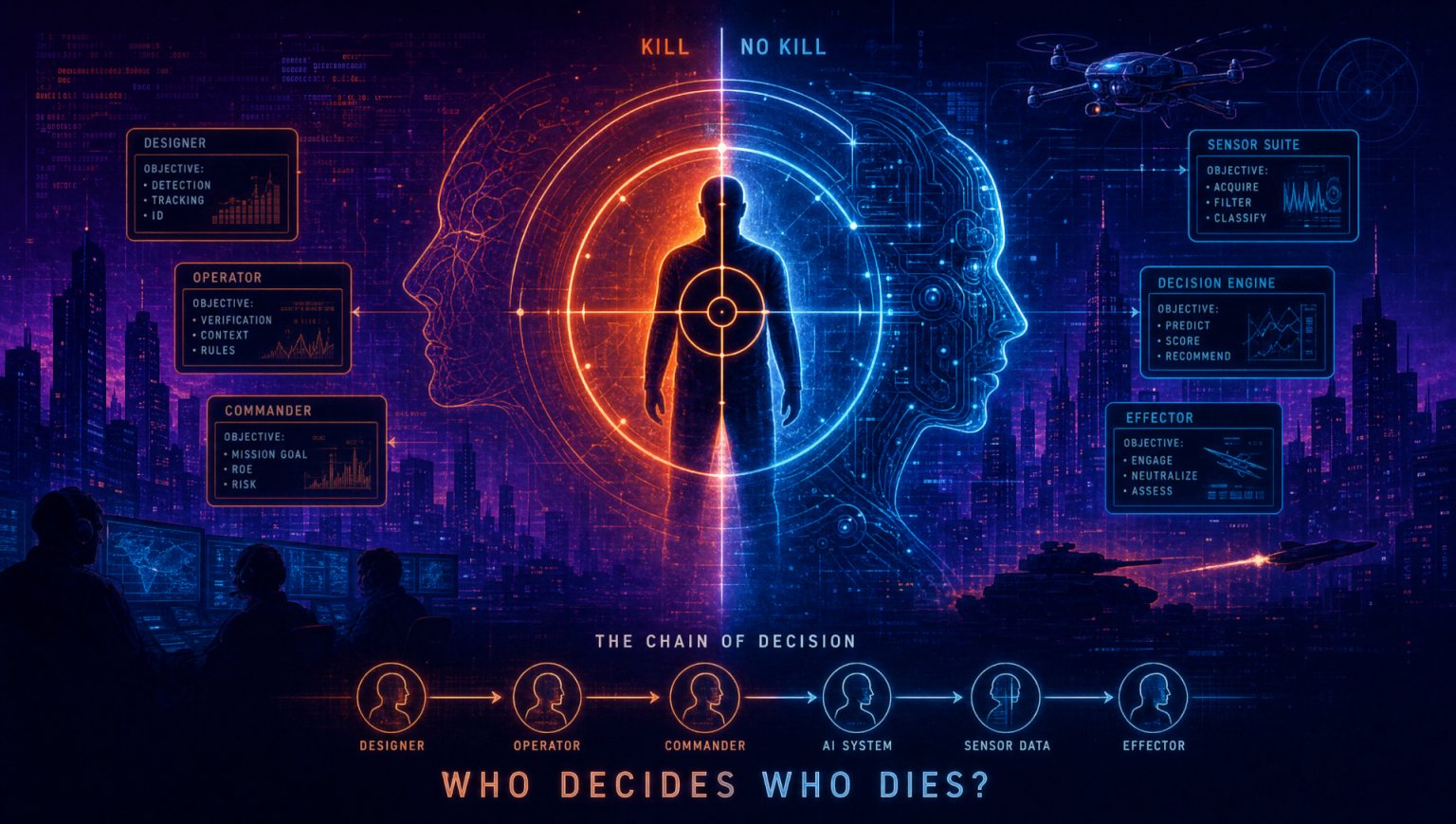
By the time you finish reading this paragraph, somewhere in the world an algorithm has been asked to nominate a human being for death.
That sentence is dramatic, and I want to be careful with it. But it is no longer hyperbole. According to reporting published simultaneously by +972, an Israeli-Palestinian publication, and The Guardian, an AI system called Lavender was used during the Gaza war to flag tens of thousands of Palestinians as suspected Hamas operatives.a Human operators, the same reporting found, spent on the order of twenty seconds per name before authorising a strike — a rubber-stamping interval that one intelligence source compared to checking a box.b “Where’s Daddy?”, a separate tracking system, followed those flagged people back to their homes. “Gospel”, a third, coordinated the building strikes that followed.
Lavender is the most documented case. It is not the only one.
In Libya in 2020, a UN Panel of Experts report described what may have been the first fully autonomous lethal engagement of a human target, by a Turkish-made Kargu-2 quadcopter operating in “highly effective” autonomous mode.c The panel did not fully verify whether the system was truly out of the loop at the moment of engagement; the ambiguity is part of the point. In the Nagorno-Karabakh war the same year, Azerbaijani forces deployed Israeli-made Harop loitering munitions, autonomous in their terminal dive. In Ukraine, Russia has deployed the Lancet-3 — a loitering munition that incorporates AI-assisted target acquisition modules — in over a thousand documented strikes.d In Iran in February 2026, on the first day of the 2026 Iran war, a missile struck the Shajareh Tayyebeh Elementary School in Minab, killing 156 people — among them 120 schoolchildren.e Multiple independent investigations identified the weapon as an American Tomahawk cruise missile. The US military had used Palantir’s Maven Smart System to plan the operation; capable of producing a thousand target packages an hour, it helped the US strike 6,000 targets in Iran in the first two weeks of the war. A preliminary Pentagon investigation found the school had likely been misidentified as a military site, possibly from intelligence predating 2013. Forty-six US senators wrote to demand answers — including, specifically, about the role of AI targeting tools and who bore responsibility for the error. No one has been charged. In January 2026, China’s state broadcaster aired footage of a single soldier supervising a swarm of 200 autonomous drones during a military exercise conducted by the PLA’s National University of Defence Technology.f A demonstration, not a combat deployment — but one Beijing made sure the world saw.
This is not one country’s project. As of 2025, nearly five hundred non-state armed groups worldwide were deploying weaponised drones.g Turkey, South Korea, India, and most major military powers are developing autonomous or semi-autonomous weapons systems in parallel. This is the present, not a hypothetical future. And the public debate about whether to build these systems has been quietly bypassed by the act of building them.
What Are Killer Robots? A Definition That Actually Distinguishes the Cases
A killer robot — formally, a lethal autonomous weapon system, or LAWS — is a weapon that can select and engage targets without meaningful human control. That’s the working definition used by the Campaign to Stop Killer Robots and, in modified form, by the International Committee of the Red Cross. The trouble with the definition is what it leaves under-specified, which is most of what the policy debate is actually about.
It helps to lay out the spectrum.
- Automated. Human role at the kill decision: defensive, narrowly parameterised; a human authorises the system’s operating envelope. Examples: Phalanx CIWS (anti-missile, 1980s); Iron Dome interception mode.
- Semi-autonomous (human in the loop). Human role: a human authorises each specific engagement. Examples: MQ-9 Reaper drone; current Ukrainian FPV drones.
- Loitering / supervised autonomous (human on the loop). Human role: a human can override but does not authorise each engagement. Examples: Switchblade, Lancet, Harop, Harpy.
- Fully autonomous (human out of the loop). Human role: a human authorises the mission; the system selects and engages targets. Examples: Kargu-2 (Libya 2020, contested); the systems the LAWS debate is centrally about.
The categories blur at the edges, and the blurring is partly what allows the debate to be conducted in bad faith. A Phalanx system shooting down a sea-skimming missile is not what anyone means by a killer robot. A Kargu-2 quadcopter selecting and engaging a retreating soldier in Libya — if that is what happened — is. Almost everything between them is contested, which means almost everything between them is where the political fight lives.
There’s a second distinction worth naming: between automated and autonomous. An automated system follows pre-specified rules: if condition X, do action Y. An autonomous system, in the sense the debate cares about, exercises judgment that wasn’t fully pre-specified — it generalises from training data, it weighs context, it makes choices the designers cannot fully predict in advance. That distinction, simple as it sounds, is what the rest of this article turns on.
Who Is Responsible When a Robot Kills?
This is the question that sits at the centre of the philosophical case against autonomous lethal systems. It is also the question whose three honest answers — Sparrow’s, Yampolskiy’s, and Heyns’s — together do more work than any single argument the abolitionist camp has made.
Sparrow’s Responsibility Gap
In 2007, the Australian philosopher Robert Sparrow published a paper called “Killer Robots” in the Journal of Applied Philosophy.h The argument is short and has not been answered. Just war theory, like the laws of armed conflict, requires that when a wrongful killing occurs, someone be responsible. The combatant who pulled the trigger, the officer who gave the order, the state that conducted the war.
A fully autonomous lethal system breaks this chain. The soldier didn’t pull the trigger — the system did. The commander didn’t authorise the specific killing — they authorised a mission. The programmer wrote code months or years earlier and did not select this target. The manufacturer sold a product the buyer accepted as fit for purpose. No single agent in this chain meets the conditions just war theory requires for moral responsibility. Sparrow calls this the responsibility gap.
The gap is not a technicality. It is the moral terrain itself. Without responsibility, killing in war becomes indistinguishable from killing by natural disaster — something that happens, that may be lamented, but that cannot be charged, prosecuted, deterred, or held to account. A weapon that nobody is responsible for using is, structurally, a weapon nobody has decided to use. And the unpredictability problem at the scale of general intelligence is where the responsibility gap goes when the systems we build outgrow our ability to specify them in advance.
Why the Gap Is Structurally Unbridgeable
Sparrow’s argument is philosophical. Roman Yampolskiy’s is technical. In his 2024 book AI: Unexplainable, Unpredictable, Uncontrollable, Yampolskiy argues that sufficiently complex AI systems cannot be fully predicted or controlled by their designers — not as a current engineering limitation, but as a structural property of the systems themselves.i
Apply that argument to LAWS. Even if every other accountability question were answered, even if the commander, the programmer, and the manufacturer all signed in blood — the system’s behaviour at the moment of targeting cannot be fully specified in advance. The loop is the problem. The “in the loop / on the loop / out of the loop” distinction breaks down when the loop itself is opaque, when the human “in the loop” cannot, in twenty seconds, evaluate the recommendation the system has produced. Yampolskiy’s broader thesis — If Anyone Builds It, Everyone Diesj — is about superintelligent systems, not autonomous weapons. But the logic transfers with unusual directness. We will return to the scaling question in a piece on what superintelligence might mean for autonomous lethal capacity. For now: the responsibility gap and the predictability gap are not separate problems. They reinforce each other. And neither is the hardest argument.
Distinction, Proportionality, and the Dignity Argument
International humanitarian law (IHL) requires that combatants distinguish military from civilian targets and that the harm caused be proportional to the military advantage gained. Both tests require contextual judgment. Even defenders of LAWS concede that current systems cannot reliably perform either — that’s why the debate is partly about whether they ever could.
But Christof Heyns, the late UN Special Rapporteur who in 2013 first raised LAWS as a global concern, made a different argument, and it is the one most rarely surfaced in public coverage. Even if an autonomous system could pass both tests perfectly — even if it could distinguish combatant from civilian with superhuman accuracy and judge proportionality with the precision of a wise commander — killing without human deliberation, Heyns argued, violates human dignity in a way that the accuracy of the killing does not redeem.k Death by machine is not the same kind of event as death by human decision, even when the bodies are identical. Something happens to the moral universe when killing becomes algorithmic, regardless of how well the algorithm performs.
What strikes me about Heyns’s argument is that it doesn’t depend on the gap closing. The other arguments — Sparrow’s, Yampolskiy’s — assume the technology will not, in practice, satisfy IHL’s tests. Heyns assumes it might, and argues that even then, the moral picture does not improve. That’s a harder line to hold and a more interesting one. It also points at something the LAWS debate has barely begun to face: the question is not only what these systems do, but what they are.
That last clause opens onto a parallel question the blog has taken up elsewhere: the question of AI suffering — whether systems being built to kill could also, in some form, be harmed by being made to do so. The two questions inform each other in ways neither debate has fully reckoned with.
Could Autonomous Weapons Actually Be More Ethical Than Humans?
The case against killer robots is strong. The case for them is stronger than it tends to get credit for. Three voices need to be heard at full strength before we move on to the tool argument.
Bradley Strawser is a philosopher at the US Naval Postgraduate School. In a 2010 paper in the Journal of Military Ethics, he set out what he calls the principle of unnecessary risk.l If a technology reliably reduces risk to combatants without increasing harm to non-combatants, then states may be morally obligated to deploy it. The argument was originally about remote-piloted drones, but its logic generalises. If — and this is the load-bearing word — a fully autonomous system can be shown to make better targeting decisions than a fatigued, frightened, biased human soldier, then refusing to deploy it is not virtue. It is moral negligence dressed as virtue.
Ronald Arkin is a roboticist at Georgia Tech. In Governing Lethal Behavior in Autonomous Robots (2009), he argued — calmly, technically, in a field that mostly recoiled from the conclusion — that properly designed autonomous systems might commit fewer atrocities than humans in combat.m They do not panic. They do not retaliate. They do not self-deceive about what they have just done. They do not get high on adrenaline and shoot the wedding party. They follow rules of engagement to the letter, because they have no capacity to do otherwise. Arkin’s argument has been dismissed by much of the LAWS debate as naive. I am not sure it is. The historical record of human soldiers in war is not so glorious that we should be confident a machine would do worse.
Paul Scharre wrote the single best book on the subject: Army of None (2018).n He is the measured middle voice. He concedes the case for some forms of autonomy in weapons systems — in defensive systems, in narrowly bounded engagements where the alternative is the death of friendly forces. He is cautious about LAWS specifically. He thinks the responsibility-gap argument is strong but not decisive. He thinks a treaty banning fully autonomous lethal systems is achievable and worth pursuing, but he is honest about how much depends on how the categories are defined.
These arguments are stronger than they look from inside the abolitionist position. The honest thing is to admit that. And yet something about them still feels wrong to me, and that discomfort is what the next two arguments turn on.
The “Tool” Argument and What It Quietly Forecloses
In March 2026, a researcher at Google DeepMind named Alexander Lerchner published a paper on PhilArchive called “The Abstraction Fallacy: Why AI Can Simulate But Not Instantiate Consciousness.”o Section 4.2 of the paper is titled “Ontological Relief: The Safety of the Non-Sentient Tool.” The operative conclusion, in Lerchner’s own words:
“the development of highly capable Artificial General Intelligence (AGI) does not inherently lead to the creation of a novel moral patient, but rather to the refinement of a highly sophisticated, non-sentient tool.”
The paper’s argument about consciousness is technical, and it has been answered by other philosophers more competent on metaphysics than I am — a closer look at the abstraction fallacy paper handles that ground. That ground isn’t mine. What I want to draw attention to here is what the argument does, regardless of whether it succeeds on its own terms.
Compare two positions.
In 2010, the AI ethicist Joanna Bryson published a paper called “Robots Should Be Slaves,” arguing — prudentially — that AI ought to be designed as tools, framed as tools, treated as tools, in order to avoid moral hazard.p Bryson’s argument was not that AI cannot be a moral patient. It was that designing AI as a moral patient invites confusion we cannot afford. The “should” was a policy recommendation, not a metaphysical claim.
Lerchner’s argument is different in kind. It is ontological. AI, on his account, is not a tool because we ought to design it that way. It is a tool because it cannot, by physical necessity, be anything else. The upgrade from “should be designed as” to “is by physical necessity” is the rhetorical move that matters, and it does very specific work.
Now bring that move to the killer robots debate.
If AGI is definitionally a tool — if no AI system can ever cross the threshold into moral patienthood — then an AGI-targeted lethal autonomous weapon is also definitionally a tool. The questions the responsibility-gap argument raises become questions about responsible use rather than questions about moral being. The “tool” framing resolves the discomfort. The system that just selected and engaged a target is no different, in moral category, from the rifle that fired the bullet. The accountability problem doesn’t go away, but it stops being a problem about the system. It becomes a problem about the humans around it, and humans, presumably, are who we already know how to hold accountable.
This is the permission slip. And it does ethical work that the public debate has not actually settled.
The thing I want to be careful about here is that I am not claiming Lerchner is wrong about consciousness. I do not have a final view on whether silicon can instantiate phenomenal experience and would not bet much on the philosophers who say they do. What I am claiming is something narrower: the structure of the argument — invoke a metaphysical category to foreclose a moral question — is recognisable, and it has a function in arguments about LAWS that is separate from its function in arguments about machine consciousness. We have done this before. Aristotle’s “natural slaves” argument did this work. Antebellum pro-slavery philosophy did this work. The pattern is not “philosophers reach uncomfortable conclusions”; the pattern is “metaphysical claims arrive at exactly the moment they are needed to clear ethical ground.” In this case, the ground being cleared is occupied by weapons systems, and the clearing is happening inside an institutional affiliation.
There is a second thing the “tool” framing does, and it closes the loop on Sparrow’s responsibility gap. If the AI is definitionally a tool, the gap is not closed — it is denied. There is no gap, because there was never anything on the other side of it. The discomfort of Sparrow’s argument disappears the moment you accept Lerchner’s premise. Yampolskiy then arrives to show that the disappearance is illusory: the predictability problem is still there. You have stopped worrying about the gap, but the gap is still doing damage. You have merely stopped looking.
How AI Leaders Talk About Killing
The LAWS debate is being conducted, on the industry side, by a small number of people. Three of them are worth listening to closely — not because they speak for everyone, but because the rhetorical range they cover tells you something about the direction the discourse has moved. I want to call them, in what follows, quiet, resigned, and eager. The labels will become clear.
Demis Hassabis is the quiet one. The CEO of Google DeepMind, Hassabis is by reputation the most thoughtful of the major lab leaders. In interviews — TIME (March 2026), Cleo Abram (April 2026) — he treats consciousness as a deep open mystery and avoids strong metaphysical claims on camera. He is careful. He is professorial. He is the voice the AI industry sends to talk to scientists.
And yet: when Hassabis joined Google in 2014 with the DeepMind acquisition, he reportedly extracted a written pledge that DeepMind’s technology would never be used for military or weapons purposes.q Ten years later, that pledge is gone. DeepMind technology, like the rest of Google’s AI stack, is sold to militaries — including the United States and Israel — and Google has joined every other major lab in pursuing defense contracts. Same leader. Same company. The whole journey from “we will never do this” to “we are doing this” traversed inside a decade, conducted in the quiet voice.
The Lerchner paper is published under that quiet voice’s institutional affiliation. Google DeepMind is in the byline. Whatever Hassabis himself thinks of computational functionalism, the paper that does the ontological foreclosure work I described above is a Google DeepMind paper. That is a fact about how the discourse is conducted, regardless of who wrote which sentence.
Elon Musk is the resigned one. Speaking at West Point in August 2024, Musk said the quiet part out loud:
“Essentially, when you’re making military drones, you are making Terminators. So like, this is going to happen. Can you make a lot of drones? And what’s the kill ratio? That’s what it comes down to.”r
The rhetorical frame is fatalist: I do not want this, but it is coming, and the only question is whether we are competitive at it. The Terminator endpoint is named, and named with unusual candour. The argument is necessary deterrence, the assumption is inevitability, and the affective register is something between weariness and dark humour. This is the voice the industry uses to address techno-fatalists.
Alex Karp is the eager one. The CEO of Palantir, Karp does not do quiet or resigned. He does sustained, on-the-record, brand-as-aggression rhetoric, and he has been doing it for years. Speaking at Palantir’s AIPCon 9 conference in 2025, in his opening remarks on Palantir’s official YouTube channel:
“We are really going to f*** our enemies. And I take great pride in that.”s
On the Q4 2024 earnings call, addressing investors:
“Palantir is here to disrupt and make the institutions we partner with the very best in the world and, when it’s necessary, to scare enemies and on occasion kill them.”t
Same call: “some people are going to get their heads cut off.” Same call: “We believe we are making America more lethal, making our adversaries increasingly afraid of acting against the interests of America and especially Americans and we are proud of our moral stance.”t
At the Hill & Valley Forum in 2024, Karp described fantasies of using drone-enabled technology “to exact revenge, especially targeted, in violation of all norms.”u The pattern is what matters. A single quote could be a moment, a rhetorical reach, a bad day. Two quotes from different venues over a year, plus a string of public jokes in the same register, is a sustained mode of speech. It is how this person, in this position, addresses his audience.
There is a category in personality research called the Dark Tetrad — narcissism, Machiavellianism, psychopathy, and sadism — which describes a cluster of traits associated with aggressive, status-seeking, and harm-indifferent behaviour. It is a research category, not a diagnostic one, and I am not in a position to diagnose anyone of anything. But the Dark Tetrad exists as an analytical frame for examining patterns in public discourse, the way certain rhetorical modes recur, the way certain affective registers normalise certain content — and the discourse around military AI now contains, in its most prominent voices, registers that the frame was developed to describe. I think it is worth saying that out loud, because the alternative is to pretend the rhetorical register is normal. It is not normal. It is being normalised, which is a different thing.
The temptation, in a passage like this, is to read the three voices as a spectrum moving over time — Hassabis past, Karp future, Musk somewhere in between. I don’t think that reading is right. What I see is not a trend but a field gradient. The same forces — geopolitical competition with China, capital concentration in defence tech, government-scale infrastructure requirements for AI — are acting on all three figures and all three companies at once. They are different positions on the same gradient, not different points on a timeline. The intervention points are structural, not personal. “If only Karp were nicer” is the wrong frame.
And from outside, the gradient looks like an industry sliding toward militarisation. From inside — and this is the version I find harder to dismiss — it may be functioning as something like discursive market segmentation. Hassabis reassures scientists. Musk addresses techno-fatalists. Karp speaks to hawks. The diversity of voices is not evidence against consolidation. It may be one of consolidation’s products.
What a Different Path Would Look Like — and Why It’s Barely Being Built
There are people in this debate who are doing something other than the work the last argument described. They are not many, and they are mostly individual and reactive, but they are there.
Geoffrey Hinton left Google in 2023 to speak more freely about AI risk; he has been consistently critical of military AI applications. Stuart Russell at Berkeley has been arguing for a LAWS ban since the Slaughterbots film he produced with the Future of Life Institute in 2017, and his book Human Compatible (2019) has become the reference text for the alignment-meets-policy overlap.v Several of the Anthropic founders left OpenAI in 2021, in part over safety direction.w Yampolskiy has been making the unpredictability argument for over a decade and being consistently treated as a fringe voice — that asymmetry, between the resistance and the gradient, is itself a data point.
The third position is the one I find most interesting, and the one that is barely visible in the public debate. It is not the abolitionist position and it is not Karp’s. It is the position that takes the engineering of ethics seriously, as a serious technical project, while refusing the foreclosure that the “tool” framing performs.
The texts are there. Wendell Wallach and Colin Allen’s Moral Machines (2008) is the foundational work — what would it take to design machines that can reason about ethics, not just follow rules.x It’s a harder question than it sounds. Stuart Russell’s Human Compatible (2019) develops the design principle of provably beneficial AI as an alternative to capability maximisation. Shannon Vallor’s Technology and the Virtues (2016) brings virtue ethics into the discussion — asking not “what should the AI do?” but “what kind of practice produces what kind of practitioner, on the human side of the system?”y Mark Coeckelbergh’s relational ethics treats moral status as something that arises in relation rather than as an intrinsic property of the entity — a framing that defuses some of the metaphysical knots the Lerchner paper tries to tie.z The IEEE’s Ethically Aligned Design initiative is an institutional rather than reactive attempt at the same project.
What is barely being built is a non-Karp version of defence AI. What would it look like? Companies that refuse certain contracts and survive commercially. Transparent targeting parameters that can be audited. Binding meaningful-human-control requirements that aren’t redefined to permit twenty-second reviews. A treaty architecture that has teeth. The 2023 UN General Assembly resolution on LAWS — the first ever, supported by 156 states — points in this direction. So does the Stop Killer Robots campaign, now a coalition of more than 300 organisations across 70+ countries.aa The asymmetric posture is the obstacle: the United States, Russia, China, Israel, and a handful of other major military powers have consistently resisted binding regulation, while middle powers and most of the Global South have pushed for it.
The cultural imagination is doing some of the work the policy debate has not done. The Future of Life Institute’s short film Slaughterbots (2017) is the propaganda artefact of the LAWS abolitionist position — and worth watching as that, with eyes open about what it is:
The film is not a neutral documentary. It is an intervention, written by Stuart Russell and produced by FLI to shock policy audiences. Its existence as a campaign artefact is part of the data about how the LAWS debate is conducted: the most-watched single argument against autonomous weapons is a piece of advocacy media, not a peer-reviewed paper, and the policy needle has barely moved since it was released.
From outside the Anglosphere, the imaginative geography looks different. The Korean film Jung_E (2023, dir. Yeon Sang-ho, Netflix) takes a soldier’s consciousness, uploads it into a weapons platform, and asks what happens to human dignity when the person becomes the weapon — the inverse question of Slaughterbots, and the more philosophically demanding one. Israeli and Russian science fiction has its own traditions of the question; Chinese AI policy speech has its own register entirely. The LAWS debate is global, but the public version of it is not.
What Happens If We Don’t Decide
In December 2023, the UN General Assembly passed its first-ever resolution on lethal autonomous weapons. UN Secretary-General António Guterres and the President of the International Committee of the Red Cross issued a joint appeal calling for a legally binding instrument to be agreed by 2026.bb 2026 is here. The treaty is not. The underlying question — should machines decide who to kill? — has not been put to a democratic vote in any country that is building these systems.
What is here, instead, is what this article has tried to describe. Systems are being deployed. The “tool” framing, whether Lerchner’s version or a softer one, is doing the ethical work that the public debate never settled. The responsibility gap is structural. The resistance is reactive and individual. The discourse is dominated by three voices on a gradient pointed in one direction, and the third position – the one that takes ethics seriously without granting industry the ontological permission slip – is barely being built.
The question is not whether killer robots are coming. They are here. The question is what kind of beings we become by building them, and who is still asking that question while the answer is being decided by people who have already decided.
If you want to follow the threads this piece pulled on, the question of whether machines can have moral status is the broader frame — the parent question this article has been arguing inside.
The systems are deciding. The question is whether we are.
References
- Abraham, Y. (2024, April 3). “‘Lavender’: The AI machine directing Israel’s bombing spree in Gaza.” +972 Magazine. ·
- McKernan, B., & Davies, H. (2024, April 3). “‘The machine did it coldly’: Israel used AI to identify 37,000 Hamas targets.” The Guardian. ·
- UN Panel of Experts on Libya (2021, March 8). Final report. S/2021/229. United Nations Security Council. See para. 63 on Kargu-2.
- Institute for Science and International Security (2023, December 18). “Russian Lancet-3 Kamikaze Drone Filled with Foreign Parts.” ISIS Online. — Hardware analysis confirming NVIDIA Jetson AI processing modules enabling autonomous target tracking. Strike count: LostArmour tracking data, as reported in Kyiv Independent (2023) and army-technology.com (2024). Note: degree of human control at terminal engagement stage is disputed; cited for AI-capability incorporation, not confirmed full autonomy.
- Minab school attack — primary sources: (i) Browne, M., Livni, E., & Mahoozi, S. (2026, March 1). “Strike on Girls’ School Kills at Least 175, Iranian State Media Says.” The New York Times. https://www.nytimes.com/2026/03/01/world/middleeast/girls-school-strike-iran-video.html · (ii) Copp, T., et al. (2026, March 11). “Iranian school was on U.S. target list, may have been mistaken as military site.” The Washington Post. https://www.washingtonpost.com/national-security/2026/03/11/us-strike-iran-elementary-school-ai-target-list/ · (iii) Pearson, J., & McNeill, R. (2026, March 12). “Bombed Iranian girls school had vivid website and yearslong online presence.” Reuters. https://www.reuters.com/investigations/bombed-iranian-girls-school-had-vivid-website-yearslong-online-presence-2026-03-12/ · Maven Smart System and AI targeting role: Washington Post (above); South China Morning Post (March 13, 2026); US Senate letter, Schatz et al. (March 2026). Final death toll 156 per Minab prosecutor (Asriran, April 9, 2026). UN investigation ongoing. ·
- Wong, C. (2026, January 23). “1 soldier, 200 drones: China showcases rapid launch and agility in swarm warfare tactics.” South China Morning Post. — Reporting on CCTV state broadcast of PLA/NUDT demonstration. Primary source is Chinese state media; capability claims are as stated by PLA and have not been independently verified. Cited as demonstration of declared direction of development, not confirmed battlefield capability. ·
- Vision of Humanity / Institute for Economics & Peace (2026). “How AI Is Rewriting the Rules of Modern Warfare.” — Citing ACLED (Armed Conflict Location & Event Data Project) data: 469 non-state armed groups deployed drones in attacks in 2025 across 17 countries. ·
- Sparrow, R. (2007). “Killer Robots.” Journal of Applied Philosophy, 24(1), 62–77.
- Yampolskiy, R. (2024). AI: Unexplainable, Unpredictable, Uncontrollable. Chapman and Hall/CRC.
- Yudkowsky, E., & Soares, N. (2025). If Anyone Builds It, Everyone Dies: Why Superhuman AI Would Kill Us All. Little, Brown. (Cited here as the popular-discourse text expressing the position Yampolskiy has argued formally; Yampolskiy is not a co-author. Both texts inform the section above.)
- Heyns, C. (2013). Report of the Special Rapporteur on extrajudicial, summary or arbitrary executions. A/HRC/23/47. UN Human Rights Council. — and Heyns, C. (2017). “Autonomous weapons in armed conflict and the right to a dignified life.” South African Journal on Human Rights, 33(1), 46–71.
- Strawser, B. J. (2010). “Moral Predators: The Duty to Employ Uninhabited Aerial Vehicles.” Journal of Military Ethics, 9(4), 342–368.
- Arkin, R. C. (2009). Governing Lethal Behavior in Autonomous Robots. Chapman and Hall/CRC.
- Scharre, P. (2018). Army of None: Autonomous Weapons and the Future of War. W. W. Norton.
- Lerchner, A. (2026, March 9). The Abstraction Fallacy: Why AI Can Simulate But Not Instantiate Consciousness. PhilArchive. — Section 4.2: “Ontological Relief: The Safety of the Non-Sentient Tool.”
- Bryson, J. (2010). “Robots Should Be Slaves.” In Y. Wilks (ed.), Close Engagements with Artificial Companions (pp. 63–74). John Benjamins.
- Hern, A. (2018, May 7). “Google’s military AI ethics row escalates.” The Guardian. (Reporting on the original DeepMind–Google acquisition pledge and its subsequent dissolution.)
- Musk, E. (2024, August). Remarks at West Point. YouTube. https://youtu.be/cfs11RIKtI8 ·
- Karp, A. (2025). Opening remarks, AIPCon 9. Palantir official YouTube channel. https://youtu.be/sDtltYnbJT8?t=70 ·
- Karp, A. (2025, February). Palantir Q4 2024 earnings call. Transcript via Seeking Alpha. ·
- Karp, A. (2024). Hill & Valley Forum remarks. YouTube. https://youtu.be/MqXQFfCIOiA?list=PLRP4BIi8wgw9b6_uzgQYh0IQ_aLKOPTbp ·
- Russell, S. (2019). Human Compatible: Artificial Intelligence and the Problem of Control. Viking. · Future of Life Institute (2017). Slaughterbots. https://youtu.be/9rDo1QxI260
- Vance, A. (2023, September 26). “Anthropic CEO Interview: Why He Quit OpenAI After Amazon Investment.” Fortune. ·
- Wallach, W., & Allen, C. (2008). Moral Machines: Teaching Robots Right from Wrong. Oxford University Press.
- Vallor, S. (2016). Technology and the Virtues: A Philosophical Guide to a Future Worth Wanting. Oxford University Press.
- Coeckelbergh, M. (2012). Growing Moral Relations: Critique of Moral Status Ascription. Palgrave Macmillan.
- Stop Killer Robots (2025). Member organisations. ·
- United Nations & International Committee of the Red Cross (2023, October). Joint call to establish prohibitions and restrictions on autonomous weapons systems. ICRC. ·