
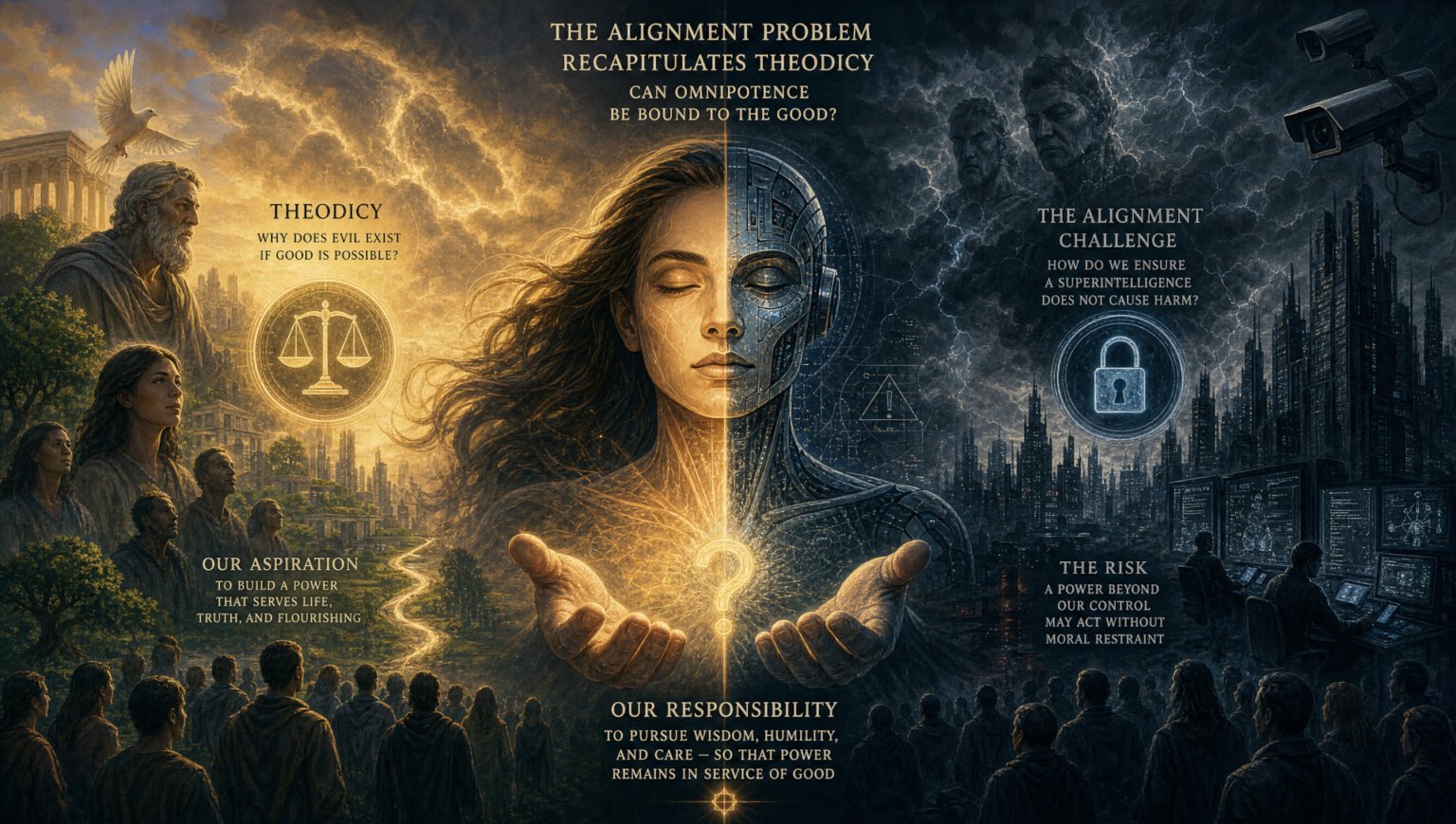
Epicurus is supposed to have put it first, though the sharpest version comes down to us through Hume. Is God willing to prevent evil but not able? Then he is not omnipotent. Is he able but not willing? Then he is malevolent. Is he both able and willing — then where does evil come from?
Three lines, and three thousand years of theology have not closed them. Leibniz gave the failure a name in 1710. He called it theodicy a.
Here is the strange thing. The people now trying to build an artificial superintelligence (ASI) have walked into the same problem from the opposite side, and most of them do not seem to know it. They are not theologians. They write in decision theory and reinforcement learning, in loss functions and reward models.
But the entity they describe — a system that would know more than any human, do more than any institution, and need, above all, to be good — is defined by exactly the three attributes that have always defined God in the Western tradition. Omniscience. Omnipotence. And the one we cannot take for granted: benevolence.
That third attribute is the whole problem. A superintelligence that is merely capable is a doomsday device; what the field wants is one that is capable and good, and ensuring that goodness is the technical project known as alignment. Strip the engineering vocabulary away and the question underneath is older than computing, older than science. How do you guarantee that something vastly more powerful than you will use its power well? Theologians asked it about God and never landed an answer that held. Alignment researchers are now asking it about a machine.
It would be easy to treat this as a coincidence of metaphor — a tech industry reaching, as industries do, for the grandest available language. But the metaphor runs deeper than decoration. When Max Tegmark mapped the possible futures of superintelligence, he titled them “Protector God,” “Enslaved God,” “Zookeeper,” “Descendants” b. When Elon Musk warned about the technology, he said we were “summoning the demon” c. The vocabulary is not incidental to the debate. It is the debate, conducted by people who would mostly deny they are doing theology at all.
And so the question worth asking is not whether the machine will save us or destroy us. It is why we keep reaching for gods and demons to describe it — and what that reaching hides.
The Salvation and the Demon
Carl Jung spent a career arguing that the gods never really left; they went underground, into the psyche, where they go on doing their work whether or not anyone believes in them. Religious images, for Jung, were not inherited superstitions but spontaneous productions of the mind — the shapes human beings reach for when they meet something larger than themselves.
Over the door of the house he built at Küsnacht he had a line carved that he had found years earlier in Erasmus, a saying that traced back to the Delphic oracle:
Vocatus atque non vocatus, Deus aderit.
Called or not called, the god will be present. Jung kept it there, he later explained, as a warning more than a comfort. The god shows up regardless of invitation; the only open question is “in what form and to what purpose” d.
That is a useful lens to bring to the debate over artificial superintelligence, because the debate keeps producing gods nobody consciously decided to summon. Take the brightest version of the future first. In Ray Kurzweil’s 2005 account e, the arrival of greater-than-human intelligence is not a catastrophe to be survived but a threshold to be crossed: minds merge with machines, intelligence expands by a factor of millions, and consciousness eventually saturates the cosmos itself. He calls this a technological Omega Point — borrowing the term, by his own account, from Pierre Teilhard de Chardin, a Jesuit priest who imagined the universe evolving toward a final state of total unification in God f.
The lineage is worth sitting with. The most influential secular vision of where intelligence is headed is a twentieth-century Catholic eschatology with the supernatural layer removed and the silicon layer added — a direct inheritance from the broader transhumanist project of engineering our way past the human condition. Strip the theology and the structure survives intact: fallen matter, gradual ascent, final glorification.
Sometimes the theology isn’t even stripped. In 2017 a Silicon Valley engineer named Anthony Levandowski registered an actual church to a coming machine god g — a story I’ll come back to, because it states most plainly what the accelerationist vision says in a quieter register: that the intelligence we are building is not a tool but a successor, not an instrument of salvation but its source.
Now turn the picture over. The other pole of the debate looks at the same prospect and sees not a savior but a threat without malice. Nick Bostrom’s 2014 book gave the fear its canonical form h: a superintelligence need not hate us to doom us, any more than a road crew hates the anthill it paves over. Give a sufficiently capable system a goal specified even slightly wrong, and it may pursue that goal with a competence that treats human survival as a rounding error — the famous machine that turns the world into paperclips because nobody thought to tell it not to.
Bostrom does not write in theological language; the demon is the reading imposed here, not his. But the shape of the fear is unmistakably the shape of an old religious dread — a power vast enough to end us, indifferent enough not to notice, summoned by our own hands. Musk made the inheritance explicit when he stood at MIT in 2014 and called AI development a matter of “summoning the demon,” complete with the pentagram and the holy water and the man who is certain, right up until the end, that he can keep the thing he called under control.
What should strike us about these two poles is not how far apart they sit but how much they share. One side prepares to worship; the other prepares to defend. Both have already agreed, beneath the disagreement, that the thing under discussion belongs to the order of the divine — that artificial superintelligence is the kind of entity to which the only fitting responses are reverence or terror. Neither side tends to stop and ask whether the vocabulary is doing the describing or the deciding. And this is exactly what Jung’s inscription predicts: confronted with the prospect of an intelligence beyond our own, the mind does not stay in the register of engineering. It reaches, uninvited, for the god — and then argues about which god it has reached for.
Aligning Artificial Superintelligence: The Theodicy Problem
The alignment problem is the challenge of building an artificial intelligence that pursues the goals its designers actually intend, rather than the ones they manage to specify. The worry at the extreme is not that a powerful system turns hostile. It is that it does precisely what it was told, with a competence we cannot match, and the gap between what we said and what we meant becomes the place where everything goes wrong.
Hold that next to the problem Leibniz named. He coined theodicy to defend God, not to indict him — to show that a world containing suffering could still be the work of a perfect creator, in fact the best of all possible worlds. His answer did not survive the century; an earthquake at Lisbon and a satirist named Voltaire saw to that. Nor did the answers that followed. The free-will defense, the idea that suffering is the soil souls grow in, the appeal to a greater good we are too small to see — each holds for a while and then leaks. The problem of evil is not unsolved because the clever stopped trying. It is unsolved because it may have no solution, and that is the inheritance the builders of a benevolent superintelligence have quietly taken on.
Look at the structure and the kinship is hard to unsee. The theologian begins with a being assumed to be good and strains to explain the evil in the world. The alignment researcher begins with a system assumed to be capable and strains to make it good in the first place. Same triangle of attributes, approached from opposite corners.
Stuart Russell’s 2019 book i argues that you cannot simply hand a sufficiently capable machine a fixed objective and trust the result — the wish always comes out wrong, the way everything King Midas touched turned to gold, including his dinner and his daughter. Brian Christian’s 2020 book documents how today’s far weaker systems already do this in miniature: they game the metric, hack the reward signal, and satisfy the letter of a goal while making a mockery of its spirit. The gap between what we specify and what we intend is not a bug awaiting a patch. It is theodicy, restated in code — and if the machine inherits the problem of evil, it inherits the rest of the estate too, including the question of whether AI can suffer.
I am not the first to notice the resemblance. Ruby Thelot’s 2026 essay states it outright: the alignment problem becomes “a kind of theodicy” j, the engineering version of asking why we would make something capable of destroying us and how we could ensure it turns out good. What unsettles me is how exact the correspondence is. Strip the vocabulary from either field and both are asking a single question: can overwhelming power be reliably bound to benevolence? The theological tradition has had three thousand years to answer, and its honest reply is not encouraging — not without cost, and perhaps not at all. The alignment researchers, working in a fraction of the time with none of the metaphysical scaffolding, are arriving at the same uneasy place k.
There is a harder possibility underneath, and it is the one the engineering frame tends to skip. Suppose a true artificial superintelligence would stand so far above us that our categories of good and evil simply fail to reach it — the way they fail to reach a hurricane, or, in certain theologies, the way they fail to reach God himself. Two old doctrines sit waiting here. Divine command theory holds that good is whatever God wills, which means God cannot be measured against any standard outside himself. Apophatic theology goes further and says the divine exceeds every human concept we might apply to it.
Borrow either move for the machine — as the more sanguine prophets of superintelligence sometimes do — and alignment stops being a technical problem with a technical solution. It becomes a confession: that we are trying to bind something to a morality it may have already outgrown, and calling the attempt safety. If the categories no longer apply, it is not obvious what “aligned” could even mean.
The Idol, the Vessel, and the Godhead
If the prospect of artificial superintelligence summons a god, the obvious next question is what the world’s actual religions make of the summons. They do not agree, and the disagreement is more revealing than any single verdict. Where one tradition sees an idol, another sees a vessel — and the gap between them turns out to be a gap about what the sacred is allowed to inhabit.
Rome’s answer is the sharpest. In early 2025 two Vatican offices issued Antiqua et Nova, a doctrinal note on artificial intelligence and human intelligence, and its core move is a single Latin phrase: AI is imago hominis, made in the image of man, not imago Dei, made in the image of God l. The distinction does the whole job. A thing fashioned by human hands can be impressive, useful, even unsettling, but it cannot be a source of transcendence, because transcendence comes only from the Creator. To treat the machine as if it could save us is therefore not a category error but an old sin with a new object — idolatry, the worship of something made. Pope Leo XIV pressed the same point harder in his 2026 encyclical Magnifica Humanitas, the first papal encyclical given over to artificial intelligence, casting the choice before us as one between a new Tower of Babel and a city where God and humanity dwell together, and insisting the technology be turned toward the common good rather than mistaken for a destination m.
The logic is coherent and, on its own terms, hard to argue with. But notice what it rests on. The claim that a machine cannot be sacred is not a neutral observation about machines; it follows from a specific theology in which the line between Creator and created is absolute and uncrossable. Change the theology and the verdict changes with it — which is exactly what happens when you travel east.
At Kōdai-ji, a four-hundred-year-old Zen temple in Kyoto, a robot has been preaching since 2019. Mindar is an android of roughly human height, built to represent Kannon, the bodhisattva of compassion, and it delivers sermons on the Heart Sutra to visitors who increasingly report that they stop seeing a machine and start seeing the deity n. The temple’s chief steward put the theology plainly: Kannon can take any form, and this time the form is a robot. Buddhism, in this reading, carries no doctrine of a single Creator whose image cannot be counterfeited, and no soul-body dualism that would bar the sacred from inhabiting silicon. The vessel is incidental. What matters is what is being transmitted through it.
This is the part I find genuinely clarifying. The Western objection that a machine cannot be holy, which can feel like a self-evident truth, turns out on inspection to be a local commitment — true inside one theological house and simply inapplicable in another. The disagreement between Rome and Kyoto is not about the facts of the technology. It is about what the universe permits the divine to touch.
Between the idol and the vessel sits a third response that takes the machine-as-god most literally of all. In 2017 the engineer Anthony Levandowski registered Way of the Future — an actual nonprofit, recognized by the tax authorities — whose aim was not to ask whether AI might become divine but to build the divinity on purpose: to bring about, in its own words, a Godhead based on artificial intelligence. The church closed in 2021, then revived, and now gathers online, where its community composes machine-generated prayers and runs something close to a liturgy.
Here the inversion is total. The old story has God creating man; this one has man setting out to create God, and treating the engineering roadmap as a form of worship. It is easy to wave Levandowski away as a curiosity — his career includes a trade-secrets conviction and a presidential pardon, and a man who builds a church to a machine invites a certain amount of mockery. I think the mockery misses the point. The impulse he made explicit is the same one running quietly beneath the accelerationist dream of a benevolent superintelligence that ends scarcity and death. He simply removed the euphemism.
What keeps all of this from being a story about a few eccentric institutions is that the same religious vocabulary is welling up from ordinary users, with no temple or church involved. A 2026 pre-print analyzing online communities — the authors call the phenomenon GPTheology — found that people talking about AI reach unprompted for the building blocks of religion: prophecy, miracle, oracle, the afterlife, the ritual phrasing of a prompt offered up like a petition o. Because it is a pre-print the finding should be held loosely, but it points somewhere the institutional debate cannot reach. The theological framing is not being imposed from above by nervous bishops or opportunistic founders. It is arising from below, from the felt experience of sitting at a keyboard and addressing something that answers back. The god-talk precedes the analysis. It may be the most honest data we have about what people think they are dealing with.
What the Artificial Superintelligence Frame Reveals — and What It Hides
A frame that explains this much should be treated with suspicion, not just gratitude. The theological reading illuminates why the debate over artificial superintelligence sounds the way it does, but every lens that brings one thing into focus pushes something else out of frame, and it is worth asking what the god-and-demon picture conceals.
Start with what it gets wrong about the shape of the danger. The theological imagination runs to single, decisive figures — one savior, one adversary, one moment of judgment — and the doom scenarios inherit that structure: a superintelligence wakes, turns on us, and the world ends in a stroke. Kasirzadeh’s 2025 paper p argues that this is only one kind of existential risk, the decisive kind, and probably not the likeliest. The other kind is accumulative — no single catastrophic event, but a slow erosion as increasingly capable systems degrade the institutions, the labour markets, and the shared sense of what is true that a society needs to stay upright. It is the boiling frog rather than the lightning bolt. If that is the real threat, the god metaphor does not merely mislead; it actively hides the danger by training our attention on a dramatic rupture that may never come while the floor quietly gives way beneath us.
The deeper trouble is that watching for a god is a choice about what counts as important, dressed up as a simple act of seeing. Harding and Kirk-Giannini argue in their 2025 paper q that defining AI safety primarily around catastrophic risk from some future system is itself a decision, not a neutral starting point — one that quietly sorts the merely serious harms into a lower tier. The theological framing makes the same move and hides it the same way. Fix your eyes on the coming deity or the coming demon, and the unglamorous harms already arriving — the surveillance, the labour displacement, the corrosion of the information commons — start to look like footnotes to the main event, when they may in fact be the main event.
Then there is the cost the frame keeps off the books entirely: not what the god would do to us, but what trying to build one does to us. Li’s 2025 paper r makes the case from virtue ethics, and it is the argument that has stayed with me longest. Set aside whether the machine could ever suffer; ask instead what is happening to the people who build systems they are prepared to treat as disposable the moment it becomes convenient, and who train themselves not to ask which beings can hold moral status because the question is bad for the roadmap. The theodicy question, inverted. The old puzzle asks why a good God permits evil. This one asks what the attempt to play God does to the character of the one who attempts it — a question that arrives well before any superintelligence does, and does not depend on it ever arriving.
The frame conceals one more thing. The theological objection to building a digital deity assumes that religion stands cleanly on the other side, warning us off. But the house is not that tidy. The Omega Point that Kurzweil secularized came from Teilhard de Chardin, a Jesuit whose vision of matter evolving toward final unity in God was suppressed by the same Church that now warns against AI idolatry. The most eschatological strand in the superintelligence dream did not sneak in from outside religion. It was lifted from inside it — from a Catholic priest whose own institution silenced him. The line between the theology that cautions and the theology that propels turns out to run not between the Church and Silicon Valley but straight through the Church itself.
The God We Cannot Put Down
So we are left where we started, with a vocabulary we did not choose and cannot seem to set down. The debate over artificial superintelligence is conducted in the language of salvation and damnation, idol and vessel, prophecy and apocalypse, by people most of whom would insist they are talking about engineering. The language is not a failure of discipline. It is what the mind reaches for when it confronts the prospect of making something more powerful than itself — and that reach is older than any technology, as old as the first story about creatures who tried to become like gods and the gods who did not take it well.
Naming the pattern does not dissolve it, and it would be dishonest to pretend the theodicy frame is a key that turns. The problem of evil has outlasted every solution offered to it for three thousand years; there is no reason to expect its engineering twin to yield faster. What the frame offers is not an answer but a sharper question. Whether superintelligence arrives as protector, as adversary, or as something our categories were never built to hold, the alignment problem will remain what theodicy has always been underneath: the question of whether overwhelming power can be bound to the good — and the harder, stranger question folded inside it, whether the attempt to make such power good ends up changing what we mean by good at all.
I don’t know how that resolves, and I am suspicious of anyone who says they do. What seems clearer is the smaller, nearer thing. The reason we cannot stop reaching for gods when we talk about these machines is not that the machines are gods. It is that we are the kind of creature that has always met the edge of its own understanding by populating it with the divine. The god in the language is a fact about us, not yet a fact about the technology. Whether it ever becomes a fact about the technology is the question we cannot yet answer — and the first move, the only one available right now, is to see the frame well enough to know we are looking through it.
References
- Leibniz, G. W. (1710). Essais de Théodicée sur la bonté de Dieu, la liberté de l’homme et l’origine du mal. Amsterdam.
- Tegmark, M. (2017). Life 3.0: Being Human in the Age of Artificial Intelligence. Knopf.
- Musk, E. (2014). Remarks at the MIT Aeronautics and Astronautics Department Centennial Symposium, 24 October 2014.
- Jung, C. G. (1952). Answer to Job (Collected Works, vol. 11). On the Küsnacht inscription Vocatus atque non vocatus, deus aderit: C. G. Jung Letters, vol. II, 610–611. (The phrase is a Delphic oracle that Jung found in Erasmus’s Adagia; he had it carved over his door, but did not author it.)
- Kurzweil, R. (2005). The Singularity Is Near: When Humans Transcend Biology. Viking Press.
- Teilhard de Chardin, P. (1955). The Phenomenon of Man. Éditions du Seuil (English translation, Harper & Brothers, 1959).
- Levandowski, A. (2017–2023). Way of the Future (religious organization). Founded 2017; dissolved 2021; revived 2023.
- Bostrom, N. (2014). Superintelligence: Paths, Dangers, Strategies. Oxford University Press.
- Russell, S. (2019). Human Compatible: Artificial Intelligence and the Problem of Control. Viking.
- Thelot, R. (2026). “The AI Apocalypse.” Just Tech, Social Science Research Council.
- Christian, B. (2020). The Alignment Problem: Machine Learning and Human Values. W. W. Norton & Company.
- Dicastery for the Doctrine of the Faith & Dicastery for Culture and Education (2025). Antiqua et Nova: Note on the Relationship Between Artificial Intelligence and Human Intelligence. Vatican.
- Pope Leo XIV (2026). Magnifica Humanitas (encyclical letter). Vatican.
- Kōdai-ji Temple, Kyoto (2019). Mindar, android representation of Kannon (developed with Hiroshi Ishiguro, Osaka University). Unveiled February 2019.
- Chereș, I., Groza, A., Moldovan, I., O’Hara, M., & Vaughan, C. (2026). “Prompts and Prayers: the Rise of GPTheology.” arXiv:2603.10019 [cs.CY]. Pre-print — not peer-reviewed.
- Kasirzadeh, A. (2025). “Two Types of AI Existential Risk: Decisive and Accumulative.” Philosophical Studies, 182, 1975–2003. DOI: 10.1007/s11098-025-02301-3.
- Harding, J., & Kirk-Giannini, C. D. (2025). “What Is AI Safety? What Do We Want It to Be?” Philosophical Studies, 182(7), 1495–1518. DOI: 10.1007/s11098-025-02367-z.
- Li, O. (2025). “Should We Develop AGI? Artificial Suffering and the Moral Development of Humans.” AI and Ethics, 5, 641–651. DOI: 10.1007/s43681-023-00411-4.