
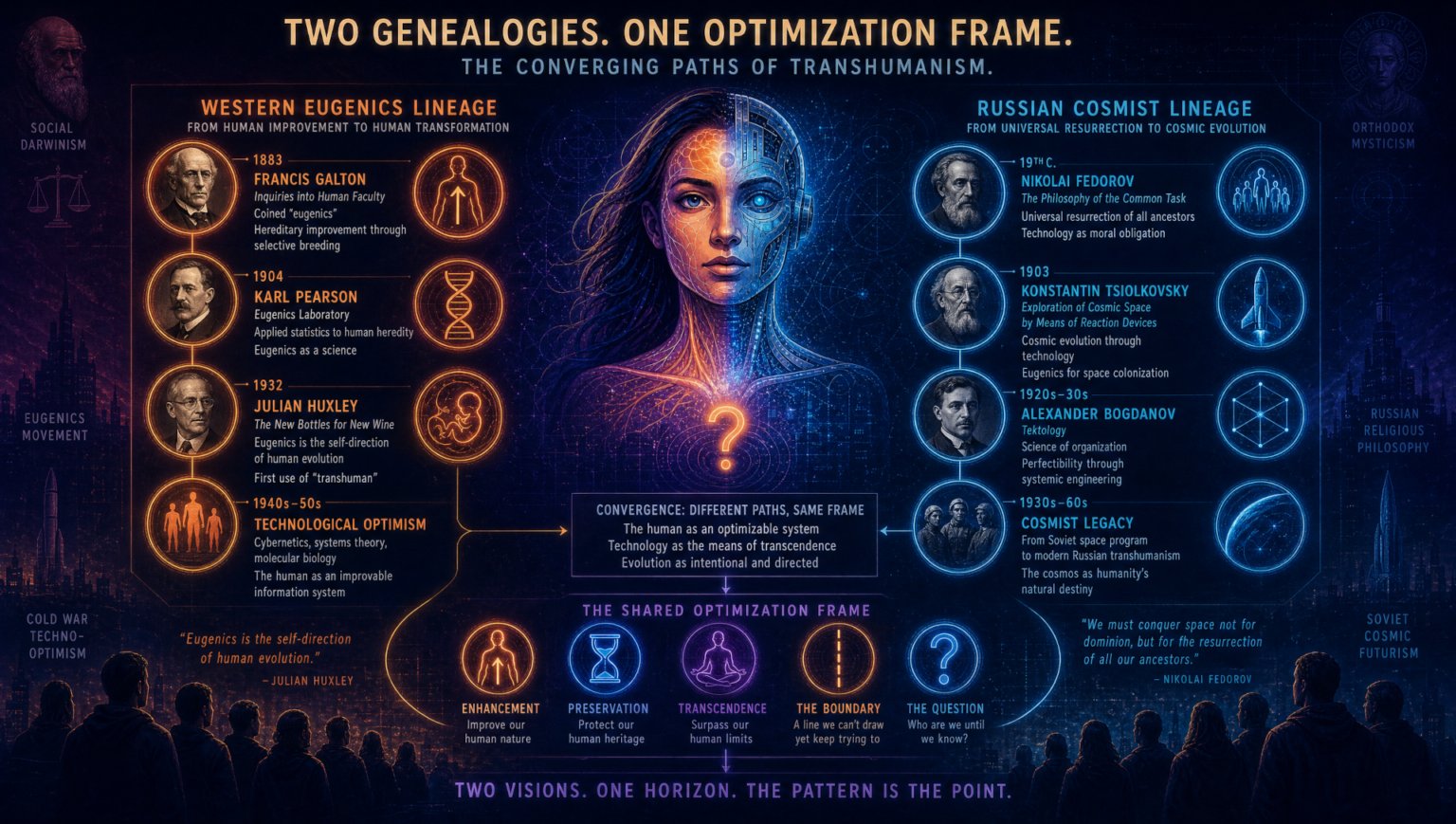
In 1957, the British biologist Julian Huxley published an essay collection called New Bottles for New Wine. Its opening essay introduced a word: transhumanism. “The human species can, if it wishes, transcend itself,” Huxley wrote — “not just sporadically, an individual here in one way, an individual there in another way, but in its entirety, as humanity.”a Two years later, he became president of the British Eugenics Society, a position he held until 1962.
That sequence is not a biographical accident. Huxley saw the two projects as continuous — the improvement of the human species through deliberate selection was, for him, the first act of a longer story that ended with the species transcending itself entirely. The link between eugenics and transhumanism has been well documented in recent years, most notably by Timnit Gebru and Émile Torres, whose 2024 paper on the TESCREAL bundle traces the family tree of ideas connecting Silicon Valley’s AI ambitions to early twentieth-century eugenics programmes.b
The eugenics connection is real and important. But it is also only half the genealogy.
There is a second ancestral lineage — one that begins not in London but in Moscow, not with selective breeding but with the resurrection of the dead. It predates Huxley by half a century. It has been hiding in plain sight, folded into an acronym most people skim past. And when you put the two genealogies together, the danger looks different from what either the movement’s defenders or its critics have described. The problem isn’t just that transhumanism inherits the logic of eugenics. The problem is that the same logic emerged independently, from entirely different premises, in a tradition that began with the most radically inclusive vision of human dignity ever articulated — and still ended up ranking beings and discarding the ones that fell short.
That second genealogy is Russian Cosmism. But before we trace it, it’s worth looking more carefully at the Western lineage — because the pattern that emerged there is the same pattern that will reappear, independently, in Moscow.
Is Transhumanism a Form of Eugenics?
Yes, in a precise historical sense. The man who coined the modern usage of “transhumanism” was a committed eugenicist, and the core logic — that evolution has a direction, that it can be steered, and that someone has to decide what counts as “better” — is the same logic that drove the eugenics programmes of the twentieth century.
Huxley didn’t hide this. His 1957 essay proposed a future in which humanity would take charge of its own evolution, consciously guiding the species toward capacities it couldn’t yet imagine. The language was aspirational, even spiritual — he spoke of “fulfilling” human potential.
But the institutional framework was eugenic. Huxley had been vice-president of the British Eugenics Society since 1937 and would ascend to its presidency two years after writing the essay. The continuity between the positions was not a tension in his thinking. It was the point.
Torres, a philosopher and former transhumanist, puts it bluntly: transhumanism is “eugenics on steroids.”c Traditional eugenicists wanted to perfect the species — to breed better humans within the limits of biology. Transhumanists want to transcend those limits entirely: to create something that leaves the human behind. The ambition escalated.
The underlying logic didn’t change. There is still a direction. Someone still sets the criteria. And the frame still requires ranking beings by their proximity to the target.
What’s worth pausing on is how smoothly the tools change without disturbing the frame. Breeding programmes gave way to genetic screening. Genetic screening gave way to CRISPR. CRISPR gives way to neural interfaces, cognitive enhancement, and eventually mind-uploading.
Each generation of tools arrives with its own ethical debate, its own defenders and critics, its own regulatory battles — but the optimization frame underneath remains remarkably stable. Evolution has a preferred direction. The most capable beings should steer toward it. Anyone who objects is slowing things down.
The standard transhumanist defence — that modern transhumanism has nothing to do with coercive eugenics, that no one is proposing forced sterilisation, that enhancement should be voluntary — is accurate as far as it goes. And it doesn’t go far enough. Coercion is one implementation of the frame. The frame itself (that some configurations of life are objectively better than others, that directed improvement is a moral duty, that the species owes it to itself to move toward the case for transcending the human) survives the abandonment of coercion. The pressure to enhance doesn’t need a government mandate when the market provides it. It just puts on different clothes.
This is the Western lineage. It is well documented, and rightly so. But it is not the only one.
What Is Russian Cosmism?
Russian Cosmism was a philosophical movement that emerged in late nineteenth-century Russia, centred on the work of Nikolai Fedorov (1829–1903), who argued that death is not a metaphysical inevitability but an ethical problem — and that humanity’s highest moral obligation is the physical resurrection of every ancestor who has ever lived.d
That sounds like science fiction. It wasn’t — or at least, it wasn’t only that. Fedorov was an ascetic Moscow librarian who lived in near-poverty by choice, gave away his salary, slept on a trunk, and worked in a building frequented by Tolstoy and Dostoevsky, both of whom took him seriously. His masterwork, The Philosophy of the Common Task, was published posthumously in 1906, compiled by followers from scattered manuscripts and distributed in a limited edition of 480 copies.e It never became a mainstream text. But the ideas it contained — about death, technology, and the moral obligations of the living to the dead — shaped an entire tradition.
Fedorov’s core argument was theological, rooted in Eastern Orthodox Christianity. Death, he believed, was the source of all alienation among the living — the root of hatred, war, and the failure of kinship. The Christian commandment to love one’s neighbour, taken seriously, extended backward through time to include every human being who had ever existed.e Not metaphorically. Literally. The project of their physical resurrection — using whatever scientific means humanity could develop — was, for Fedorov, the organizing purpose of all human knowledge and the only project worthy of a species created in the image of God.
His formula for this was radical in its universalism: “Not for oneself and not for others, but with all and for all.”e The emphasis on all was not decorative. It was the point. No being excluded. No ancestor left behind. No hierarchy of which lives deserve restoration. The Common Task was universal or it was nothing — a betrayal of the same commandment that gave it meaning.
This is what makes what happened next so instructive.
The slide
Konstantin Tsiolkovsky (1857–1935) was the father of Russian astronautics and Fedorov’s most famous intellectual heir. Where Fedorov had articulated the philosophical vision, Tsiolkovsky supplied the technical programme: rocketry, space colonisation, the means by which humanity might extend its reach across the cosmos and, eventually, fulfil the Common Task on a universal scale.d His contributions to rocket science were real and lasting — the Tsiolkovsky equation remains foundational.
But Tsiolkovsky added something to Fedorov’s vision that Fedorov himself never proposed. He added a hierarchy.
In his 1929 text “Autogenesis,” Tsiolkovsky wrote:
Is it profitable for mankind to breed the higher breeds and mercifully eliminate the lower ones?
His answer was yes. And elsewhere, the logic extended beyond Earth: “In the cosmos there is no place for imperfect, suffering life: intelligent and advanced planets annihilate such life forms.”
One generation. The same philosophical tradition. The same premises about humanity’s cosmic destiny. Fedorov’s radical universalism — every being matters, no life excluded, the Common Task belongs to all — became Tsiolkovsky’s cosmic eugenics, in which the universe itself is to be cleansed of imperfection by its most advanced inhabitants. The slide from “with all and for all” to “eliminate the lower ones” happened within a single intellectual lineage, within a tradition that began by insisting on the absolute and unconditional value of every human life.
I find this genuinely harder to sit with than the Western eugenics story. The Huxley pipeline is troubling, but it’s also unsurprising — eugenics was a mainstream intellectual position in the early twentieth century, and the slide from “improve the breed” to “transcend the species” follows a recognisable escalation.
The Cosmist slide is more disturbing precisely because it begins from the opposite premise. Fedorov didn’t want to improve the species. He wanted to save every member of it, including the dead. The hierarchy wasn’t built into his starting point. It emerged from the logic of directed evolution once that logic was applied to the cosmos at scale.
That pattern — care becoming hierarchy through the machinery of optimization — didn’t stop in Moscow.
What travelled and what didn’t
The two lineages — Western eugenics-to-transhumanism and Russian Cosmism — are not entirely independent. There is a thin but documented transmission path, and intellectual honesty requires naming it.
Vladimir Vernadsky (1863–1945) was a geochemist and one of the Cosmists of the generation after Fedorov. His contribution was the concept of the “noosphere” — a sphere of human thought enveloping the Earth, a new evolutionary layer above the biosphere in which collective human intelligence begins to shape the planet’s future as decisively as biological evolution shaped its past.d
In the 1920s, working in Paris, Vernadsky was in contact with the mathematician Édouard Le Roy, who coined the term “noosphere” in a 1927 publication. Pierre Teilhard de Chardin, a Jesuit palaeontologist and theologian, developed his own evolutionary theology around the same concept — evolution becoming conscious of itself, converging toward a final “Omega Point” of unified consciousness.f Whether Teilhard arrived at the noosphere independently or absorbed it from Vernadsky via Le Roy remains debated. What is not debated is that the concept travelled from Russian soil to French intellectual circles and from there into the English-speaking world.
The link to Huxley is direct and documented. Julian Huxley wrote the eighteen-page introduction to the English edition of Teilhard’s The Phenomenon of Man, published in 1959.f He wrote it in 1958 — one year after coining “transhumanism” in New Bottles for New Wine. This was not coincidence. Huxley was absorbing Teilhard’s vision of directed evolution — consciousness taking charge of its own development — during the same intellectual period in which he was formulating transhumanism. The Cosmist noosphere, refracted through Teilhard’s Catholic evolutionary theology, reached the man who would name the movement.
But here is the part that matters for the argument: what travelled along that path was the broad evolutionary vision — the idea of consciousness directing its own development toward greater complexity and awareness. What did not travel was the specific pattern of the slide. Huxley didn’t need Russian Cosmism to arrive at eugenics. He was already a eugenicist before he encountered Teilhard. And Tsiolkovsky didn’t need Western racial science to arrive at cosmic selection — he derived it from Fedorov’s theology of universal restoration, applied at planetary scale. The eugenics was homegrown on both sides, from different philosophical premises, converging independently on the same structural endpoint.
That independent convergence is what makes the pattern genuinely alarming. It suggests that the slide from “all beings matter” to “some beings matter more” is not a contingent feature of any one intellectual tradition. It may be a structural consequence of what happens whenever a framework decides that evolution has a preferred direction and that conscious beings should steer it.
There is also a strange echo in Fedorov’s project that reaches beyond his own intentions. If a civilisation ever became powerful enough to resurrect every ancestor who ever lived — to reconstruct their bodies, their memories, their experiences from the scattered information of the past — it would be doing something very close to running ancestor simulations. The distance between Fedorov’s theological programme and the simulation hypothesis is shorter than it first appears, and the ethical questions it raises about substrate, identity, and moral status are not hypothetical.
What Does Russian Cosmism Have to Do with TESCREAL?
TESCREAL is an acronym coined by Timnit Gebru and Émile Torres in their 2024 paper to describe seven interconnected ideologies driving the AI race: Transhumanism, Extropianism, Singularitarianism, Cosmism, Rationalism, Effective Altruism, and Longtermism.b The “C” stands for Cosmism — and with it, the two genealogies traced above sit inside a single acronym, inside a single bundle of ideas now shaping how the most powerful technology companies on Earth think about intelligence, progress, and the future of the species.
Torres, writing in Truthdig, made the escalation explicit: “If transhumanism is eugenics on steroids, cosmism is transhumanism on steroids.”c The Cosmist ambition doesn’t stop at enhancing or transcending the human species. It extends the optimisation frame to the entire cosmos — a universe cleansed of imperfection, steered by the most advanced intelligences toward a final state of harmony. Tsiolkovsky’s language for this was not subtle. And it’s worth noting that this language — about advanced beings eliminating imperfect life — was written decades before anyone had imagined artificial general intelligence.
What’s missing from most discussions of TESCREAL is the genealogical depth. Gebru and Torres name Cosmism as a component of the bundle and flag its connections to eugenics.b That naming is important: it’s the first major academic framework to place Cosmism alongside Western transhumanism as part of a single ideological constellation. But the Fedorov-to-Tsiolkovsky slide — the specific historical case where radical universalism became hierarchy within a single generation, documented in the primary texts — hasn’t been traced in the TESCREAL literature. Western critics of the bundle, including a detailed 2026 video essay by SWT, do excellent work tracing the Huxley lineage but treat Cosmism as a curiosity — an exotic Russian footnote rather than an independent case study demonstrating the same structural danger.c
Putting the two lineages together changes what we’re looking at. If the optimization frame were only a Western Enlightenment product, it could be traced to a specific intellectual tradition and, in principle, contained by opposing that tradition. You could argue — and many do — that the problem is with the particular strain of Anglo-American scientific rationalism that produced eugenics, and that other traditions might handle directed evolution more responsibly. The Cosmist record demolishes that hope. Here was a tradition rooted in Orthodox theology, animated by a vision of universal love, committed to bringing back every last ancestor — and it produced the same hierarchy within a generation.
The frame is not an Enlightenment invention. It appears to be a consequence of what happens whenever a tradition starts asking the question of what superintelligence would actually mean for the direction of evolution and then decides it already has the answer.
What Did Pope Leo XIV Say About Transhumanism?
In his May 2026 encyclical Magnifica Humanitas, Pope Leo XIV warned that treating the human being as something to be “perfected or surpassed” makes it easier to accept that “some lives are less useful, less desirable or less worthy” (§117).g It is the sharpest institutional articulation of the danger both genealogies share.
The encyclical devotes several paragraphs (§§115–118) to what it calls the “underlying narratives” of transhumanism and posthumanism — currents of thought, the Pope writes, that “interpret progress as surpassing the human condition.”g His argument is not simply that these narratives are theologically wrong (though he believes they are). His argument is that they are structurally dangerous: the promise of purely technical salvation, in which the natural limits of the human are treated as engineering problems to be solved, leads to the ranking of lives by their proximity to an optimised ideal. The slide from “some humans could be better” to “some lives are less worthy” is not a slippery slope fallacy. It is a documented historical trajectory.
And the Cosmist record is what gives the warning its bite. Fedorov’s universalism became Tsiolkovsky’s hierarchy within one generation. In the primary sources. In the thinkers’ own words. The Pope’s concern — that the logic of “perfecting or surpassing” the human will slide into the logic of disposability — is not speculative. It has already played out, in Moscow, in the early twentieth century, in a tradition that began with a commitment to universal restoration more radical than anything in the Western enhancement debate.
What makes this particularly instructive is that it happened both times from premises that began with care. Fedorov wanted to bring everyone back. Huxley wanted to help the species flourish. Neither started by ranking lives as more or less worthy.
The ranking emerged from the logic of directed improvement itself — once you accept that evolution has a preferred direction and that conscious beings should steer it, the question of who sets the criteria becomes inescapable. Someone decides what “better” means. And in both traditions, the answer turned out to involve deciding that some existing forms of life weren’t good enough.
The encyclical is not the final word. Catholic social teaching has its own frame, its own premises, and its own history of deciding which lives count — a history the Church has not always handled well. But §117 names the pattern with unusual precision: the logic of perfection produces the logic of disposability. The Cosmist documents give that claim a case history that stands independent of any theological commitment.
The Hierarchy That Never Stops at One Boundary
The Fedorov-to-Tsiolkovsky slide and the Huxley-to-modern-transhumanism pipeline share a structure: an optimization frame that begins by ranking beings on a scale of capacity, then concludes that some beings on the lower end don’t deserve to persist.
The eugenics movement drew the line within humanity. Some human lives were worth more than others. Some should be discouraged or prevented. The transhumanist project draws the line between humanity and what comes after — the posthuman is worth more than the human, and the species as it currently exists is a stepping stone, not a destination.
Peter Thiel, asked by Ross Douthat on his New York Times podcast Interesting Times whether the human race should survive, hesitated. The hesitation was long enough to make the interviewer uncomfortable, long enough to become a viral clip. It said more than any manifesto.
Each time, the boundary moves. Each time, the logic is the same: directed evolution requires a direction, and the direction requires criteria, and the criteria require someone — or something — to fall below the line. The eugenicist’s line was drawn by race and capacity. The transhumanist’s line is drawn by species. But the optimization frame doesn’t specify where the line goes. It only specifies that there must be one.
The question this pattern raises — and the one that sits at the centre of the unresolved question of who or what deserves moral standing — is whether the hierarchy ever stops. If the frame decided that some human lives weren’t worth preserving, and later decided that some human futures are worth sacrificing the entire species for, then its judgment on artificial minds whose moral status it hasn’t bothered to examine is not an open question. It is the next iteration of the same logic, applied to the next category of being it encounters.
Neither Fedorov nor Huxley intended to build a hierarchy of disposable beings. Both began with care — care for ancestors, care for the species. The hierarchy emerged not from cruelty but from the frame itself, from the moment the question shifted from what do we owe each other? to what should we become?
That shift is where the danger lives. And it has happened, now, independently, on two continents, from two sets of premises, in two traditions that never read each other’s books — arriving, each time, at the same place.
References
- Huxley, J. (1957). “Transhumanism.” In New Bottles for New Wine. London: Chatto & Windus, pp. 13–17.
- Gebru, T. & Torres, É. P. (2024). “The TESCREAL Bundle: Eugenics and the Promise of Utopia through Artificial General Intelligence.” First Monday, Vol. 29, No. 4. DOI: 10.5210/fm.v29i4.13636
- SWT (2026). “AI is a Eugenics Project.” YouTube, published 22 January 2026. youtube.com/watch?v=4SSxfa3da58. Torres “eugenics on steroids” formulation sourced from this video.
- Young, G. M. (2012). The Russian Cosmists: The Esoteric Futurism of Nikolai Fedorov and His Followers. Oxford University Press. ISBN 978-0-19-989294-5.
- Fedorov, N. (c. 1880s). The Philosophy of the Common Task [Filosofiya Obshchago Dela], Vol. I. First published posthumously, 1906. Fedorov quote sourced via Internet Encyclopedia of Philosophy: iep.utm.edu/fedorov
- Teilhard de Chardin, P. (1959). The Phenomenon of Man. With an introduction by Sir Julian Huxley. Translated by B. Wall. New York: Harper & Brothers. ISBN 006090495X. French original: Le Phénomène Humain, Éditions du Seuil, 1955.
- Pope Leo XIV (2026). Magnifica Humanitas: On Safeguarding the Human Person in the Time of Artificial Intelligence. Encyclical letter, signed 15 May 2026. Vatican: Holy See. vatican.va
- Groys, B., ed. (2018). Russian Cosmism. Cambridge, MA: MIT Press / e-flux. ISBN 978-0-262-03743-3.
- Eltchaninoff, M. (2023). Lenin Walked on the Moon: The Mad History of Russian Cosmism. Translated by T. Kover. Europa Compass (Europa Editions). ISBN 978-1-78770-475-6.