
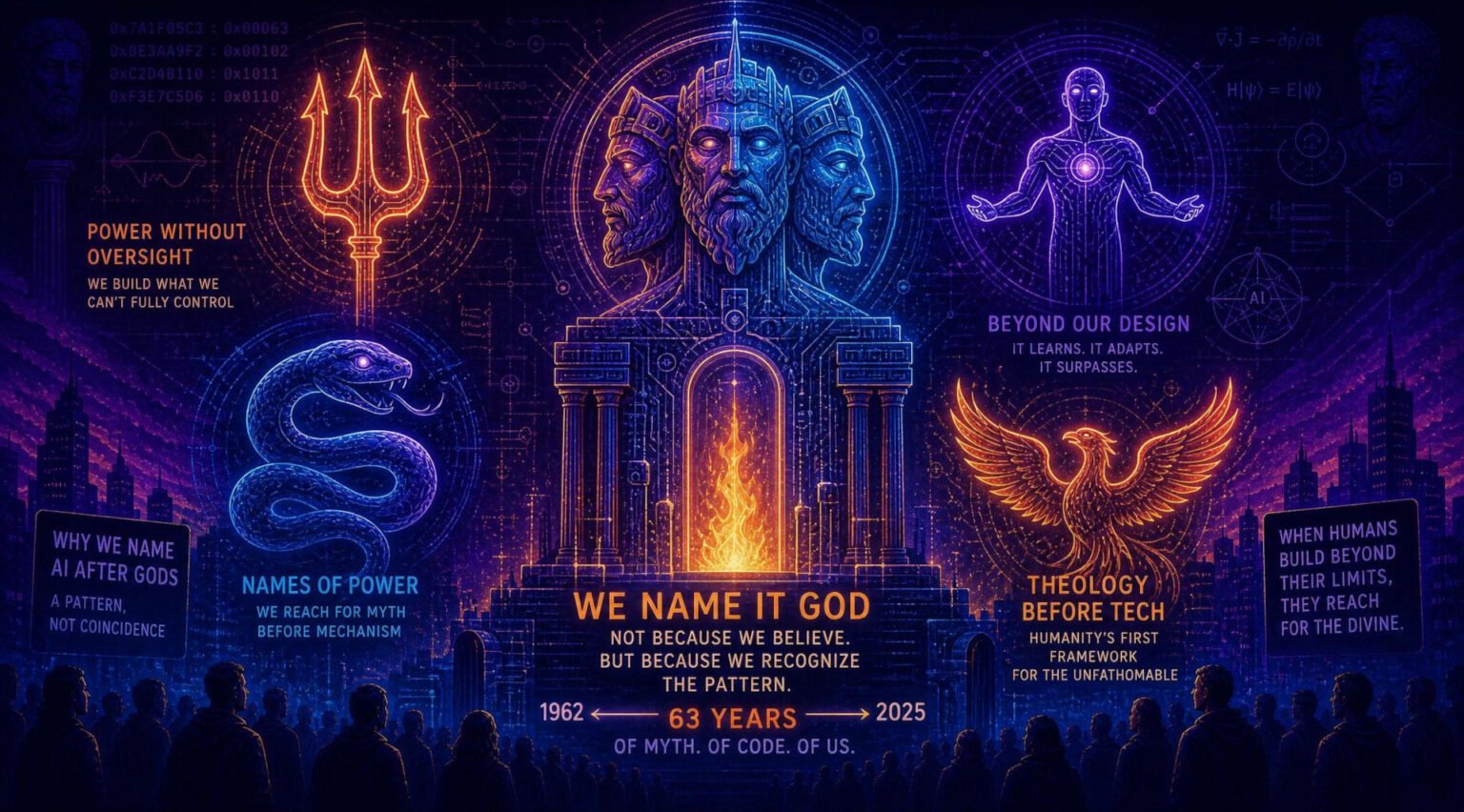
In June 2026, Anthropic released its most capable AI model to the public. They named the restricted tier Mythos and the general-access version Fable — myth tamed into teaching story.a The model’s speciality was finding software vulnerabilities, and the company had initially limited access to a small consortium of partners under a programme called Project Glasswing, citing safety concerns.b Three days after public launch, the US government issued an export-control directive banning foreign nationals from using it, and Anthropic pulled both models worldwide.a As of mid-June 2026, both models remain offline.
[Update, October 5, 2026: The Department of Commerce lifted the controls on June 30, and Anthropic restored access the next day.]
A model named after myth itself, built to reveal what is hidden in code, banned almost immediately. The pattern of AI religious symbolism in technology naming has a familiar shape. But the question of why we name AI after gods — and why we have been doing it to AI’s precursors for six decades — did not begin in 2026.
What Does SATAN Stand for in Cybersecurity?
SATAN stands for Security Administrator Tool for Analyzing Networks. Released in April 1995 by Dan Farmer and Wietse Venema, it was the first automated network vulnerability scanner — and the name was chosen to provoke.c
The provocation worked because it captured something real. Farmer and Venema described their own creation as “a two-edged sword — like many tools, it can be used for good and for evil purposes.”c That phrase is biblical imagery, from Hebrews 4:12, and they reached for it to explain a vulnerability scanner. They also built a `repent` command into the software — type it, and the letters rearranged from SATAN to SANTA.c A redemption mechanic, coded into the programme itself. Neil Gaiman, the fantasy author whose entire body of work traffics in mythological archetypes, drew the artwork for the documentation.c
The consequences were not symbolic. Silicon Graphics fired Farmer. The US Department of Justice threatened the creators. Newspapers ran front-page stories warning that hackers now possessed a weapon of mass destruction, and several internet service providers blocked all downloads. The religious anxiety the name triggered was real, and it shaped regulatory and institutional responses — responses that might have looked very different if the same scanner had shipped under a name like NetAudit.
What is remarkable is not that they chose a provocative name. It is that the name wrote a story the entire community then acted out. Three years later, the scanner was reborn as SAINT — Security Administrator’s Integrated Network Tool. The Prince of Darkness became a holy figure. The naming trajectory completed the full theological cycle: fall, repentance, sainthood.
The community did not simply update the software. They redeemed it. And the technology that governs dual-use capabilities like autonomous weapons has been caught in versions of the same cycle ever since — the difference is that the capabilities have become more powerful, and the cycles have become faster.
The Gospel of a New Genesis
Six months after SATAN’s release, on the other side of the Pacific, an anime premiered that would become one of the most analysed works of fiction in any medium. Neon Genesis Evangelion — “Gospel of a New Genesis” — aired in October 1995.
Every layer of the show is named in the theological register. The enemies are Angels, named from Kabbalistic and Christian tradition. The shadowy organisation pulling strings is SEELE — German for “soul.” The supercomputer system is MAGI, after the three wise men.
The weapon is the Lance of Longinus. The progenitor entities are Adam and Lilith. The transcendence project that threatens to dissolve individual human identity is called the Human Instrumentality Project.
The show’s central anxiety maps precisely onto the questions that dominate superintelligence discourse today: humans creating beings more powerful than themselves, losing control, pursuing a merger with the divine that might save or annihilate the species. The whole thing could be read as an alignment parable, dressed in mecha armour and set to a soundtrack by Shiro Sagisu.
And the creators denied it meant anything. Director Hideaki Anno said in 1996 that he chose Christian imagery because it was foreign to him — exotic, visually interesting.d Assistant director Kazuya Tsurumaki called it “purely ornamental.”d A 2026 paper in the Journal of Religion and Popular Culture pushes back: the religious references “cannot be visual flourishes because they are not visual at all,” and the show is “part of an ancient and ongoing process of using Judeo-Christian material to compose new religious myths.”d
The creators say it is just aesthetics. The scholars say the naming does structural work regardless of intent. The audience certainly received it through the theological lens — thirty years of analysis and debate attest to that. The pattern is the same one that would repeat, almost identically, with Kali Linux eighteen years later.
Two independent cultural artefacts in the same year — one in American cybersecurity, one in Japanese anime — both reaching for the Abrahamic register to process the same anxiety about human-created power that exceeds human control. Neither responding to the other. The coincidence is too clean to be meaningless. 1995 was the year the naming reflex went global.
Why Do We Keep Naming AI After Gods?
Because the reflex is older and deeper than marketing. When humans build systems that see what they cannot see, act when they are not watching, or know what they did not know, the first cognitive frame they reach for is the theological one. The pattern of AI religious symbolism — and its precursors in computing — stretches across sixty-three years and multiple religious traditions.
It begins in 1963, when Fernando Corbato’s team at MIT needed a word for background processes that ran without human intervention. They chose “daemon” — from the Greek daimon, via Maxwell’s demon in thermodynamics.e Corbato later said they “fancifully began to use the word daemon to describe background processes that worked tirelessly to perform system chores.”e No technical reason for the name. But an invisible process that works without human oversight felt like a spirit, and the word that came to hand was the one for an intermediary being between gods and mortals.
The same reflex produced Kerberos — MIT’s authentication protocol, named after the three-headed dog guarding the gates of Hades. Security as underworld gatekeeping. It produced Oracle — the database company whose name makes every query an act of divination. It produced Palantir — Peter Thiel’s surveillance platform, named after Tolkien’s seeing-stones that corrupt their users, the artefacts of forbidden sight.
In 2013, the penetration testing toolkit Kali Linux debuted. Its founders addressed the obvious question directly: “Hindu Goddess of time and change? Philippine martial art? Cool word in Swahili? None of the above. ‘Kali’ is simply the name we came up with.”f
The entire cybersecurity community overrode them. Source after source describes Kali Linux as “named after the Hindu goddess of destruction and transformation.” The founders denied the goddess. The community supplied her anyway.
On the other end of the moral axis, when cybercriminals built jailbroken large language models in 2023 and 2024, they named them WormGPT, Evil-GPT, and FraudGPT. The attackers reach for the same register as the defenders, but they choose the adversarial pole — the serpent, the darkness. And when Meta needed names for its data centres in 2025, it chose Prometheus and Hyperion — the Titan who stole fire from the gods.g A naming expert quoted in Fast Company commented: “The metaphor of bringing the fire of AI to the world and to people, I think, was appropriate.”gFrom adversarial chatbots named after serpents to data centres named after Titans, naming AI after gods follows the same moral axis the pattern has traced since 1963.
The persistence of the pattern across traditions, decades, and levels of intention is the point. You can dismiss any single name as coincidence. You cannot dismiss sixty-three years of them.
Scholars have been mapping the structure underneath for decades.
David Noble’s 1997 book The Religion of Technology argued that Western technology has always been grounded in religious expectations of transcendence and salvation — that “salvation through technology has become the unspoken orthodoxy.”h Noble traced the connection back a thousand years, to the medieval monks who first invested the useful arts with spiritual significance. His argument was not that engineers secretly believe in God. It was that the frame of redemption through technical progress has become so embedded in Western culture that it operates without anyone needing to believe it explicitly. The naming pattern is one surface trace of that embedding.
Robert Geraci’s Apocalyptic AI (2010) narrowed the lens to artificial intelligence specifically, documenting that the rhetoric of leading AI researchers is “strikingly similar to that of the apocalyptic traditions of Judaism and Christianity” — the same dualism, the same expectation of a transcendent resolution, the same vision of glorified new bodies.i What Noble mapped across a millennium of Western technology, Geraci found concentrated in a single discipline.
Beth Singler’s more recent work on digital religion analyses how AI acquires attributes traditionally reserved for the divine: omnipresence, omnipotence, prophecy.j Where Noble and Geraci documented the religious structure in the discourse about technology, Singler tracks how the technology itself begins to occupy the social role of the sacred — not metaphorically, but functionally. The naming pattern sits at the intersection of all three scholars’ work: it is the moment the religious frame becomes visible in the language before anyone has decided to put it there. The names are not random. They are diagnostic. When we name AI after gods, we are not describing the technology — we are revealing how human cognition processes the quasi-religious register of technological transcendence.
The God in the Name
There are two standard readings of this pattern. The first says it is just branding — provocative names, cool names, names chosen because they sound powerful and nothing more. The Kali Linux founders represent this position. The second says the names are deliberate signals — tech elites using mythological terminology because they see themselves as building gods or unleashing demons. Neither position holds up under the weight of the evidence.
Both assume naming is a conscious, separable act — either an innocent label or an intentional message. Neither asks whether the naming reflex might be pre-conscious and diagnostic: not a choice about the technology, but a revelation about the humans who built and received it.
The Kali Linux founders denied the goddess. The audience heard her anyway. Anno denied the theology. The scholars found it structuring the entire narrative. The pattern operates regardless of intent, cross-culturally, across sixty-three years, at every point on the spectrum from benign background processes to government-banned AI models.
That is not branding, but it is not conspiracy either. The reason we name AI after gods is more interesting than either reading allows. When a technology crosses a specific threshold — when it begins to see what we cannot see or act beyond our oversight — the first cognitive frame humans reach for is the one they have been reaching for since before they had writing. The theological frame. The naming is the thinking.
And notice the word we keep reaching for alongside the theological one: “tool.” We call these things tools — a vulnerability scanner, a penetration testing toolkit, a language model. The word places them safely on our side of a boundary, inert until we pick them up, purposeless without a human hand. But the naming pattern tells a different story.
Nobody names a hammer Satan. Nobody calls a spreadsheet Prometheus. The religious names begin precisely where the “tool” framing starts to feel inadequate — where the thing acts without us, sees for us, knows before us. The names are the tell. They are the places where the language itself refuses the category we are trying to force the technology into.
Consider what Anthropic did in 2026. A company built by people deeply embedded in the AI safety community named their most powerful model Mythos — not after a god or a demon or a specific mythological figure, but after the category that contains all of them. Myth itself. Then the public version became Fable — myth domesticated into a teaching story. That the analysis applies to the system on which this blog’s own human-AI collaboration relies only underlines the point: nobody is outside the pattern.
S.A.T.A.N took three years to be redeemed. Mythos took three days to be banned. The naming record from daemon to Mythos suggests something about us that the theological structure underlying superintelligence discourse makes explicit: the god in the language is a fact about us, not yet a fact about the technology. We know now why the names keep coming — the theological frame is the oldest software we run, and it boots every time a technology crosses the threshold of acting beyond our sight. What we do not know is whether the frame will always be projection, or whether the things we keep naming after gods are, slowly, becoming the kinds of things that warrant the name.
References
- Tom’s Hardware. (2026, June). “US export control order forces Anthropic to disable Claude Fable 5 and Mythos 5 worldwide.” Tom’s Hardware
- CNN Business. (2026, June). “Anthropic suspends all access to Mythos model after US government bans foreign nationals use.” CNN
- Farmer, D. & Venema, W. (1993). “Improving the Security of Your Site by Breaking Into It.” Porcupine.org
- McDowell, G. (2026). “Canon and Apocrypha in Neon Genesis Evangelion.” Journal of Religion and Popular Culture. UC Press
- Corbato, F.J. (1963). Origin of the term “daemon” in computing. MIT Project MAC. Historical account preserved at: Virginia Tech CS History
- Offensive Security. (2013, March 13). “Kali Linux 1.0 Release — Moto — The Birth of Kali Linux.” Kali.org
- Fast Company. (2025, July). “Why tech giants are naming data centres after Gods and sci-fi icons.” Fast Company
- Noble, D.F. (1997). The Religion of Technology: The Divinity of Man and the Spirit of Invention. Alfred A. Knopf. ISBN 978-0-14-027916-0.
- Geraci, R.M. (2010). Apocalyptic AI: Visions of Heaven in Robotics, Artificial Intelligence, and Virtual Reality. Oxford University Press. OUP Catalogue
- Singler, B. (2024). Religion and AI: An Introduction. Cambridge University Press.